
 Download App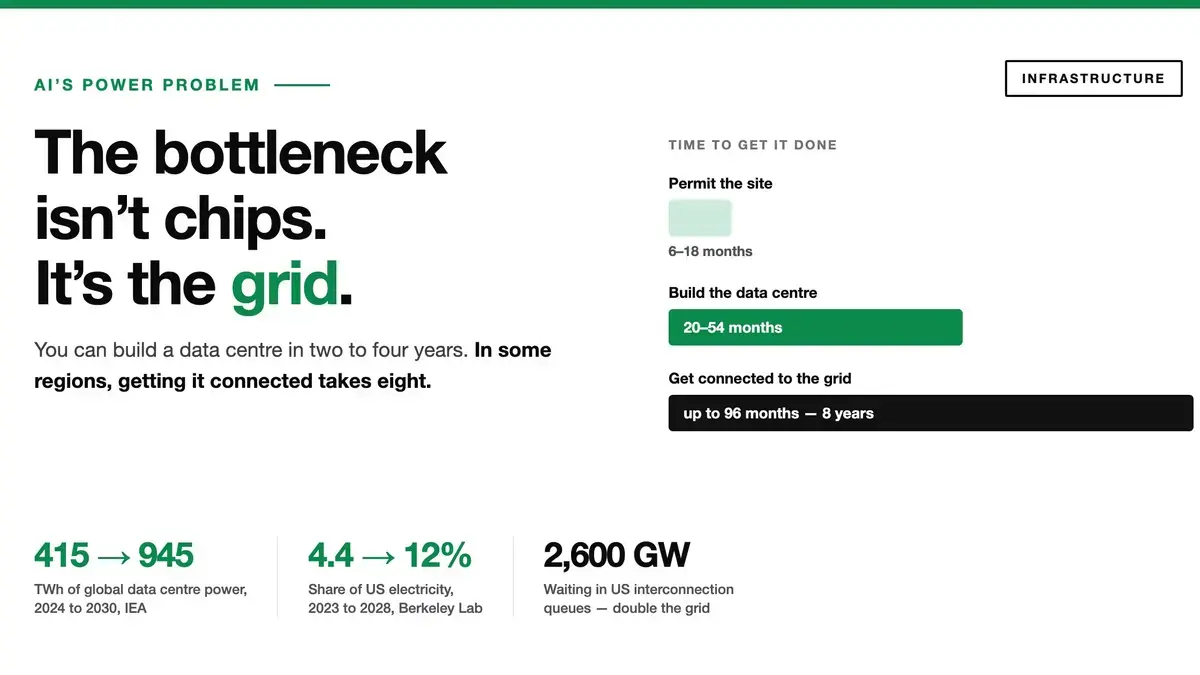
Here's the number that reframes the whole AI infrastructure story.
You can permit a data centre site in 6 to 18 months. You can build the thing in 20 to 54 months. But in the mid-Atlantic and Midwest grid region, projects that got approved in 2025 had been waiting in the interconnection queue for eight years.
Building the facility is the fast part. Getting electricity to it is the slow part.
That single inversion explains more about 2026 than any chip-supply story. It's why capacity is being rationed, why token prices stopped falling, and why the compute you can buy is increasingly a function of which grid region has spare headroom. If you build products on AI, this has quietly become your constraint too.
Key Takeaways
Global data centre electricity was ~415 TWh in 2024 and is projected to more than double to ~945 TWh by 2030 (IEA).
US data centres used 4.4% of national electricity in 2023, projected at 6.7–12% by 2028 (Berkeley Lab).
The binding constraint is the interconnection queue, not generation capacity.
Sceptics and alarmists agree on this: only about a third of announced capacity is actually being built.
How Much Power Does AI Actually Use?
Enough to matter nationally, not enough to be the largest thing on the grid.
The International Energy Agency's Energy and AI report put global data centre consumption at around 415 TWh in 2024 — roughly 1.5% of world electricity — and projects it more than doubling to about 945 TWh by 2030.
The US picture is sharper, because that's where the build-out concentrates. Berkeley Lab's report for the Department of Energy tracked the trajectory:
Year | US data centre electricity | Share of US total |
|---|---|---|
2014 | 58 TWh | — |
2023 | 176 TWh | 4.4% |
2028 (projected) | 325–580 TWh | 6.7–12% |
That projection range is wide because nobody knows how much announced capacity gets built. Hold onto that — it's the crux of the disagreement later.
The density shift is what makes this different from previous data centre growth. Conventional server racks draw something like 5 to 10 kW. AI training and inference racks are reported in the 50 to 100 kW range. You're not adding more of the same load; you're adding a load with a different shape, concentrated in specific locations, arriving faster than transmission planning cycles.
Why the Real Constraint Is a Queue, Not a Power Plant
The US doesn't lack electricity projects. It lacks approvals to connect them.
More than 2,600 GW of generation and storage is reported waiting in national interconnection queues — more than double the country's entire existing operational capacity. The power isn't missing. It's queued.
This is an administrative bottleneck with physical consequences. Every proposed generator or large load needs studies to determine its grid impact and who pays for upgrades. Those studies are sequential, contested, and slow. In PJM's territory, the wait reached eight years for projects clearing in 2025.
So the sequence that actually governs AI capacity looks like this:
Permit the site — 6 to 18 months
Build the facility — 20 to 54 months
Get it energised — up to 8 years in constrained regions
Steps one and two are capital and construction problems, which money solves. Step three is a regulatory queue, which money does not solve, at least not quickly.
That's why "we're spending $X billion on compute" and "compute will be abundant next year" are different claims. Announcements are bounded by capital. Delivery is bounded by interconnection.
Our read: this reframes the compute shortage as something more durable than a supply-chain hiccup. Chip fabs can be built, and TSMC will eventually catch up on advanced nodes. Interconnection queues are governed by regulatory process across dozens of jurisdictions, and they've been getting longer, not shorter. Which means the scarcity that pushed GPU rental prices and token prices up in 2026 has a much longer tail than the chip narrative implies. If you're modelling your AI costs on the assumption that capacity constraints resolve in a year, you're modelling the wrong bottleneck.
The Case That This Is Overblown
There's a credible argument that the doom framing is wrong, and it's worth taking seriously because it comes with numbers.
Robin Gaster of ITIF laid out four reasons new AI data centres won't overwhelm the grid (ITIF, April 2026):
The build-out will be slower than announced. Capital is the limit — he notes OpenAI planning around $600 billion in investment against roughly $20 billion in revenues. New data centre deals fell over 40% in late 2025, and only about a third of announced capacity is actually under construction.
Data centres can manage demand. Grid peaks occur only a few hours a year. Hyperscalers can shift flexible work away from those windows without new infrastructure.
Hyperscalers will bring their own power. Generation placed "behind the meter" at the facility avoids transmission upgrades entirely.
Utility contracts protect existing ratepayers. Large-load tariffs increasingly include 15-year minimum terms, 85% load guarantees, and hold-harmless provisions.
Gaster still concedes the underlying scale: roughly a 20% increase over current total US demand by 2030.
Notice something, though. His first and strongest reason is the queue and the capital constraint — the same mechanism the alarmists point to, read with the opposite conclusion. He's not arguing the constraint is fake. He's arguing it will bind hard enough to prevent the grid crisis, by preventing the build-out.
Both readings can't be comforting at once. If you're worried about the grid, reason one is reassuring. If you're a developer hoping compute gets cheap and plentiful, reason one is the bad news.
What It Means If You're Building on AI
Three consequences, all already visible in 2026:
Capacity gets allocated rather than sold. When supply is constrained, providers ration — reserved capacity, enterprise-first access, waitlists for the newest models. Availability becomes a commercial negotiation, not an API call.
Unit prices stop falling. The long-run trend of collapsing inference costs was driven by hardware and algorithmic efficiency. Physical scarcity pushes the other way, and in 2026 it won for a stretch. Planning on another order-of-magnitude discount at the frontier is a bet, not a baseline.
Geography starts mattering again. If capacity concentrates where grid headroom exists, your latency, data-residency options and regional availability get shaped by transmission planning decisions made years ago in places you've never thought about.
None of this stops you shipping. It does mean treating compute as a constrained input with a real price and a real supply risk, the way you'd treat any other physical dependency.
The Political Constraint Is Moving Faster Than the Physical One
The fastest-changing variable here isn't engineering. It's consent.
Local opposition to data centre projects has escalated sharply — reporting indicates moratoriums rising from single digits in 2023 and 2024 into the dozens in 2025 and the hundreds through the first part of 2026. At the federal level, an AI Data Center Moratorium Act has been introduced by Senator Bernie Sanders and Representative Alexandria Ocasio-Cortez, explicitly citing consumer electricity costs.
Those cost concerns aren't abstract. Reporting points to sharply higher wholesale prices near data centre clusters and projected residential bill increases across a multi-state region beginning in summer 2026. I'd treat the specific percentages with caution — the underlying studies are contested and the attribution between data centre load and other drivers is genuinely hard — but the political reality doesn't depend on the precise number. It depends on households seeing a higher bill and a new building nearby.
There's also a resource dimension that gets less attention than electricity. Stanford's 2026 AI Index notes that annual inference water use for a single major model may exceed the drinking water needs of 1.2 million people.
The practical upshot: siting is becoming a social licence problem. That's a slower thing to fix than a transformer order.
What You Can Actually Do
Six things, roughly in order of impact:
Right-size the model per request. Most calls don't need the frontier. This is the single largest lever on both cost and energy per unit of work.
Cache aggressively. A cache hit consumes no inference at all. Unglamorous and consistently the best return.
Batch anything that isn't interactive. Overnight and off-peak batching is cheaper, and it aligns with the demand-shifting that grid operators want.
Measure energy or cost per request, not per month. You cannot optimise what you only see aggregated on an invoice.
Don't architect around an assumption of falling prices. Build so a 2x price move doesn't break your unit economics.
Keep provider optionality. In a rationed market, the ability to shift workloads between providers and regions is worth real engineering investment.
[INTERNAL-LINK: why AI bills rise even as token prices fall → analysis of inference cost and agent token consumption]
Frequently Asked Questions
How much electricity do data centres actually use?
Globally, around 415 TWh in 2024 — roughly 1.5% of world electricity — projected by the IEA to more than double to about 945 TWh by 2030. In the US specifically, Berkeley Lab measured 4.4% of national electricity in 2023, projected at 6.7% to 12% by 2028.
Will AI break the electricity grid?
Contested, and the sceptics have a real case. ITIF argues capital limits, demand management, behind-the-meter generation and large-load tariffs will contain it, noting only about a third of announced capacity is being built. The constraint is more likely to slow AI than to break the grid.
Why is compute still scarce if there's plenty of power available?
Because connection, not generation, is the bottleneck. Over 2,600 GW of projects sit in US interconnection queues — more than double existing operational capacity — and waits reached eight years in the PJM region. Building generation is faster than getting permission to connect it.
Does data centre growth raise my electricity bill?
Possibly, though attribution is genuinely disputed. Reporting points to higher wholesale prices near data centre clusters and projected residential increases in some regions from 2026. Utilities are increasingly using large-load tariffs with hold-harmless provisions intended to shift those costs to the data centre operators.
Compute Is a Physical Product Again
For a decade, developers could treat compute as an abstraction — a slider you drag, an instance you spin up, priced on a curve that only went down. AI ended that, and not because of anything about models.
It ended because inference at this scale runs into transformers, transmission lines, permitting boards and county commissioners. Those things move on decade timescales and don't care about release cycles. The industry built a demand curve on a supply chain that includes public hearings.
So the useful mental model for the next few years isn't "intelligence gets cheaper forever." It's closer to how you'd think about any commodity with constrained delivery infrastructure: usable, valuable, occasionally rationed, and worth engineering around rather than assuming away.
Sources
Source | Title | URL |
|---|---|---|
International Energy Agency | Energy and AI — Executive Summary | |
Lawrence Berkeley National Laboratory / DOE | 2024 United States Data Center Energy Usage Report | |
ITIF (Robin Gaster) | Four Reasons New AI Data Centers Won't Overwhelm the Electricity Grid | |
Congressional Research Service | Data Centers and Their Energy Consumption: FAQ (R48646) | |
Belfer Center, Harvard Kennedy School | AI, Data Centers, and the U.S. Electric Grid: A Watershed Moment | |
Stanford HAI | The 2026 AI Index Report |