
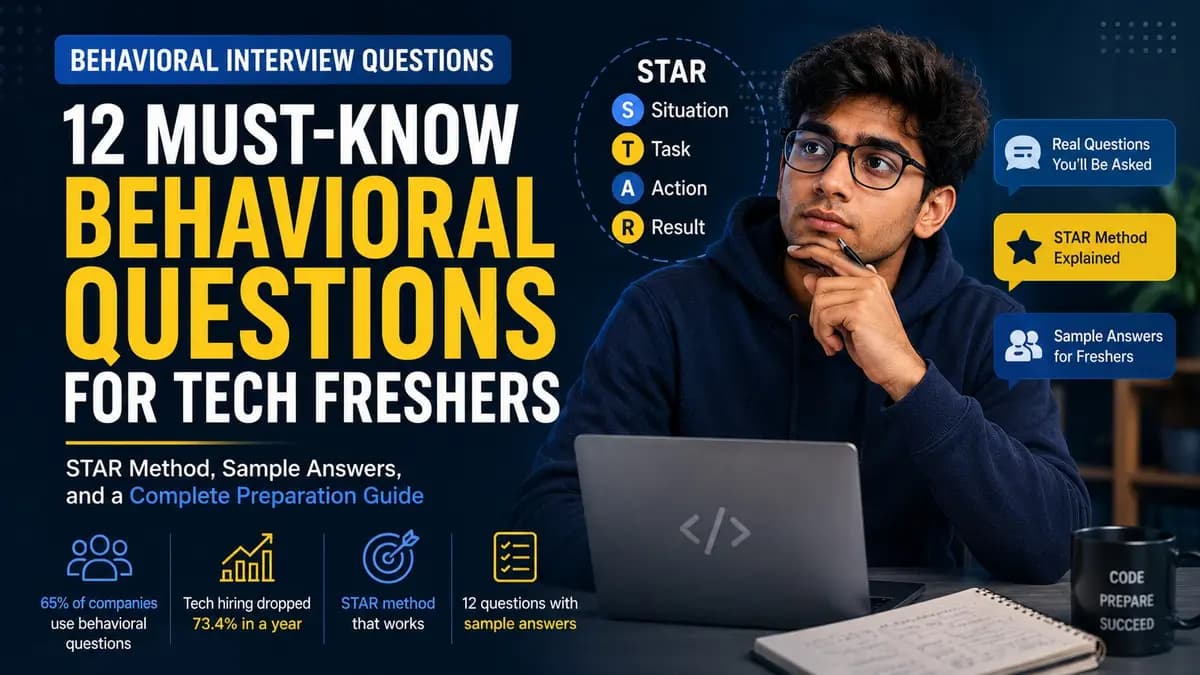
Here's what nobody tells you before your first tech interview: the hardest questions won't be about algorithms. They'll be about you. "Tell me about a time you failed." "Describe a conflict with a teammate." "Walk me through a moment you showed leadership."
These behavioral questions trip up thousands of smart candidates every year — not because they lack ability, but because they've never prepared for this format. You can ace every LeetCode problem and still bomb a behavioral round if your answers are vague and unstructured.
A 2025 study found 58% of fresh graduates were still job-seeking after graduation. The market hasn't gotten easier since. The candidates landing entry-level roles in 2026 are the ones who did the prep work everyone else skipped. This guide gives you the framework, the most common questions with sample answers, and a preparation plan you can start today.
Key Takeaways
65% of companies use behavioral questions to assess how candidates handled past situations (9CV9, 2025)
The STAR method works without full-time experience — academic projects, hackathons, and open-source contributions all count
Entry-level tech hiring dropped 73.4% in a single year (Ravio, 2025) — every interview matters more than it used to
70% of hiring managers say being unprepared is the number one interview mistake (Jobera, 2025)
Build a story bank of 8–10 STAR examples before you apply and you'll be ready for almost anything
Why Tech Companies Use Behavioral Interviews
65% of companies use behavioral questions to evaluate how candidates have handled real situations in the past (9CV9, 2025). The format dominates tech hiring because past behavior is the most reliable predictor of future performance. Technical skills can be learned on the job. How you handle pressure, disagreement, and failure is harder to train quickly — and harder to fake in an interview.
Structured behavioral interviews are twice as predictive of job performance as unstructured conversations, according to a Schmidt & Hunter meta-analysis (Testlify, 2025). 75% of interviewers say behavioral questions are effective at revealing candidate potential (LinkedIn via Jobera, 2025). That's why companies from early-stage startups to large tech firms have standardized on this format.
The competitive context makes preparation more urgent. Data from 2025 shows entry-level tech hiring collapsed 73.4% in a single year, junior roles declined 75–84%, and only 18% of US tech postings were open to candidates with one year or less of experience (Indeed Hiring Lab, 2025). Those conditions are still shaping the market in 2026. Every interview you land is a real opportunity — wasting one on a poorly structured answer is a cost you can't afford.
The STAR Method — and How Freshers Can Use It Without Work Experience
STAR stands for Situation, Task, Action, Result. It gives your answer a clear shape: where things stood, what you were responsible for, what you specifically did, and what happened because of it.
Freshers assume STAR requires professional experience. It doesn't. Academic group projects, hackathons, personal coding projects, open-source contributions, part-time jobs, and student club leadership all count. The professional setting matters far less than the specificity of the story.
Situation — One or two sentences. Set the scene briefly.
Task — Your specific role or responsibility.
Action — What you did, not "we." Be concrete and specific.
Result — What happened? Quantify where possible.
Weak vs. Strong: A Real Example
Question: "Tell me about a time you worked under pressure."
Weak: "During my final project I was really stressed but we got it done in time."
No structure, no specifics, nothing to score.
Strong: "In my final semester, our team had to complete a machine learning project two weeks faster than planned because one member had a family emergency. As de-facto lead, I broke the work into daily deliverables and ran 15-minute standups. I wrote the data preprocessing pipeline solo so teammates could focus on model tuning. We submitted on time and got a distinction. I learned that clear task ownership prevents panic when timelines compress."
Specific, structured, and reveals how you think. That's what interviewers are scoring.
12 Behavioral Questions You'll Actually Be Asked
92% of employers say soft skills are as important as technical skills (LinkedIn, 2024). These 12 questions cover every category you'll face, with sample answers adapted for freshers with no full-time work history.
1. "Tell me about a time you worked effectively in a team."I was part of a four-person hackathon group. Our back-end developer got sick halfway through, so I picked up API integration while finishing my own front-end tasks. We placed second out of 30 teams. I learned to adapt quickly when team dynamics shift unexpectedly.
2. "Describe a time a team member wasn't pulling their weight."During a database project, one member kept missing deadlines. Rather than escalating, I had a direct conversation and discovered they were struggling with SQL. I spent two evenings helping them. They finished their sections and we submitted on time.
3. "Tell me about a time you disagreed with a teammate's idea."My hackathon partner wanted to adopt an unfamiliar framework two days before submission. I laid out the time risk versus shipping something solid with known tools. She agreed. We delivered a working product — and tried the new framework together afterward.
4. "Describe a situation where you had to deal with a difficult person."A group member kept dominating planning sessions and dismissing others. I pulled him aside privately and named the specific behaviors affecting the team. He adjusted, and our presentation went smoothly. Specific private feedback beats public correction every time.
5. "Tell me about a time you failed."I led a student club project and over-promised the delivery date to our faculty advisor. We missed it by three weeks. I now break every estimate into components and build a 20% time buffer into any commitment I make to stakeholders.
6. "Describe a time you made a mistake and how you handled it."I accidentally deleted the main branch of our shared repo. I told my partner immediately, found a 30-minute-old local copy, and restored the work within an hour. I set up automatic commits and branch protections right after. Own it quickly, fix it fast, close the gap.
7. "Tell me about a time you received tough feedback."My professor gave my first algorithm assignment a failing grade and annotated nearly every function. I re-read her comments the next day and realized she was right on every point. I rewrote the assignment voluntarily — she later mentioned it in a recommendation letter.
8. "Describe a time you took initiative."During my internship I noticed the onboarding documentation was six months out of date. Nobody assigned me to fix it. I updated it and sent a pull request. The team lead merged it within an hour. Small self-directed contributions get noticed more than people expect.
9. "Tell me about a time you led a project."I volunteered to be scrum master for my five-person software engineering team. I ran sprint planning, assigned tasks by strength, and unblocked issues weekly. We were the only team to deliver all three milestones on time.
10. "Describe a time you solved a difficult technical problem."Our web app kept crashing under load. I read logs for three hours and traced it to an unoptimized query on every page load. Adding an index dropped response time by 60%. I documented the finding so future contributors would understand the decision.
11. "Tell me about a time you had to learn something new quickly."A week before a hackathon, our project needed a WebSockets integration I'd never built. I spent two evenings on documentation and a tutorial project. By day three I had a working prototype. We demonstrated real-time features no other team had.
12. "How do you handle competing deadlines?"During exam season I had three project submissions and two exams in ten days. I listed every deliverable with its deadline and effort estimate, built a day-by-day schedule, and finished one project early to bank the time. Proactive communication beats silently struggling and delivering late.
How to Prepare With Zero Work Experience
70% of hiring managers say being unprepared is the top interview mistake, and 47% of candidates fail partly because they don't know enough about the company (Jobera, 2025). Both are entirely avoidable.
Build your story bank first. Before applying anywhere, write 8–10 situations from your academic history in full STAR format — at least one per category: teamwork, conflict, failure, leadership, problem-solving, and motivation. Most interviewers ask 4–6 questions, so having double the inventory means you'll never get caught recycling the same anecdote twice.
Practice out loud. Reading stories silently is not the same as speaking them under pressure. Record yourself on your phone and watch it back. Freshers who practice their answers aloud at least ten times before an interview consistently perform better — not because they've memorized a script, but because they've internalized the structure.
Practice with peers. Joining a developer community like DevSunite gives you access to other freshers and developers to run mock interviews and sharpen your delivery before the real thing. Peer feedback is often more useful than solo practice.
Research the company. Read the job description carefully. Check their tech stack and engineering blog. Behavioral answers land better when they mirror what the company actually values.
5 Mistakes That Kill Your Chances
1. Vague, story-free answers. "I'm a good team player" tells the interviewer nothing. Use STAR every time.
2. Too much context, not enough action. Don't spend three minutes on background and thirty seconds on what you actually did. Interviewers are scoring your actions.
3. No numbers in your results. "It went well" is wasted. "Response time dropped 60%" or "we placed second out of 30 teams" is scoreable.
4. Saying "we" throughout. Be clear about your specific contribution. Interviewers are assessing you, not your team.
5. Rambling. A strong answer is 90–120 seconds spoken aloud. Past two minutes, you're padding. Time yourself in practice.
5 Smart Questions to Ask at the End
38% of candidates ask no questions at all (CareerBuilder, 2025). Asking nothing signals disinterest. Have these ready:
"What does success look like in the first 90 days for someone in this role?"
"What does onboarding typically look like for junior engineers here?"
"What are the biggest technical challenges the team is working through right now?"
"How does the team handle code reviews and feedback for newer developers?"
"What's one thing you wish you'd known before joining this team?"
Frequently Asked Questions
Can I use academic projects as examples?Yes — and you should. Capstone projects, hackathons, group assignments, and open-source contributions are all legitimate STAR sources. With only 18% of tech postings open to candidates with under one year of experience (Indeed Hiring Lab, 2025), freshers are expected to draw from academic work. Quality of the story matters more than the professional setting.
How long should a behavioral answer be?90–120 seconds when spoken aloud — roughly 200–250 words. Practice timing yourself out loud. The spoken version is always longer than you expect when you read it silently.
What if I don't have a good example for a question?Don't say "I've never experienced that." Use a close analog: "I haven't formally managed a team, but in my capstone I took on a coordinating role with a similar dynamic." Then give your full STAR answer. Honesty about gaps beats fabrication every time.
Conclusion
Entry-level tech hiring collapsed 73.4% in a single year and the new grad hiring rate fell 44% from its 2022 peak. Every interview you land in 2026 is a real opportunity — don't waste it on an unstructured answer.
Behavioral interviews reward preparation, not pedigree. You need clear, specific stories structured around STAR, solid knowledge of the company you're applying to, and the discipline to practice speaking out loud before the day arrives. Start building your story bank this week.
If you want structured practice with real feedback, joining a developer community like DevSunite connects you with other freshers and developers for mock interviews before the real thing.
The interviewers you're about to meet are looking for candidates who communicate clearly, think through problems methodically, and learn from experience. With the right preparation, that's exactly who you can show them.