
 Download App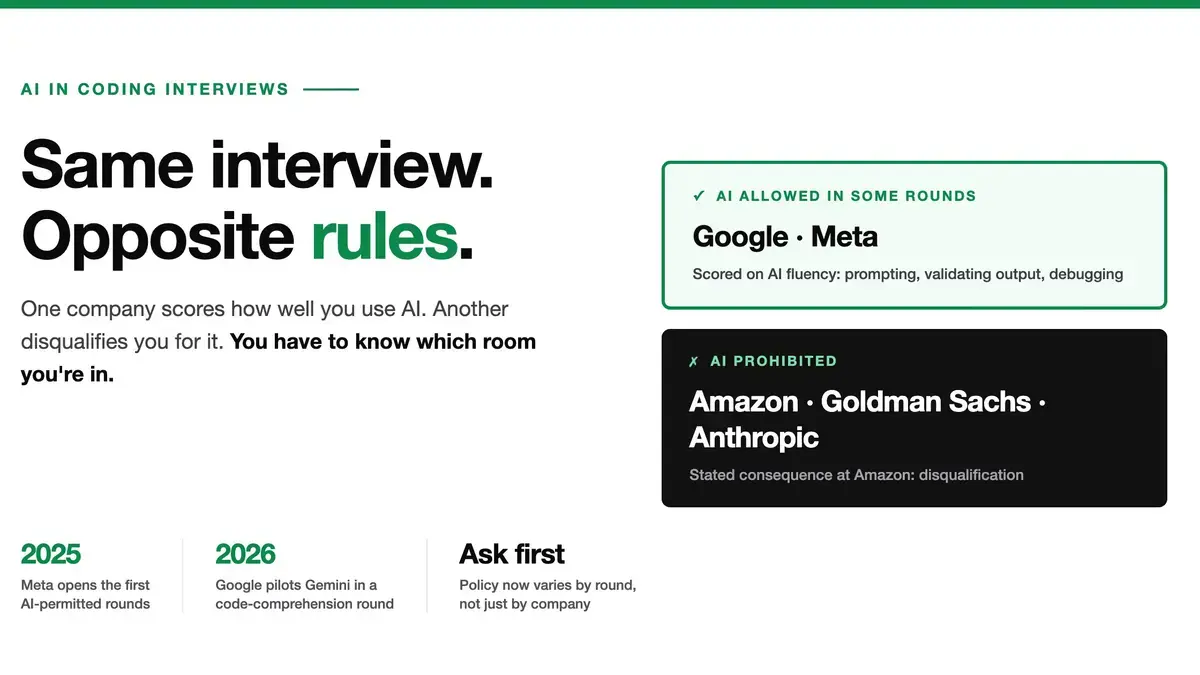
Open Gemini during a Google coding round and you may be earning points. Do the same thing at Amazon and you can be disqualified.
That's not a contradiction anyone plans to resolve soon. Two of the largest employers in tech have looked at the same question — should an engineer be allowed to use the tools they'd use on the job? — and reached opposite conclusions. Meta opened AI-permitted rounds in late 2025. Amazon's recruiter guidance warns that using generative AI "may result in disqualification from the recruitment process" (Fortune, June 2025).
For anyone interviewing right now, this creates a practical problem that has nothing to do with ethics. The rules changed, they didn't change uniformly, and nobody sends you a memo. Here's the map.
Key Takeaways
Policy now varies by round, not just by company — Google bans AI in standard loops while piloting Gemini in a new code-comprehension round.
Amazon, Goldman Sachs and Anthropic prohibit AI assistance; Amazon's stated consequence is disqualification (Fortune, 2025).
AI-permitted rounds score "AI fluency": prompting, output validation, and debugging.
The reliable detector isn't software. It's one unscripted follow-up about code you didn't write.
Which Companies Allow AI, and Which Disqualify You?
The market has split roughly in half, and the dividing line runs through individual interview loops rather than between companies.
Company | Position | Detail |
|---|---|---|
Meta | Allows in some rounds | First major tech employer to open AI-permitted coding rounds, late 2025 |
Mixed by round | Bans AI in standard loops; piloting Gemini inside a code-comprehension round | |
Amazon | Prohibited | "Do not use gen AI tools during your interview unless explicitly permitted" |
Goldman Sachs | Prohibited | Bans "any external sources, including ChatGPT or Google search engine" |
Anthropic | Prohibited by default | Asks candidates not to use AI assistants during the application process |
The reasoning on the prohibition side is consistent and worth taking seriously. Goldman Sachs spokesperson Jennifer Zuccarelli said the bank wants to "hear from our applicants in their own voice." Anthropic — a company whose entire product is an AI assistant — asks candidates to skip it because it wants to assess personal interest and non-AI-assisted communication.
That last one tends to surprise people. If the AI lab itself says no, the ban camp clearly isn't driven by technophobia.
Why the Split Isn't Really About Cheating
Both camps are making a prediction about what engineering work will be, and they've bet differently.
The prohibition camp is testing your unassisted reasoning. The logic: tools change every eighteen months, but the ability to hold a problem in your head, decompose it and reason about tradeoffs is durable. Test the durable thing. Anthropic's framing — wanting to see how you think through problems in real time — is the cleanest statement of this position.
The permission camp is testing your judgment over machine output. The logic: nobody ships code in a silent room without tools, so an interview that simulates 2015 conditions measures a skill that no longer maps to the job. Test the real thing.
Our read: the ban-vs-allow framing gets the disagreement backwards. Both camps are trying to isolate the same thing — the part of engineering the model can't do. They just disagree about where it hides. One thinks it hides in reasoning from a blank page; the other thinks it hides in evaluating a plausible-looking answer. Notice that neither camp is testing whether you can produce syntax quickly. That skill is genuinely gone as a differentiator, and it was the entire basis of interview prep for fifteen years.
What an AI-Allowed Interview Actually Tests
Not whether you can get an answer. Whether you can catch a wrong one.
Google's newer format has candidates working with an existing codebase — reading, debugging and optimising real code — with Gemini available. Interviewers assess AI fluency across three components: prompt engineering, output validation, and debugging skills.
Unpack "output validation," because that's where candidates lose. The model produces something plausible. Your job is to notice the off-by-one, the unhandled null, the approach that works but won't scale. That requires you to understand the problem better than the model appears to, which is a higher bar than solving it yourself, not a lower one.
This connects to a finding worth knowing. A randomized trial by METR found experienced developers were 19% slower with AI tools while believing they were 20% faster (METR, 2025). If you walk into an AI-permitted round assuming the assistant makes you faster, you'll likely burn your time budget reviewing generated code you didn't need.
The candidates who do well in these rounds treat AI like a fast junior colleague: useful for scaffolding, never trusted without review, and not consulted for things they can do themselves in less time than it takes to write the prompt.
Can They Tell If You Cheat?
Software detection is unreliable enough that no serious process leans on it. What catches people is conversation.
Amazon's internal guidance reportedly trains recruiters to watch for behavioural tells — candidates typing while a question is being asked, reading rather than responding, eyes tracking across a second screen. Those are observations, not measurements, and they generate both misses and false accusations.
The mechanism that actually works is much simpler: ask a follow-up about a decision in the code. "Why a map here instead of a list?" "What happens if this input is empty?" "What would you change if this ran a thousand times a second?"
Someone who reasoned their way to the solution answers immediately, because the reasoning is still in their head. Someone who accepted generated output has to reconstruct it live. The gap is obvious and it isn't faked easily.
Which produces a genuinely useful rule: the exposure isn't the tool, it's the explanation. If you use AI where permitted and can defend every line, you pass. If you can't, no amount of tool-hiding saves you, because the follow-up question is coming regardless.
How to Prepare for Both Kinds of Interview
You can't pick which format you'll get, so build for both. These are different skills and both are trainable:
Practise unassisted, on a timer. Two or three problems a week, no autocomplete, no assistant. This is the skill the ban camp is measuring and it atrophies quietly.
Practise reading unfamiliar code. Pull an open-source repository you've never seen and answer: what does this module do, where's the bug, what would you refactor? This is Google's code-comprehension round almost exactly.
Practise catching AI mistakes deliberately. Ask a model for a solution to something you already understand well, then find what's wrong with it. Note the failure patterns — they repeat.
Rehearse explaining decisions out loud. Every solution you write, assisted or not, defend three choices in it. This is the highest-return habit for both formats.
Never submit code you can't walk through line by line. In a permitted round this is what's being graded. In a prohibited round it's what exposes you.
Don't use invisible overlay tools. Beyond the integrity problem, they optimise for producing an answer — the one thing that no longer earns points in either format.
[INTERNAL-LINK: skills that hold value as AI spreads → guide to durable engineering skills for early-career developers]
The One Question to Ask Your Recruiter
Ask this, in writing, before every loop: "What's your policy on AI tools during the interview, and does it differ by round?"
That second clause is the important one. Google's split shows policy now living at the round level, and a recruiter answering "we allow AI" about the company may be wrong about the specific session you're in.
Asking costs nothing and carries no stigma — you're demonstrating that you check constraints before starting work, which is a trait interviewers like. Assuming instead is the expensive option, in both directions: assume permission and you risk disqualification, assume prohibition and you may under-perform against candidates being scored on tool use.
Get the answer in email. If the format changes on the day, you have something to point at.
Frequently Asked Questions
Is using AI in a coding interview cheating?
Only where it's prohibited. Meta and Google permit it in specific rounds and score how well you use it, while Amazon, Goldman Sachs and Anthropic prohibit it. The same action is either graded or disqualifying depending on the round, which is why asking first matters.
Will companies know if I used AI secretly?
Detection software is unreliable, but interviewers catch it conversationally. One unscripted follow-up about why you made a particular decision separates people who reasoned through a solution from people who accepted generated output. That gap is difficult to fake in real time.
Do I still need to practise coding without AI?
Yes. A significant share of employers still run unassisted rounds, including Amazon, Goldman Sachs and Anthropic, and Google keeps AI out of its standard loops. Unassisted problem-solving remains directly tested, and it degrades quickly without practice.
What does "AI fluency" mean in an interview rubric?
Google's framing covers three things: prompt engineering, output validation, and debugging. Validation carries the most weight — it requires understanding the problem well enough to spot a plausible but wrong answer, which is harder than solving it unaided.
What's Actually Being Tested Now
The interview didn't get easier or harder. It moved.
For fifteen years, technical hiring rewarded people who could produce a correct algorithm from memory under time pressure. Models do that instantly now, so both camps have quietly stopped measuring it. What's left is the part that survived: can you reason about a problem you haven't seen, and can you tell when a confident answer is wrong?
The ban camp tests the first. The permission camp tests the second. The candidates who struggle in 2026 aren't the ones who used AI or didn't — they're the ones who trained for a test that no longer exists.
Sources
Source | Title | URL |
|---|---|---|
Fortune (Emma Burleigh) | Goldman Sachs wants students to stop using ChatGPT in job interviews | |
IT Pro | Amazon bans AI tools during job interviews | |
GeekWire | Is it cheating? AI use during job interviews sparks debate | |
TechRadar | Meta says it will let candidates use AI in some job interviews | |
METR | Measuring the Impact of Early-2025 AI on Experienced Open-Source Developer Productivity |