
 Download App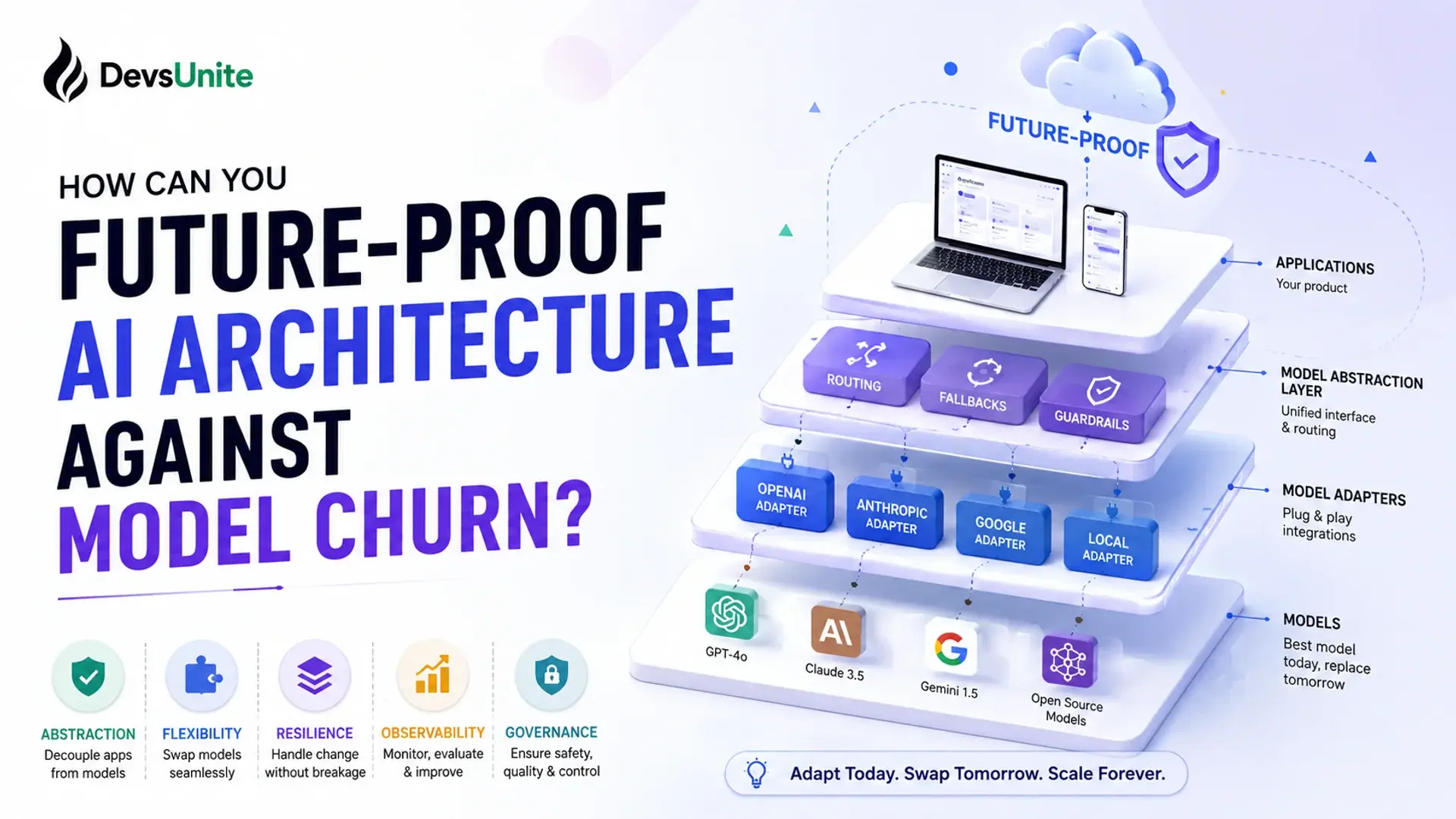
Future-proof AI architecture isn't about predicting which model wins next year. It's about designing your system so that a model swap is a config change and a re-run of your eval suite, not a rewrite. That means isolating model-specific logic behind stable interfaces, versioning prompts like code, and treating evaluation infrastructure as a first-class system component, not an afterthought.
Why "just use the best model" isn't an architecture
Frontier labs have been shipping meaningfully better models every few months for years running, and there's no sign that cadence is slowing. Any system architected around the specific quirks of GPT-4, Claude 3, or whatever's current when you built it is architected around a snapshot, not a target.
The mistake isn't picking a model. It's letting that model's specific behavior leak into places it doesn't belong: prompts hardcoded with vendor-specific formatting tricks, output parsers that assume one model's particular JSON quirks, business logic that silently depends on a context window size or a refusal pattern that's true today and false in six months.
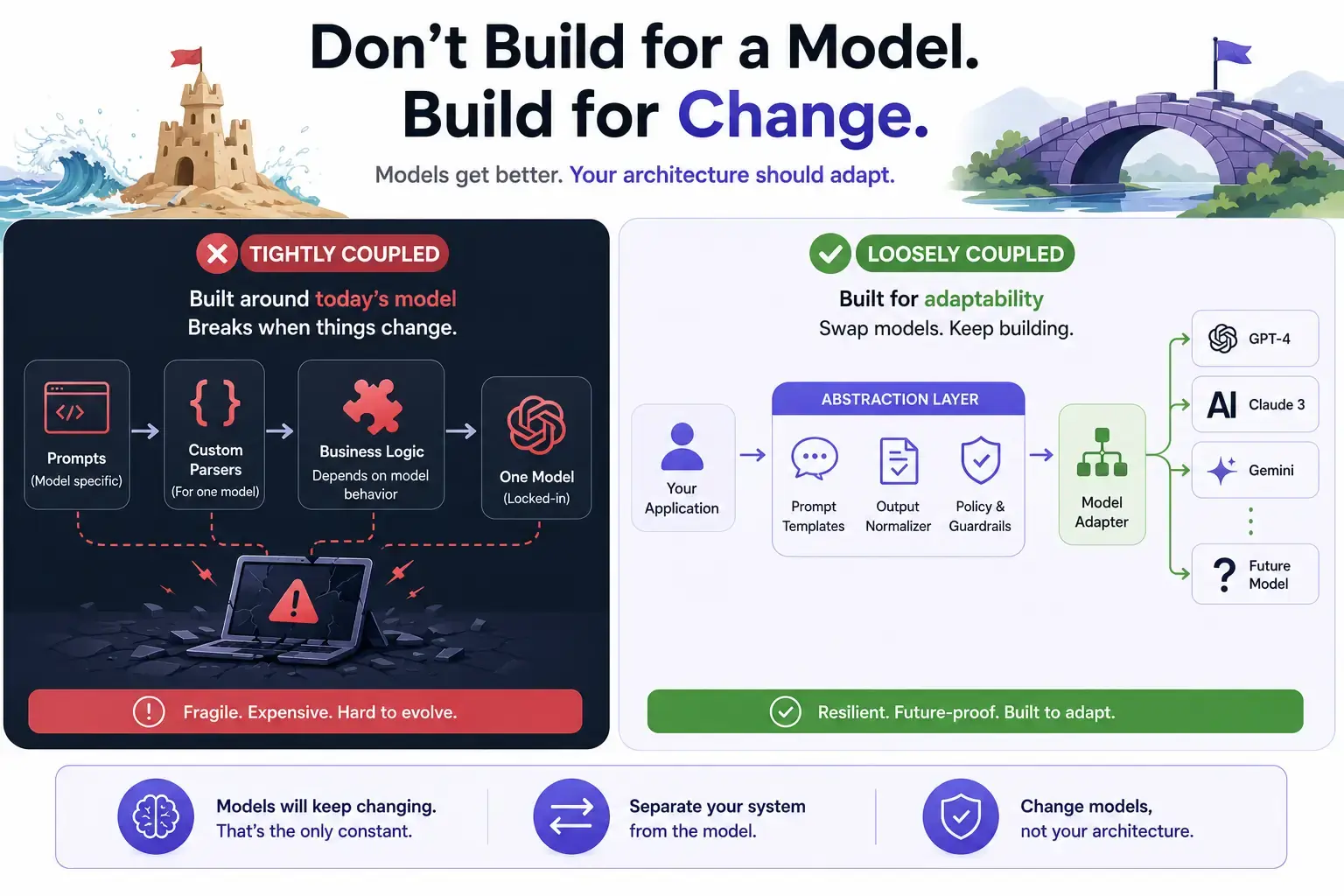
Teams that get burned by this don't get burned by choosing wrong. They get burned by coupling tightly to a choice that was correct when they made it. The system design question isn't "which model should we pick," it's "how much of our system breaks when we change our mind."
Draw the line: what should depend on the model, and what shouldn't
Start by separating your system into three layers, and be honest about which one each piece of code actually belongs to.
The model layer is the thing that changes: the specific model, its provider, its API shape, its prompt format, its context window, its pricing. Nothing outside this layer should know these details.
The interface layer is what stays stable: a function that takes structured input and returns structured output, regardless of which model sits behind it. This is your actual API surface for "get an AI to do X," and it's the contract the rest of your system codes against.
The application layer is your product logic: what you do with the model's output, how you handle failures, what you show the user. This layer should be able to run against a completely different model tomorrow without a single line changing, because it never talks to the model directly.
from typing import Protocol

# interface layer — stable contract, application code depends on this
class SummarizerModel(Protocol):
    def summarize(self, text: str, max_words: int) -> SummaryResult:
        ...

# model layer — one implementation per provider, isolated behind the interface
class ClaudeSummarizer:
    def summarize(self, text: str, max_words: int) -> SummaryResult:
        ...  # builds a Claude-specific prompt, calls the Anthropic API, parses the response

class LocalLlamaSummarizer:
    def summarize(self, text: str, max_words: int) -> SummaryResult:
        ...  # different prompt format, different parsing, same contract
When a new model ships, you write a new class that satisfies the same protocol. The application layer, the part that actually matters to your users, doesn't move.
Prompts are code. Version and test them like code.
A prompt tuned for one model's instruction-following style is a liability the moment a new model changes how it interprets that style. Treat prompts as versioned artifacts with their own change history, not as inline strings scattered through application code.
That means three concrete things in practice:
Store prompts separately from application logic, in files or a prompt registry, not as f-strings buried inside business functions. This makes a prompt change reviewable as a diff, and makes it obvious which prompts a model swap actually touches.
Pin a prompt to the model version it was validated against. A prompt engineered for one model's quirks may need retuning for another, even if both nominally support "the same task." Track that pairing explicitly instead of assuming portability.
Run prompts through an eval suite before and after every model swap, not just on release day. This is the step teams skip under deadline pressure, and it's the step that turns "we upgraded the model" into "we upgraded the model and don't know if it's actually better on our specific task."
Build the eval harness before you need it
Here's the uncomfortable part: most teams don't build real evaluation infrastructure until after a model swap already broke something in production. The LLMOps community has been converging on this exact point in recent years, that systematic evals, not vibes-based spot-checking, are what separate teams that ship AI features confidently from teams that ship and hope. Future-proofing means building that infrastructure before you need it, because the eval harness is what tells you whether a new model is actually a safe swap, not just a newer one.
A minimal harness needs three things: a fixed set of representative inputs pulled from real usage (not synthetic examples you made up), a scoring method appropriate to the task (exact match, a rubric an LLM judge applies consistently, or human review for anything high-stakes), and a way to diff results across model versions side by side.
def run_eval(model: SummarizerModel, test_cases: list[TestCase]) -> EvalReport:
    results = []
    for case in test_cases:
        output = model.summarize(case.input_text, case.max_words)
        score = case.scorer(output, case.expected)
        results.append(ScoredResult(case.id, output, score))
    return EvalReport(model_name=model.__class__.__name__, results=results)
This is boring infrastructure. It's also the difference between "we can evaluate a new model in an afternoon" and "we find out the new model regressed on an edge case three weeks after a customer complains." Build it once, against your interface layer, and every future model swap gets cheaper to validate instead of more expensive.
How do you avoid vendor lock-in without losing frontier capability?
You don't avoid lock-in entirely, and pretending you can is how teams end up building generic, mediocre infrastructure instead of a real product. The move is choosing lock-in deliberately, one layer at a time, instead of accumulating it by accident.
Some lock-in is worth taking on purpose. If a provider's function-calling reliability or a specific fine-tuning capability is genuinely load-bearing for your product, use it, and accept that swapping providers means real engineering work, not a config change. That's a tradeoff you made with eyes open.
The lock-in to avoid is the accidental kind: business logic that parses a provider's exact response format, retry logic tuned to one API's specific rate-limit behavior, feature flags that only exist because "that's what the SDK gave us." None of that should exist outside your model layer. If it does, it'll cost you the day you need to switch, whether that switch is planned or forced by a price change, a model deprecation, or an outage.
A practical middle ground: maintain at least one working integration with a second provider at all times, even if you don't route production traffic to it. It doesn't need to be optimized. It needs to prove your interface layer is actually model-agnostic, not agnostic in theory.
Design for graceful model degradation, not just graceful failure
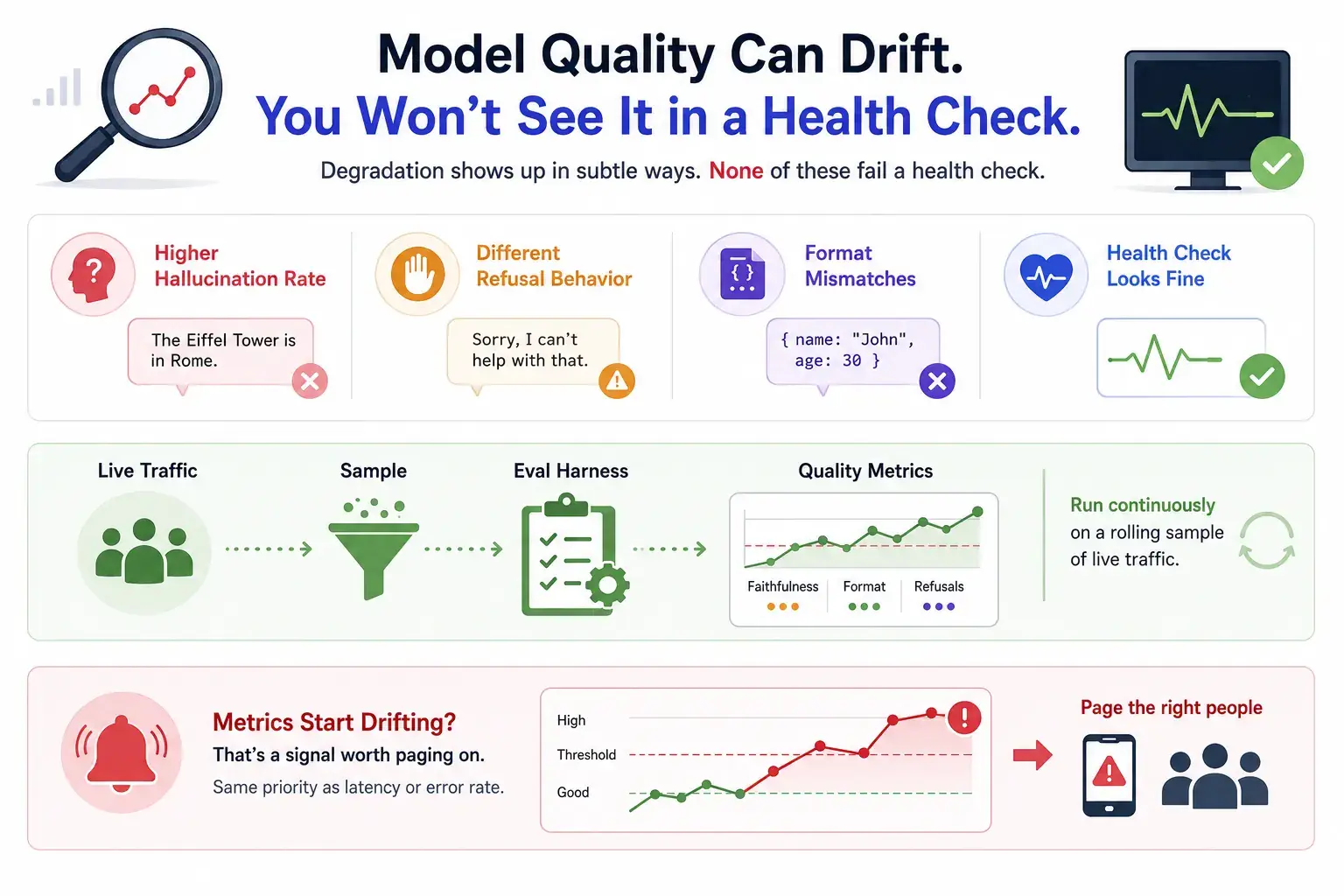
Most production AI systems have some kind of fallback for outright failures: retries, circuit breakers, a default response when the API times out. Fewer have a fallback for a model that responds successfully but with quality that's silently worse, which is a more common failure mode than an outright outage.
Model degradation shows up as increased hallucination rate on a specific task type, subtly different refusal behavior, or output that no longer matches the format your parser expects, none of which trip a health check. Catching it requires the same eval harness from the previous section, run continuously against a sample of live traffic, not just at swap time. If your quality metrics on a rolling sample start drifting, that's a signal worth paging on, the same way you'd page on latency or error rate.
Build a rollback path with the same seriousness you'd give a database migration: know how to revert to the previous model version quickly, keep the previous version's prompt and parsing logic around until the new one has proven itself, and don't delete the old integration the week after a swap looks successful.
A practical checklist for future-proof AI architecture
Audit where model-specific logic lives. If application code references a vendor SDK, a specific model name, or a provider's response shape directly, that's coupling to fix before it costs you.
Extract a stable interface layer if one doesn't exist yet, even a thin one. Start with your highest-traffic AI feature, not all of them at once.
Move prompts into versioned, reviewable artifacts separate from application code, pinned to the model version they were validated against.
Build or expand your eval harness against real usage data, and make running it a required step before any model swap ships.
Keep a second provider integration alive, even unoptimized, as a standing proof that the interface layer actually works.
Add quality drift monitoring, not just uptime and latency monitoring, so degradation without failure gets caught.
Document a rollback path for every AI feature the same way you'd document one for a database migration.
None of this is about predicting the next model generation correctly. It's about making sure a wrong prediction doesn't cost you a rewrite.
FAQ
Does future-proof AI architecture mean avoiding vendor lock-in entirely?
No, and treating it as an absolute rule is a mistake. It means knowing exactly where you're locked in, choosing that deliberately for a specific capability you can't get elsewhere, and never letting lock-in creep into layers where it's accidental. Zero lock-in usually means you're building generic infrastructure instead of a product.
How often should I actually expect to swap models?
Frontier model releases have been landing every few months for the last several years, and that pace shows no sign of slowing. You don't have to swap on every release, but your architecture should treat "swap available" as a monthly-scale event, not a yearly one, even if you only act on it a few times a year.
Is a model router overkill for a small team?
Not if you keep it minimal. A router can be a config file mapping task type to model identifier plus a thin client wrapper, not a service. The point isn't infrastructure weight, it's making the model choice a config change instead of a code change spread across the codebase.
What's the single biggest mistake teams make here?
Writing prompts, output parsing, and business logic directly against one vendor's SDK and response format, then discovering a year later that switching means rewriting the integration instead of changing a config value. The fix is a thin translation layer at the boundary, decided before the second model shows up, not after.
Do open-weight models make future-proofing less important?
They lower the ceiling on catastrophic lock-in, since you can self-host as a fallback, but they don't remove the need for architecture that abstracts model choice. Prompt formats, context limits, and tool-calling conventions still differ across open-weight models, so the same evaluation harness and interface discipline still matter.
The one change to make this week
If you only do one thing from this post, build the eval harness before your next model swap, not during it. Everything else here, the interface layer, the prompt versioning, the rollback plan, is what makes a swap safe to attempt. The eval harness is what tells you whether the swap was actually worth it, and it's the piece most teams only build after getting burned once.
This kind of layered, defense-in-depth thinking shows up across AI systems work, not just model swaps. The same instinct that keeps your model layer isolated is what keeps a layered approach to LLM security from collapsing into a single point of failure, and it's a pattern AI engineer interviews increasingly probe for directly: not whether you can integrate a model, but whether your system survives the next one.
Sources
OpenAI API deprecations — reference for how frontier providers retire and replace models on an ongoing basis, cited above on planning for forced model changes.
Hamel Husain, "Your AI Product Needs Evals" — widely cited reference on building systematic evaluation infrastructure for LLM products, referenced above in the eval harness section.