
 Download App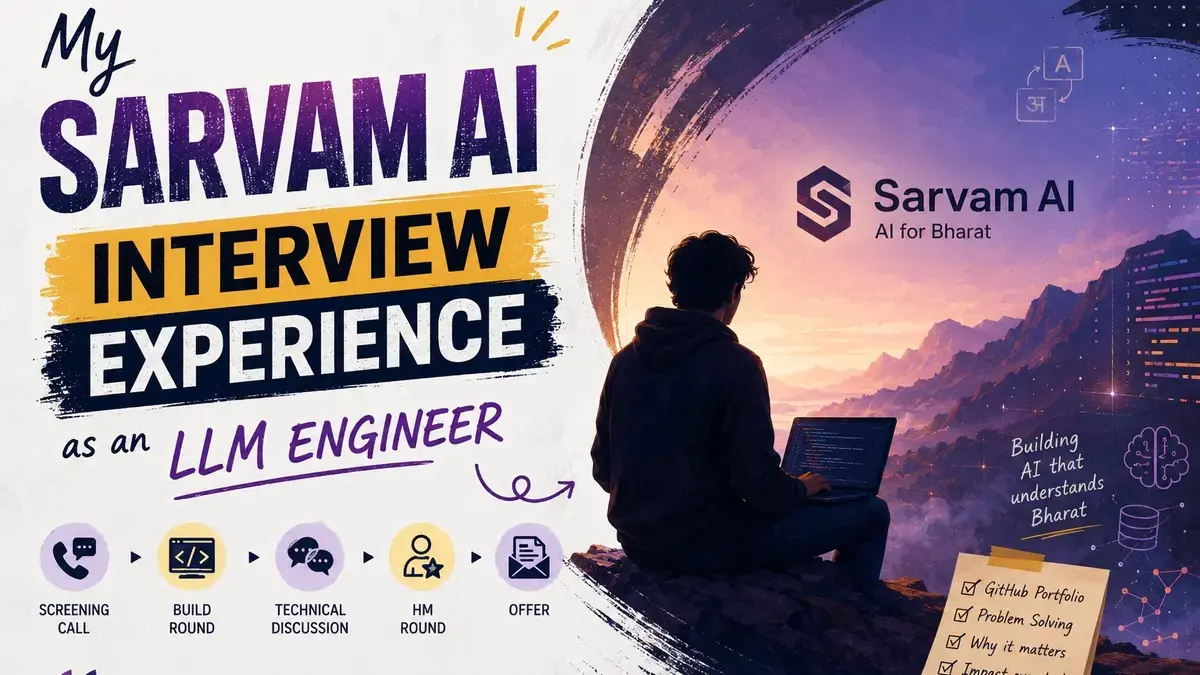
Half my batch spent placement season lined up for TCS Ninja and Infosys SP forms. I'd been building small LLM side projects on GitHub for close to a year by then — a retrieval pipeline over Hindi PDFs, a half-working transcription tool — mostly because I liked it more than DSA grinding, not because it was part of any plan. A senior who'd interned at Sarvam forwarded me a referral link one evening with one line: "apply, they don't care about your college." I didn't fully believe him. Applied anyway.
The screening call was nothing like I expected. No warm-up DSA question, no "tell me about yourself" filler. The interviewer had actually opened my GitHub repo before the call and spent most of the thirty minutes walking through my retrieval pipeline line by line — why I'd chunked documents the way I had, why that embedding model over the alternatives. Then came a question I couldn't have answered from my README alone: why did I fall back to keyword search when the vector similarity score dropped below a certain threshold, instead of just always running hybrid search? I hadn't rehearsed that answer. I gave it anyway, slower than I'd have liked.
The build round felt nothing like a coding test
Round two was proof of work under a clock — a little over two hours, proctored, to build a query-routing layer that could take a question in Hindi or English, decide whether it needed document retrieval or could just be answered directly, and return a response with a citation to the source chunk. Tools were fair game. I could use an AI coding assistant, search anything, pull from my own old repos — which felt strange at first, like I was getting away with something, because every timed round I'd done before had trained me to treat that as cheating.
About forty minutes in, I hit a wall. My routing logic kept misclassifying short factual Hindi queries as needing retrieval when they didn't. I spent almost fifteen minutes convinced my embedding call was broken before I finally printed the raw classifier output and saw the actual issue — my confidence threshold was tuned for English query lengths and just didn't hold for shorter Hindi phrasing. Small bug, way too much panic. Fixed it with twenty minutes left and used the buffer to add a fallback for when retrieval came back with nothing above the confidence floor. Nobody asked for that part. Felt worth showing anyway.
Defending my own code was harder than writing it
The next round wasn't about new code — it was two engineers, one infra-leaning, one more research-leaning, walking through what I'd already built and pushing on every decision under different constraints. What if this had to handle ten languages instead of two? What if the corpus was a hundred times larger — does the chunking strategy still hold?
I stumbled hardest on a scaling question. I answered with "just increase the vector index size," technically true, completely missing what they were actually pointing at — the real bottleneck was re-embedding cost every time the underlying documents changed, not storage. One of them nudged me: "think about what happens every time the documents change, not just how big the index gets." The moment he said it, the answer was obvious, which is its own specific kind of embarrassing.
The hiring manager round was less about tools, more about why
This round asked less "can you build this" and more "why does this problem interest you." I gave an honest, slightly rambling answer about growing up switching between Hindi and English mid-sentence the way most of us do, and being quietly annoyed at how badly most AI tools handled that switching. She didn't push for something more polished — just nodded and moved into a question about how I'd prioritize shipping something imperfect quickly versus waiting to ship something better, which seemed to be a real tension their team deals with often, not a hypothetical.
Screening call to offer took just under three weeks for me — noticeably faster than the multi-month process some friends went through elsewhere. The offer itself came as a direct phone call on a Thursday evening while I was reheating leftover dal, which threw me a little since I'd only ever gotten offers by email before.
A few quick answers, if you're prepping for something similar:
Does Sarvam AI ask DSA-heavy questions? Not in my loop — the weight was on defending real project work and building under pressure, not LeetCode patterns.
Can you use AI tools during the build round? Yes, and avoiding them reads as a weakness here, not integrity — treat it less like an exam hall.
How long does the process take? Under three weeks for me, screening call to offer.
What matters most on the resume? A GitHub portfolio you can actually defend under questioning beats a polished DSA sheet or college name.
One thing that helped me talk through my own code calmly under pressure instead of just reciting what it does: I'd run through mock technical interviews and a portfolio review on devsunite.com/resources before starting this process, and that's what made the defending-my-code round feel less like an ambush.