
 Download App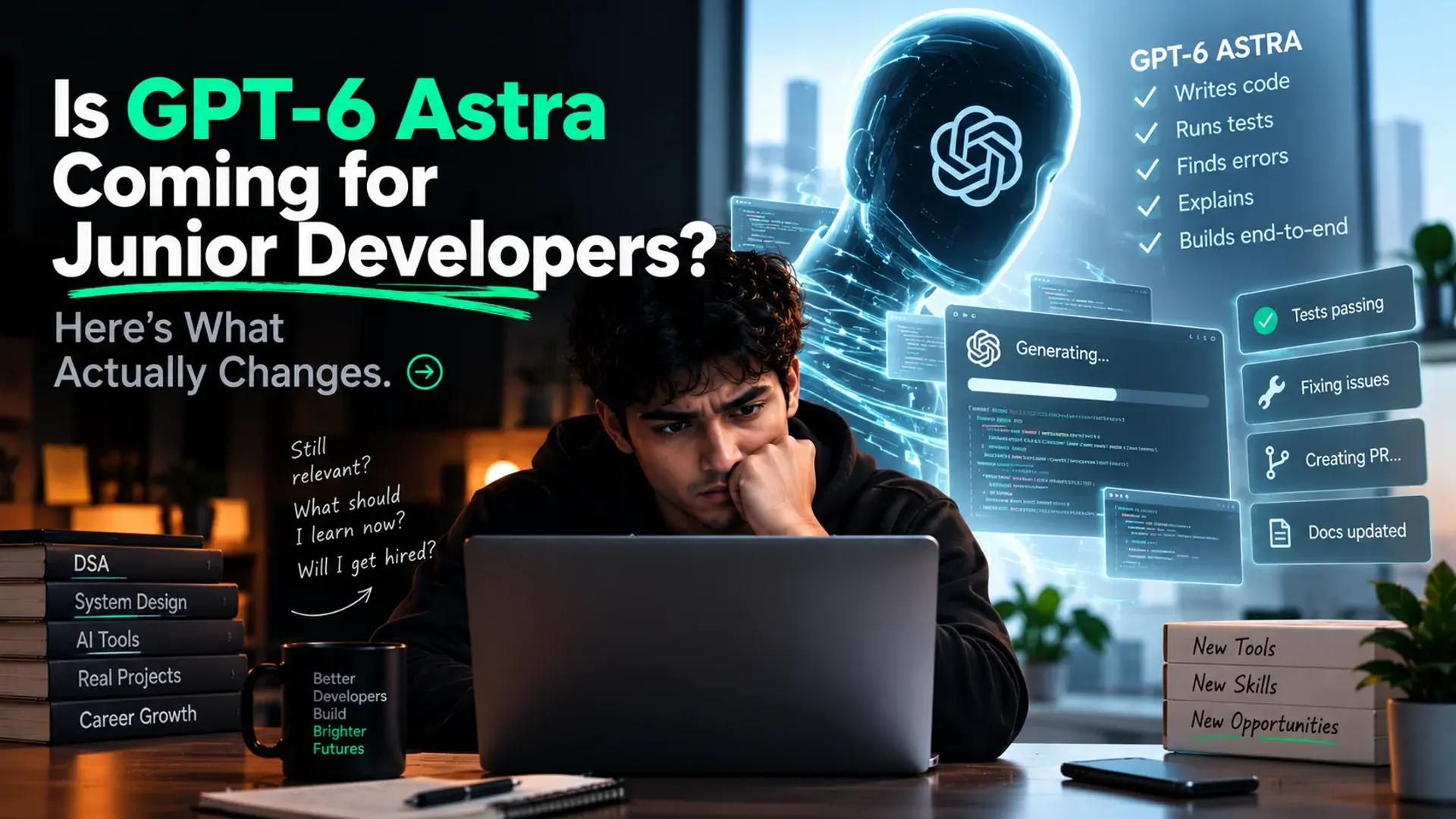
GPT-6 Astra began a limited rollout on September 4, 2026, so the question is already shifting from "is ChatGPT Astra coming?" to who can use it and for which work. For junior developers, its most immediate effect is a tougher bar on routine feature delivery. It does not establish that junior roles vanish, especially in India, where this release supplies no hiring data.
The useful response is concrete: learn to set constraints, inspect an agent's diff, test the failure path, and explain why a change is safe to merge. Those are visible skills in a portfolio and an interview. They also make a faster coding tool genuinely useful instead of dangerously persuasive.
Separate a model release from a labor-market forecast
The product name is GPT-6 Astra. OpenAI says it is rolling out first to a limited set of organizations, with API and eligible ChatGPT-plan access due over the following days. Its model documentation lists coding, hosted shell, patching, computer use, and MCP among supported capabilities.
That combination matters because it expands an agent's role from suggesting a function to carrying out a multi-step engineering task. It still leaves important facts unknown: how widely teams will deploy it, which tasks their policies permit, and whether they alter entry-level hiring as a result.
OpenAI reports 72.6% on OSWorld 2.0 at roughly 40 minutes per task in its latency simulations, compared with 65.7% at roughly 75 minutes for GPT-5.6 Sol. That is a concrete capability signal. It is an OpenAI-reported benchmark result, and it says nothing about production reliability or junior-developer employment. The detail is in the Astra launch announcement.
Why a stronger coding agent changes junior work first
Junior engineers are often assigned bounded work: reproduce a bug, add a validation rule, extend an existing endpoint, or create tests around a known behavior. A capable agent can generate much of the first attempt when it has a repository, a task, and permission to use tools.
The human work moves toward deciding what the task actually means and whether the proposed result survives contact with the system. That is where a junior can demonstrate judgment early: asking about an ambiguous edge case, spotting a changed public API, or refusing a patch that passes a narrow test while weakening authorization.
OpenAI's own safety overview is a useful reminder that capability and authorization are separate. It says Astra reaches its Critical threshold for cyber capabilities and that its deployment includes additional safeguards and monitoring. A sensible engineering team will still give agents narrow credentials, reviewed changes, and reversible environments, because a capable tool with broad access can make a bad assumption expensive. OpenAI's safety overview describes those safeguards and their limits.
Treat the table as a preparation framework, not a claim about every employer. Small teams, regulated companies, and teams without agent access will delegate differently. It does identify a portable advantage: evidence that you can validate work instead of only generate it.
Will GPT-6 Astra replace junior developers?
No responsible answer can turn a launch-day model announcement into a hiring forecast. The best current evidence describes an earlier transition: a June 2026 IZA discussion paper studied U.S. online software-developer vacancies from January 2019 through March 2025, using a main comparison of the 12 months before and after ChatGPT's November 2022 release. It defines junior postings as requiring three or fewer years of experience and finds a 14–15% relative decline in junior versus senior vacancies over that initial post-release period. Read the paper and its methods.
Its other finding is more actionable for a candidate: remaining junior vacancies shifted toward problem solving, communication, and attention to detail, instead of AI-specific skills. In plain terms, adding "prompt engineering" to a resume has limited value if the rest of your evidence cannot show reasoning and verification.
The paper is preliminary research using U.S. online vacancies, not hires. It cannot tell an Indian student how many openings exist this month, whether a particular company is recruiting, or what GPT-6 Astra will cause. Treat it as evidence that hiring requirements can move with AI adoption, not as a forecast carved in stone.
Build a portfolio that survives an agent review
For students and freshers in India, the target is not a project that looks as if it materialized from a prompt. Build one small system where a reviewer can see your decisions.
Pick a feature with a failure mode. An appointment-booking API with conflicting time slots is more useful than another static dashboard. Write acceptance criteria before asking an agent for code.
Ask the agent for an implementation and then write tests for the paths it skipped: duplicate requests, expired sessions, malformed input, and a downstream timeout. Keep at least one rejected patch or failed test in the project notes.
Make one change by hand after reading the generated diff. Explain the choice in the pull-request description: a missing transaction, an unsafe default, a leaky error, or an incorrect assumption about an existing interface.
Practise explaining the work out loud. If an interviewer asks why the test matters or what would break after a rollback, the answer has to come from your understanding, not a regenerated chat response.
For the algorithm and system-design foundations that support that review work, use structured DSA and system-design practice as a regular training loop. The aim is fluency with invariants, complexity, state, and failure modes. Those are the lenses that let you spot when generated code only looks plausible.
What to watch over the next few months
Watch job descriptions and interview formats, not product-demo headlines. A company that replaces a take-home task with a live review, an ambiguous-ticket exercise, or an AI-assisted debugging session is telling you what it wants candidates to prove.
Also watch the access model. Astra's capabilities vary by tool, account, and organizational permissions. The model page lists a long context window and tool support, but a company can still restrict shells, network access, repositories, or production credentials. Your first job may use a much narrower version of an agentic workflow than a launch video suggests.
FAQ
Is GPT-6 Astra available in ChatGPT?
As of September 4, 2026, OpenAI says GPT-6 Astra is rolling out first to a limited set of organizations. API access and access for Plus, Pro, Business, and Enterprise plans are expected over the following days, so availability can differ during rollout.
Will GPT-6 Astra replace junior developers?
The release itself cannot answer that. It makes more multi-step coding work delegable, while U.S. vacancy research on the earlier ChatGPT transition found higher entry-level requirements alongside fewer junior vacancies relative to senior ones. That study does not measure Indian hiring and does not predict Astra's effect.
What should I learn alongside an AI coding agent?
Practise requirements writing, code review, test design, debugging from logs, and communicating trade-offs. These skills give you a way to check an agent's output when it is quick, confident, and wrong about a local detail.
Should I disclose AI use in my portfolio?
Describe it precisely when asked. Show what you delegated, what you changed after review, and how you tested the final behavior. That record is more credible than trying to make AI assistance invisible.
Your next project should include a review trail
On the next feature you build, save the requirement, the generated draft, the test that first failed, and the change you made after reading the diff. By the time agentic coding becomes ordinary in more teams, that review trail will show an interviewer the part of engineering that a model release cannot certify: how you decide what deserves to ship.
Sources
OpenAI, GPT-6 Astra: A new generation of intelligence, accessed September 4, 2026. Product availability, computer-use claims, coding context, and the OSWorld 2.0 benchmark are first-party product evidence.
OpenAI Developers, GPT-6 Astra model documentation, accessed September 4, 2026. Supported API capabilities and rollout information.
OpenAI, Safety overview: GPT-6 Astra, September 3, 2026. First-party safety claims and deployment safeguards.
Samuel Westby, Alicia Sasser Modestino, and Peiran Cheng, Generative AI and the Redefinition of Entry-Level Software Work, IZA Discussion Paper 18723, June 2026. U.S. online-vacancy study; preliminary research, not India-specific hiring evidence.