
 Download App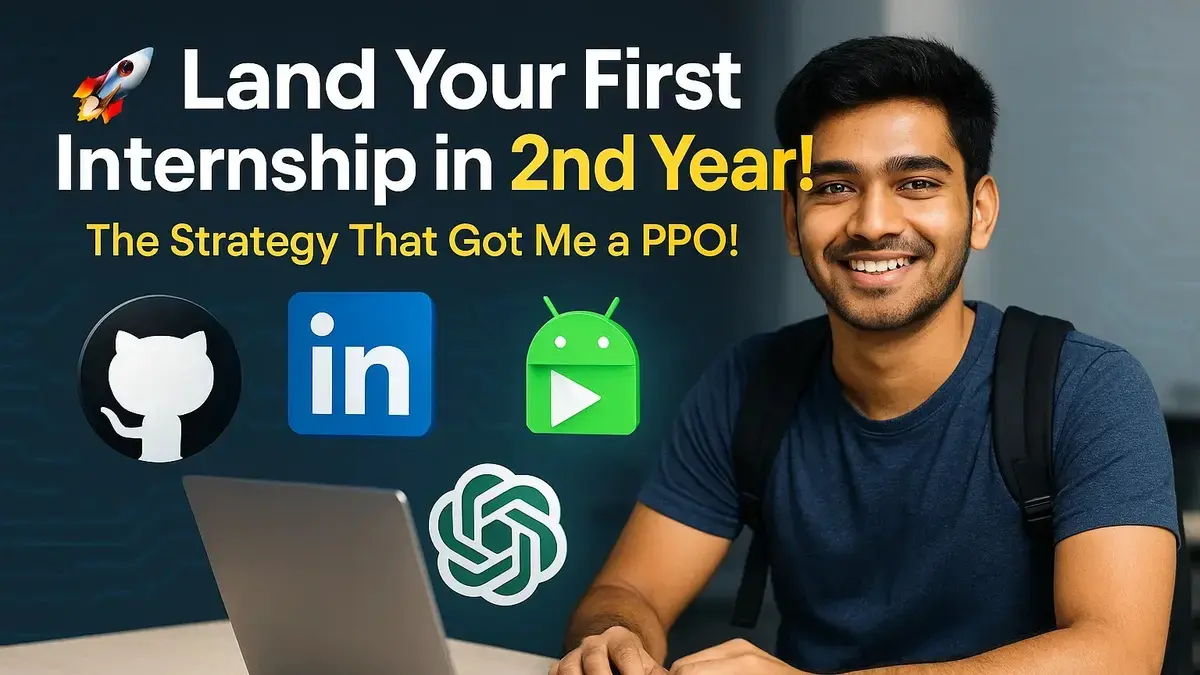
So you’re a B.Tech/BCA student, you’ve barely survived engineering math, and suddenly everyone around you is building "startups," making apps, and casually dropping the word internship in conversations.Meanwhile, you’re wondering how to even start the Hello World without Googling it. Yeah, I’ve been there.
But guess what? You can land your first internship in your second year, even if you’re not a 10x developer who drinks Java in the morning and breathes Python at night.
Let me walk you through how I did it and how you can too without losing your sleep or sanity.
1. Start Early. Like, Earlier-Than-You-Think Early.
Most people spend their first year binge-watching Netflix or, worse, anime without subtitles (don't ask me how I know this). But if you're even vaguely interested in tech, this is your golden time to mess around, fail fast, and learn faster.
Don't wait till third year when placements are breathing down your neck. Use your first year to:
Learn basic programming (pick one language and stop switching every week).
Build small things. I’m talking “To-Do App with ugly UI but working backend” kind of small.
Watch YouTube tutorials, but don’t just watch build alongside.
Focus on development and DSA (data structure and algorithms) both, plan accordingly.
Don’t treat your first year like a gap year.
2. Build Projects (Even if They Look Like a Potato)
Your code doesn't have to look like it's been written by an expert engineer. Just make sure you’re building things that work. My first few apps? Honestly, they were clunky. But they worked.
Eventually, I built a couple of Android apps, slapped them on the Google Play Store, and suddenly I wasn’t just “some kid with a GitHub,” I was “that student who’s published live apps.” And believe me, that opens doors.
Internship interviews went like:
Them: “So what have you built?”
Me: “Here’s an app I made. It’s on the Play Store.”
Them: “Okay wow. That’s pretty cool.”
No one cares that your UI was made with StackOverflow duct tape. If it solves a problem, it counts.
3. Make It Public (No, Not Like That)
There’s no point building cool stuff if it’s buried in your “Projects” folder next to your failed attempts at learning React. You have to show your work:
Make a portfolio site (can be super simple).
Upload code to GitHub.
Publish apps on Play Store, host websites on Netlify or Vercel.
Think of it like this: Your portfolio is your dating profile for internships. Show your best side. Add a nice README. Maybe even a bad pun in your bio (optional but recommended).
4. Getting Internships in the AI Era (aka Welcome to 2025, Coder)
We’re in the AI age. ChatGPT is writing code, Midjourney is making posters, and your uncle probably asked you if “AI will take over all jobs.”
Here’s the deal: AI won’t take your internship but someone using AI better than you might.So here’s how you use AI to your advantage instead of fearing it:
Learn AI Tools:Know how to use ChatGPT, GitHub Copilot, and Google Gemini to speed up your workflow. They're not cheating they’re your teammates who don’t sleep.
Build AI-Enabled Projects:Even if it’s basic like a chatbot, image classifier, or AI-powered expense tracker just show you understand current trends.
Tailor Applications Using AI:Use AI to polish your resume, draft personalized emails, and even simulate mock interviews. Literally ask, “Write a cover letter for a React internship” and refine it from there.
Target AI-focused Startups:Tons of new companies are working in LLMs, CV, NLP, etc. Find them on LinkedIn or AngelList and reach out. They love students who are already playing in the space.
You’re not competing with AI. You’re collaborating with it.
5. Where to Find Internships (Hint: Not on Your College WhatsApp Group)
I got both my internships through applying smartly and randomly too but in the relevant field. Some tips:
Use LinkedIn and now DevsUnite like a pro.
Check DevsUnite, Wellfound (AngelList), MonsterJobs, or even Twitter/X.
Apply to startups. They don’t expect you to be perfect they want hungry learners and hard workers.
Cold email if needed. Short, direct, with a link to your portfolio.
The second internship I got (thanks to my Play Store apps) turned into a PPO. So yeah this stuff pays off, literally.
6. Leverage College Tie-Ups (Yes, Even That One Big MNC That Comes Every Year)
Most colleges have at least a few companies that hire from them. Don’t ignore these just because they’re not “fancy.” These internships can:
Give you your first taste of professional work.
Teach you how to work in teams, use Git (properly), and write emails without emojis.
Help you build confidence.
Figure out how your college’s placement system works early. Ask seniors. Bribe them with samosas if needed.
7. Internships Are Learning Grounds, Not Shark Tanks
Here’s the truth: No one expects you to know everything. You’re not going to build the next ChatGPT during your internship (unless you’re very, very lost).
What matters is:
Curiosity
Willingness to Google the heck out of errors
Taking feedback like a champ
Slowly, you’ll get used to real-world development: Git workflows, API calls, sprints, and meetings that could’ve been emails.
Don’t Wait. Execute.
If you’re in your 2nd year and still thinking, “Am I ready?” the answer is yes if you start now.
Here’s a quick cheat sheet:
Learn one programming language
Build 2–3 actual projects (no tutorial clones)
Publish something anywhere, everywhere
Make a simple portfolio
Apply to internships like you apply coupon codes on Zomato everywhere
Don’t panic, just keep showing up
Learn to use AI before AI replaces that hesitation of yours
I started early, built apps, made my work public, and that helped me land not just one but two internships, followed by a PPO all before hitting final year.
So if I could do it, with all my late-night debugging and StackOverflow surfing, you definitely can too.
Now go open that VS Code tab and build something. Or at least... close that 15th YouTube tab.
Need help building a roadmap or using AI tools for your prep? Ping me on Linkedin https://www.linkedin.com/in/harshit-asthana-3b006b20a/