
 Download App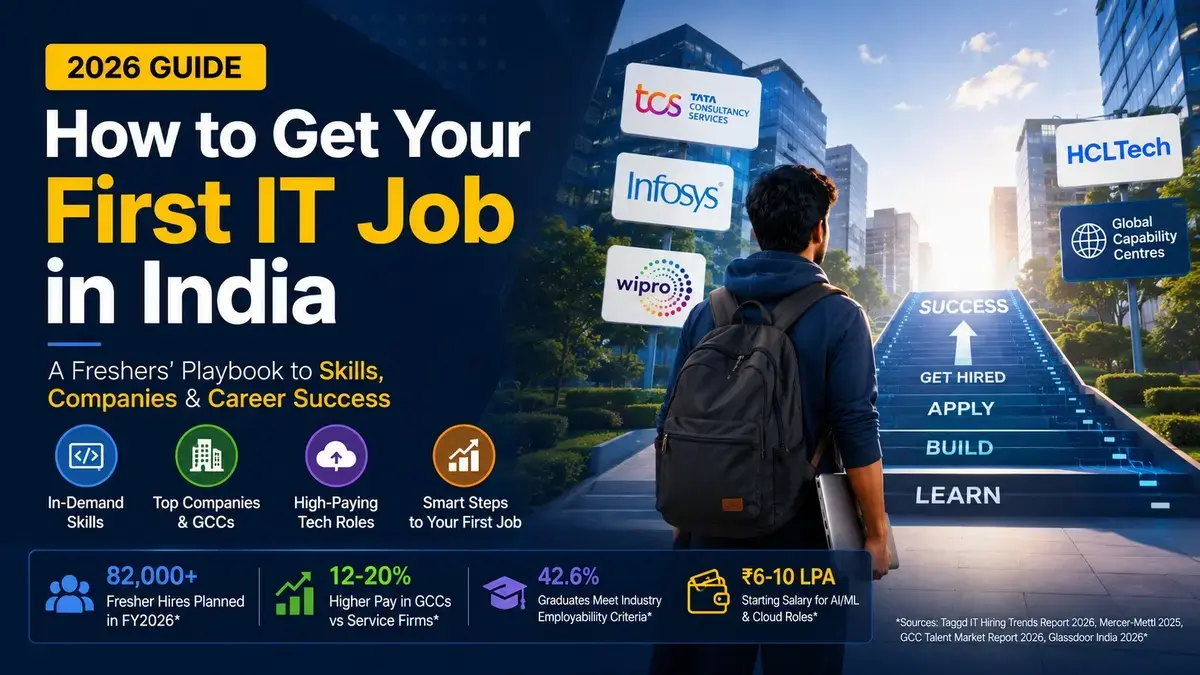
In FY2026, India's top IT firms — TCS, Infosys, Wipro, and HCLTech combined — are projected to hire 82,000 freshers, signalling a real recovery in entry-level demand after two lean years (Taggd IT Hiring Trends Report, 2026). But here's what no placement cell will tell you: the IT services sector cut fresher hiring from 600,000 in 2022 to under 150,000 in 2024. The market came back, but it came back different.
Getting your first tech job now isn't just about passing a written test and showing up to an interview. Companies test for practical skills, real projects, and the ability to learn fast. If you're a 2025 or 2026 batch graduate, this guide gives you the exact playbook — from picking the right type of company to walking into your first day.
Key Takeaways
In FY2026, major IT firms plan to hire 82,000 freshers collectively — TCS leads with ~42,000 openings (Taggd, 2026).
Only 42.6% of Indian graduates meet actual industry employability criteria (Mercer-Mettl India Graduate Skill Index, 2025), but practical skills close this gap fast.
GCCs (Global Capability Centres) pay 12–20% more than service firms and plan to ramp fresher hiring by up to 20% this year.
AI/ML and cloud roles offer ₹6–10 LPA for freshers with the right certifications, vs ₹3–5 LPA at traditional IT service companies.
Step 1: Know the Market — Service Companies, Product Firms, and GCCs Are Not the Same
In FY2026, India's tech hiring landscape splits into three very different tracks for freshers. Service companies like TCS and Infosys hire in high volumes — TCS targets 42,000 freshers and Infosys 15,000–20,000 — with structured training programs and salaries typically between ₹3.5–6 LPA (multiple company announcements, 2025). Product companies and startups hire in smaller batches but pay significantly more if you have strong fundamentals.
The fastest-growing opportunity most freshers overlook? Global Capability Centres (GCCs) — India-based R&D and tech delivery arms of multinational companies. In FY2026, 64% of GCCs plan to increase fresher hiring by up to 20%, and they pay a 12–20% salary premium over comparable IT service roles (GCC Talent Market Report, 2026).
What does this mean for you? Don't limit your target list to TCS and Infosys. Apply across all three tracks in parallel.
FY2026 Fresher Hiring Targets (Top IT Firms)
Company | Target Hires |
|---|---|
TCS | ~42,000 |
Infosys | ~20,000 |
Wipro | ~11,000 |
HCLTech + Others | ~9,000 |
Source: Taggd IT Hiring Trends Report, 2026
According to the Taggd IT Hiring Trends Report 2026, the combined fresher hiring intent of India's top five IT employers has reached 82,000 for FY2026 — the strongest signal of recovery since the sector's sharp slowdown in 2023–24. Service companies account for the bulk of this volume, but GCCs — which now number over 1,700 across India — represent the higher-value track for freshers with specialised skills.
Step 2: Build the Skills That Employers Actually Test
Here's an uncomfortable truth: in 2024, only 42.6% of Indian graduates met actual industry employability criteria, even though 71.5% of B.E./B.Tech graduates scored as "job-ready" on standardised tests (Mercer-Mettl India Graduate Skill Index, 2025; India Skills Report, 2025). That gap exists because colleges test recall, while companies test application.
What are companies actually testing? In 2026, the most in-demand skills for freshers break down like this:
Data Structures & Algorithms (DSA): Non-negotiable for product companies and most service firms' coding rounds. LeetCode, HackerRank, and GeeksforGeeks are your training grounds.
Python or Java: Pick one and go deep. Python wins for data and automation roles; Java is stronger for enterprise service tracks.
SQL and basic databases: Almost every tech role tests this. Know JOINs, GROUP BY, subqueries.
Cloud basics: AWS Cloud Practitioner or Azure Fundamentals certifications directly translate into higher starting packages (₹5–9 LPA vs ₹3–5 LPA for uncertified software developers).
Version control (Git): Every company uses it. Every recruiter will ask about it.
Our observation: Freshers who complete one cloud certification before their first interview consistently report receiving offers 1.5–2× higher than peers with identical academic scores. The certification signals practical readiness in a way that coursework simply doesn't.
You don't need all of these before your first application. You need to be genuinely strong in two or three, not passably familiar with everything.
Fresher Salary Range by Tech Role — India 2026
Role | Starting Package |
|---|---|
AI / ML Engineer | ₹6–10 LPA |
Cloud / DevOps | ₹5–9 LPA |
Cybersecurity Analyst | ₹6–9 LPA |
Data Analyst | ₹4–7 LPA |
Software Developer | ₹4–6 LPA |
Sources: Glassdoor India, Scaler, Cambridge Infotech, 2026
Step 3: Write a Resume That Passes the ATS Filter
Most fresher resumes never get read by a human. Before your CV reaches a recruiter, it passes through an Applicant Tracking System (ATS) that parses for specific keywords. In 2025, recruiters at large IT firms reported receiving 200–400 applications per opening — ATS rejection is how they manage that volume.
Here's what works:
Use a single-column format with standard section headings: Summary, Skills, Projects, Education, Certifications. Avoid tables, text boxes, and graphics — ATS parsers choke on them.
Lead with a Skills section listing specific technologies: "Python, SQL, REST APIs, Git, AWS Cloud Practitioner" beats "proficient in programming languages."
Rename "Experience" to "Projects" and treat your college projects as work. Write them with this formula: what you built + the tech stack used + the measurable outcome.
Add your CGPA only if it's above 7.0. Below that, let your skills and projects speak first.
Keep it to one page. Freshers who send two-page resumes signal poor editing judgment.
Before you send your resume anywhere, run it through DevsUnite Resume Analyser — it checks your CV against ATS parsing rules, flags missing keywords, and scores your resume for the role you're targeting. Takes under two minutes and often catches issues that cost freshers callbacks.
According to LinkedIn data cited in multiple 2026 career guides, complete LinkedIn profiles are 40% more likely to receive recruiter messages than incomplete ones, and profiles featuring a professional photo receive 21 times more views. For Indian freshers whose campus networks are geographically limited, a strong LinkedIn profile isn't optional — it's how off-campus recruiters find you.
Your LinkedIn headline should read: Software Developer | Python, SQL, AWS | 2026 Batch | Open to Work — not Student at XYZ University. That's the kind of headline that triggers recruiter search alerts.
Step 4: Target the Right Job Portals and Companies
Not all job portals give equal results. In FY2026, the most effective channels for Indian tech freshers break down by hiring type:
For campus and mass hiring (service companies):
TCS NQT and Infosys InfyTQ — apply directly through their portals, not third-party sites.
Wipro NLTH (National Level Test for Hiring) — check Wipro careers directly.
AMCAT / CoCubes assessments — several mid-size IT firms use these for initial filtering.
For off-campus and startup opportunities:
Naukri.com and LinkedIn — set up job alerts for "software developer fresher" in your target cities.
Unstop (formerly HackerEarth Challenges) — coding contests regularly lead to direct interview calls.
Freshershunt, OffCampusJobs4u — aggregate fresher-specific openings from 2024–2026 batches.
AngelList / Wellfound — for startup roles, which often skip ATS entirely.
DevsUnite — a developer community where freshers can connect with peers, share projects, and discover opportunities shared directly by hiring engineers.
For GCCs (the highest-value track):GCCs don't always advertise as "GCC" — they use their parent company branding. Search for "engineer fresher" on LinkedIn filtered by companies with "India R&D Centre" or "India Engineering Centre" in the description. Bengaluru hosts over 880 GCC units; Hyderabad is the fastest-growing Tier-1 city for new GCC setups.
What most guides miss: GCC roles listed on Naukri or LinkedIn often sit open for 4–6 weeks before being filled, while TCS and Infosys roles fill within days of announcement. If you're targeting a GCC, apply in week one — not week three when the competition is highest.
Step 5: Crack Each Round of the Selection Process
India's tech hiring for freshers typically runs in four rounds. Knowing what each tests — and what actually matters — saves enormous prep time.
Round 1 — Online Aptitude Test (OAT)This covers quantitative aptitude, logical reasoning, and verbal ability. TCS NQT, Infosys InfyTQ, and eLitmus all use structured tests. The pass threshold is usually 60–70%. Prep with: IndiaBix, PrepInsta, and the official practice tests from each company's portal.
Round 2 — Coding RoundTypically 2–3 questions in 60–90 minutes. Difficulty ranges from easy to medium LeetCode. Focus on: arrays, strings, basic recursion, sorting, and HashMap problems. Writing clean, commented code matters even if you don't finish — partial credit exists.
Round 3 — Technical InterviewThis is a live conversation, not a test. Interviewers probe your projects and conceptual understanding. Expect: "Walk me through one project you built." Know your own project cold. Be honest about what you built vs what you used from tutorials.
Round 4 — HR RoundThis tests communication and cultural fit, not personality. Prepare a 90-second introduction that covers your background, strongest technical skill, and what you want to learn at the company.
Step 6: Build a Portfolio While You Apply
What separates freshers who land offers in 60 days from those still applying at month six? A visible portfolio of real work. Here's what that looks like in practice:
GitHub profile with 3–5 projects that are pinned, documented with README files, and actually runnable. Recruiters at product companies check GitHub routinely.
One data project on Kaggle if you're targeting analytics or ML roles — even a clean EDA notebook shows practical skill.
An open-source contribution — even fixing documentation in a known Python library signals initiative and collaboration experience.
Don't wait until your portfolio is "ready." Apply and build simultaneously. Most companies allow 2–4 weeks between application and first round — that's enough time to tighten your GitHub and add one meaningful commit.
A pattern we've observed: Students who document their projects as they build — with README files, screenshots, and a brief write-up of the problem they were solving — consistently get more interview callbacks than students whose projects are technically equivalent but undocumented. The documentation is the signal.
India's Fresher Employability Gap (2025)
Measure | Rate |
|---|---|
Test-based "Job Ready" (India Skills Report) | 71.5% |
Industry Employable (Mercer-Mettl) | 42.6% |
Gap | 29 points |
Common Mistakes That Cost Freshers Offers
1. Applying too late. TCS NQT and Infosys InfyTQ registration windows open months before the actual hire date. If you're a 2026 batch student, applications for FY2026 roles may already be live. Check now.
2. Sending the same resume everywhere. A resume with "Fresher seeking an opportunity in a dynamic organisation" as its summary clears no ATS and impresses no recruiter. Tailor the skills section to match the job description — even slightly.
3. Listing projects with no outcomes. "Built an e-commerce website" says nothing. "Built a Django e-commerce site with user authentication and a PostgreSQL backend; reduced average page load time by 30% through query optimisation" says everything.
4. Skipping the aptitude section. Engineering graduates often assume the technical rounds matter most. At TCS, Infosys, and Wipro, the aptitude test is the highest-volume filter — most applicants are eliminated here before any technical assessment.
5. Neglecting Tier-2 and Tier-3 cities. Bengaluru, Hyderabad, and Pune get the most applications. Coimbatore, Jaipur, Indore, and Kochi have growing IT sectors with lower application volumes per opening — and often higher callback rates for freshers.
Frequently Asked Questions
What is the average starting salary for a tech fresher in India in 2026?
The average starting salary for a software developer fresher sits at ₹3.5–6 LPA at IT service companies (Glassdoor India, 2026). Freshers with cloud certifications or strong DSA skills joining product companies or GCCs typically start at ₹6–10 LPA. The gap between the two tracks is significant and widens quickly with experience.
Is off-campus placement better than on-campus placement for freshers?
Neither is universally better — they target different types of companies. Campus recruitment primarily connects freshers with large IT service firms. Off-campus routes reach startups, product companies, and GCCs, which collectively pay 20–40% more than service companies. Freshers applying to both tracks in parallel have a higher probability of multiple offers within 90 days.
Which skills should a fresher focus on to get hired in 2026?
The highest-demand skills are Python, SQL, Data Structures and Algorithms, cloud fundamentals (AWS or Azure), and Git. Data Science and AI roles — starting at ₹6–10 LPA — additionally require pandas, NumPy, and basic ML libraries. Communication skills remain the most common non-technical reason freshers fail HR rounds (Mercer-Mettl, 2025).
How many companies should a fresher apply to?
Apply to 20–40 companies in parallel across multiple tracks: 8–10 large IT service firms, 10–15 mid-size and product companies, 5–10 GCCs, and 3–5 startups. This volume isn't spam — it's realistic given typical callback rates. Keep a spreadsheet tracking application date, status, and next follow-up step so nothing slips.
Are GCCs realistic for freshers with no work experience?
Yes. In FY2026, 64% of GCCs in India plan to increase fresher hiring by up to 20% (GCC Talent Market Report, 2026). GCCs in Bengaluru, Hyderabad, and Pune actively recruit from campus and off-campus channels. The requirement isn't prior experience — it's demonstrated skills through projects, certifications, and clearing technical screening rounds.
Conclusion
The path to your first tech job in India has never been more structured — or more competitive. The 82,000 fresher openings in FY2026 are real, but so is the skills gap that leaves 57% of graduates on the outside looking in.
What works: picking a track that fits your skill profile, building two or three genuinely strong technical skills rather than a long list of superficial ones, and applying early and consistently across multiple company types. The freshers who land offers fastest aren't always the ones with the best CGPA — they're the ones who treated the job search itself as a project worth executing well.
Start today. Register for TCS NQT and Infosys InfyTQ, set your LinkedIn headline, and push your first polished GitHub project. The window for FY2026 hiring is open now.
Sources:
Taggd, IT Hiring Trends 2026, retrieved 2026-05-25
Sakshi Post, Infosys Resumes Campus Hiring, Targets 20,000 Fresher Jobs, retrieved 2026-05-25
Persolindia / Mercer-Mettl, India Graduate Employability Gap 2025, retrieved 2026-05-25
Storyboard18, AI Cuts Entry-Level IT Roles by Up to 25%, retrieved 2026-05-25
Taggd, GCC Talent Market 2026, retrieved 2026-05-25
Analytics India Magazine, GCC Salary Trends India 2026, retrieved 2026-05-25
Glassdoor India, IT Fresher Salary, retrieved 2026-05-25
India Skills Report 2025, retrieved 2026-05-25
Scaler, IT Salary Overview in India 2026, retrieved 2026-05-25
Beincareer, How to Build a LinkedIn Profile 2026, retrieved 2026-05-25