
 Download App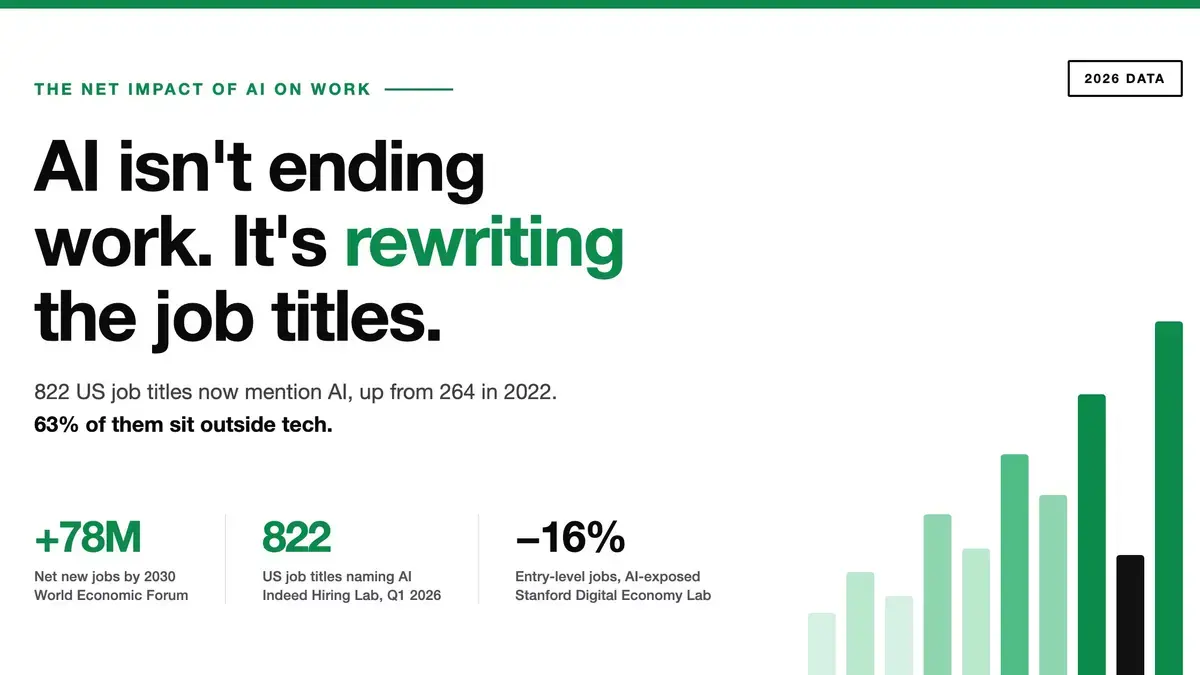
"Net" is the most misleading word in the AI jobs debate.
Every forecast eventually collapses into one number — jobs created minus jobs destroyed. That number currently looks fine. The World Economic Forum's Future of Jobs Report 2025 projects a net gain of 78 million roles by 2030 (World Economic Forum, January 2025). Meanwhile Indeed's hiring data shows AI-exposed occupations flipped from shrinking to growing sometime in mid-2025.
So the story's over? Not quite. A net number is an average, and averages hide the thing people actually experience. Beneath a healthy net figure sits a 22-year-old software graduate whose entry point has quietly closed. Both facts are true at once. This piece separates the three questions everyone keeps mashing into one.
Key Takeaways
The WEF projects 170 million jobs created and 92 million displaced by 2030, a net gain of 78 million (WEF, 2025).
US job titles mentioning AI tripled from 264 to 822 between Q1 2022 and Q1 2026, and 63% now sit outside tech (Indeed Hiring Lab, 2026).
Yet employment for AI-exposed 22-to-25-year-olds fell roughly 16% (Stanford Digital Economy Lab, 2026).
The net count is holding. The distribution is not.
Is AI Creating More Jobs Than It Destroys?
On the best available projections, yes. In January 2025, the World Economic Forum's Future of Jobs Report 2025 estimated 170 million new roles created and 92 million displaced by 2030 — a net gain of 78 million, drawn from surveys of over 1,000 employers representing 14 million workers across 55 economies.
The catch sits inside the same report. That churn equals 22% of all jobs, and employers expect 39% of core skills to change by 2030. Skills gaps are already the single biggest barrier to transformation, cited by 63% of employers.
WEF projection to 2030 | Figure |
|---|---|
Roles created | 170 million |
Roles displaced | 92 million |
Net change | +78 million |
Share of jobs structurally disrupted | 22% |
Core skills expected to change | 39% |
The exposure picture is wider than the displacement picture. The IMF estimates 40% of global employment is exposed to AI, rising to roughly 60% in advanced economies and falling to 26% in low-income countries (IMF, 2024). Exposure isn't a pink slip. Roughly half of exposed jobs in rich countries could see AI raise productivity rather than replace the worker.
Which New Jobs Is AI Actually Creating Right Now?
Forget 2030 for a moment — the creation is already measurable in job postings. In the first quarter of 2026, 822 distinct US job titles mentioned AI, up from 264 in Q1 2022, according to Indeed Hiring Lab economist Pawel Adrjan (Indeed Hiring Lab, July 2026). AI now appears in 8.3% of all US job titles, against 2.6% four years ago.
The composition matters more than the count. Nearly two-thirds — 63% — of those US titles sit outside technology occupations entirely. Truck drivers, physical therapists, real estate agents and HR managers are now hired with AI written into the title. Adrjan groups the growth into three clusters: AI enablement and consulting, AI training and content creation, and AI instruction — coaches, tutors, trainers.
Market | AI-mentioning job titles, Q1 2026 | Share of all titles |
|---|---|---|
United States | 822 | 8.3% |
Germany | 288 | 4.2% |
United Kingdom | 160 | 2.7% |
France | 138 | 3.3% |
Netherlands | 84 | 2.2% |
Spain | 81 | 2.3% |
PwC's 2026 Global AI Jobs Barometer, built on more than a billion job advertisements across 27 territories, puts the growth gap starkly: jobs requiring AI skills grew 69% against 9% for the market overall, and the wage premium for AI skills reached 62%, up from 57% a year earlier (PwC, July 2026). Just over half of AI-skill postings — 51% — now sit outside IT and computer science.
LinkedIn's Jobs on the Rise 2026 list makes the same point with titles instead of percentages. AI Engineer ranked first, AI Consultant second, Data Annotator fourth, AI/ML Researcher fifth (LinkedIn, January 2026). Data Annotator is worth pausing on. It's a job whose entire existence depends on machines needing human judgment to learn from.
Why Is the Biggest AI Hiring Boom Happening in Hard Hats?
Because compute is a construction project. Data center job postings in the US more than doubled over two years, reaching 6 per 1,000 postings by mid-2026, up from 2 per 1,000 in May 2023 — during a period when total US postings fell about 12% (Indeed Hiring Lab, July 2026).
Look at who's being hired. Installation and maintenance workers account for roughly a quarter of all data center postings. Together with IT infrastructure and operations, they make up about half. Hourly installation roles at data centers pay 42% more than comparable non-data-center work — about ten dollars more per hour.
The geography has shifted too. In Columbus, Ohio; Jackson, Mississippi; and Reno, Nevada, big tech hiring jumped from under 2% of local postings to more than 10% between mid-2025 and mid-2026.
Our read: two of LinkedIn's 25 fastest-growing 2026 titles are Commissioning Manager (11th) and Datacenter Technician (17th). Neither shows up in most "AI will take your job" essays, because neither sounds like AI. The clearest job creation from this technology so far isn't in a notebook — it's in switchgear, cooling loops and electrical panels. That's also why this wave of creation doesn't neatly absorb the people it displaces: a displaced claims processor in Ohio and a commissioning manager in Ohio are not usually the same person.
What Is AI's Net Impact on Employment So Far?
Small in aggregate, severe at the entry point. The Budget Lab at Yale finds the occupational mix of the US labor market has shifted only about 1% since 2022, far less than the early years of the computer or internet eras, concluding the picture "largely reflects stability, not major disruption at an economy-wide level" (The Budget Lab at Yale, 2026).
Now look at one age band. Stanford's Digital Economy Lab, using ADP payroll records covering 4.6 million workers across more than 730 occupations, found employment for 22-to-25-year-olds in AI-exposed occupations down roughly 16% by October 2025, while older workers in the same occupations held steady or grew (Stanford Digital Economy Lab, February 2026).
By April 2026, the annual rates looked like this:
Cohort | Annual employment change |
|---|---|
Ages 22-25, highly AI-exposed roles | −3.8% |
Ages 22-25, least AI-exposed roles | +2.0% |
Ages 31-34, AI-exposed roles | −1.7% |
Ages 35-40, AI-exposed roles | +2.0% |
Source: Stanford Digital Economy Lab / ADP Research, reported by Fortune, June 2026
Our read: Yale and Stanford are both right, and the apparent contradiction is arithmetic, not disagreement. A 1% change in national occupational mix and a 16% collapse in one cohort's entry roles are perfectly compatible, because the first number averages over the second. Anyone citing the aggregate to dismiss the youth effect — or the youth effect to claim mass unemployment — is reading one number and ignoring its variance.
Two findings sharpen this. Stanford tested and rejected interest rates as the explanation: AI-exposed jobs turn out to be less interest-rate sensitive than average, so a rate-driven story predicts the opposite pattern. And the split runs along automation versus augmentation — entry-level employment fell where AI automates tasks, while occupations where AI augments the worker grew employment across every age group. ADP's chief economist Nela Richardson framed it precisely: in aggregate, the impact "remains modest," but "dramatic differences emerge" by career stage.
PwC found the mechanism in the postings themselves. AI-exposed entry-level roles are now seven times more likely to demand traditionally senior skills such as judgment and leadership. The bottom rung didn't vanish. It moved up out of reach.
Why Is the "AI Layoffs" Number the Weakest Stat in This Debate?
Because companies choose whether to say it. Challenger, Gray & Christmas recorded 112,713 US job cuts attributed to AI in the first seven months of 2026 — 24% of all announced cuts, and already double the 54,836 attributed to AI in all of 2025 (Challenger, Gray & Christmas, August 2026).
That figure gets quoted constantly. Read what Challenger's own Chief Revenue Officer, Andy Challenger, says about it: "Naming AI in a layoff announcement can win over investors while pushing current and prospective employees away." He adds that as regulation develops, firms will grow more careful with announcements, "which would make tracking the impact of AI on jobs more opaque."
Our read: this is a self-reported, incentive-loaded metric — closer to investor-relations language than a measurement of causation. Some cuts labelled AI are ordinary cost-cutting in a flattering wrapper. Others are genuinely AI-driven but announced as "restructuring." The error runs both ways, and nobody knows the net.
Scale check: over the same seven months, announced hiring plans totalled 107,500 — roughly the same magnitude as the AI-attributed cuts, and up 25% year over year. Challenger's summary: "while AI is shifting the labor market, it is not dismantling it," with new demand appearing in aerospace, energy and manufacturing.
Does History Say New Work Will Appear?
History says yes, but slowly and to different people. Roughly 60% of US employment in 2018 sat in job titles that did not exist in 1940, rising to 74% among professional occupations, according to David Autor and colleagues (NBER, 2022). Most of the work we do now was invented after our grandparents entered the labor force.
The often-cited ATM story holds up, with an important ending. Automation cut tellers per branch from about 21 to 13, but cheaper branches meant more branches — urban locations rose 43% — so total teller employment grew through the 1990s while the job shifted from counting cash to advising customers. Then mobile banking arrived after 2010 and did what ATMs never did.
So the comforting version of the analogy is incomplete. New work appears reliably; it just doesn't arrive on the displaced worker's schedule, and the second wave of automation can finish what the first one started.
The IMF's January 2026 staff note Bridging Skill Gaps for the Future quantifies the transition cost. About one in ten vacancies in advanced economies now demands at least one genuinely new skill, IT competencies account for over half of that demand, and those postings carry 3 to 3.4% higher wage offers. But the authors warn the pattern "deepens polarization," benefiting high-skilled and low-skilled service workers while potentially shrinking the middle (IMF, 2026).
What Should Workers and Employers Do in 2026?
Pick augmentation deliberately, because the data now attaches an employment consequence to that choice. Stanford's finding is the most actionable result in this whole literature: occupations where AI augments workers grew employment across all age groups, while automation-heavy applications hollowed out the entry level.
For employers, three moves follow:
Audit which of your AI deployments replace tasks versus extend people. The employment outcome tracks this split, not total AI spend.
Rebuild the bottom rung explicitly. If entry roles now demand judgment that juniors can't yet have, the training that used to happen on the job has to be designed rather than assumed.
Hire for the adjacent boom. Energy, commissioning, installation and data center operations are where AI capital expenditure is converting into headcount today.
For workers, the premium is measurable and it is not purely technical. PwC found headcount growing faster at the most AI-exposed companies (52%) than the least exposed (36%), with the fastest-growing skill demands including human judgment. AI skills carry a 62% wage premium — and 51% of those postings are outside IT, meaning the opportunity is in applying AI to a domain you already know.
[INTERNAL-LINK: skills that hold value as AI spreads → guide to durable career skills for students and early-career professionals]
Where This Argument Could Be Wrong
The honest weakness here is attribution. Every dataset above is observational, and 2022-2026 also contained a rate-hiking cycle, a post-pandemic tech correction and a hiring slowdown that has nothing to do with AI. Stanford ruled out interest rates for the youth effect specifically, but nobody has cleanly isolated AI from the rest.
Aggregate productivity offers a second caution. US labor productivity has run about 2.4% annualized since early 2024, above the pre-pandemic trend, but Federal Reserve research finds the gain concentrated in a small number of industries rather than economy-wide (Federal Reserve Bank of Kansas City, 2026). If AI were already transforming work broadly, that pickup should be broader than it is.
Frequently Asked Questions
Will AI cause mass unemployment?
No current dataset supports that. The Budget Lab at Yale finds US occupational mix has shifted about 1% since 2022, less than the early computer and internet eras. The WEF's 2025 projection is a net gain of 78 million jobs by 2030. The measured risk is distributional, not aggregate.
Which jobs is AI creating fastest in 2026?
AI Engineer, AI Consultant, Data Annotator and AI/ML Researcher led LinkedIn's Jobs on the Rise 2026 list. Less obviously, Datacenter Technician and Commissioning Manager also made the top 25, and installation and maintenance roles make up roughly a quarter of data center postings (Indeed Hiring Lab, 2026).
Are entry-level jobs really disappearing?
In AI-exposed occupations, they're contracting sharply. Stanford's ADP-based data shows employment for 22-to-25-year-olds in those roles down about 16% by October 2025, and falling 3.8% annually as of April 2026, while the least-exposed roles in the same age band grew 2%.
Do AI skills actually pay more?
Yes, and by a widening margin. PwC's 2026 barometer, covering over a billion job ads in 27 territories, measured a 62% wage premium for AI skills, up from 57% a year earlier. The premium ranges from 118% in consumer markets to 16% in government work.
Source | Title | URL |
|---|---|---|
World Economic Forum | Future of Jobs Report 2025 | |
Indeed Hiring Lab (Adrjan) | AI Is No Longer Just a Tech Occupation Story | |
Indeed Hiring Lab (Gallacher) | AI and Job Postings: From Destruction to Creation? | |
Indeed Hiring Lab (Woessner, Ullrich) | Hiring for the Data Center Build-Out | |
Stanford Digital Economy Lab | Canaries in the Coal Mine? / Canaries, Interest Rates, and Timing | |
The Budget Lab at Yale | What We Do and Don't Know About How AI Is Affecting the Labor Market | |
PwC | 2026 Global AI Jobs Barometer | |
Challenger, Gray & Christmas | July 2026 Job Cut Report | |
Jobs on the Rise 2026 (US) | ||
Autor, Chin, Salomons, Seegmiller | New Frontiers: The Origins and Content of New Work, 1940–2018 (NBER w30389) | |
IMF | Bridging Skill Gaps for the Future: New Jobs Creation in the AI Age (SDN 2026/001) | |
IMF | Gen-AI: Artificial Intelligence and the Future of Work (SDN 2024/001) | |
Federal Reserve Bank of Kansas City | A New U.S. Productivity Chapter? What Industry Data Say About AI | |
Fortune (Lichtenberg) | The Stanford economist who called the AI entry-level jobs crisis early |