
 Download App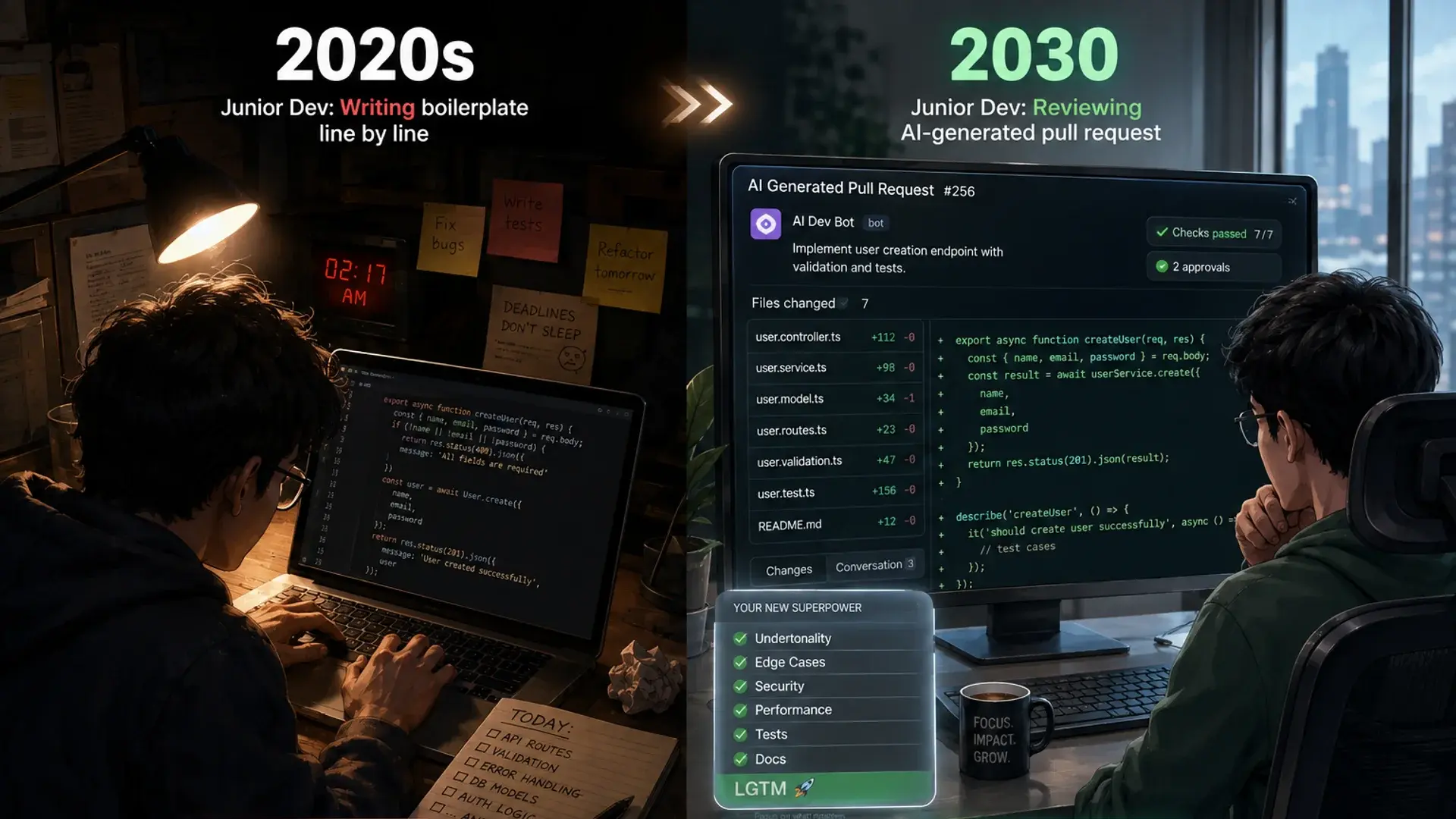
Junior developer roles in 2030 will still be posted, and companies will still fill them. The honest forecast is a narrower hiring funnel and a job rebuilt around reviewing and directing AI-written code, with earlier ownership of small features and more time spent in incident debugging. Predictions that entry-level work vanishes entirely have a poor track record.
Why the "junior developers are finished" predictions keep missing
Every wave of higher-level tooling arrived with a prediction that programming jobs were about to collapse: COBOL and the 4GLs, visual IDEs, offshore outsourcing, low-code platforms. Employment kept growing through all of them. The U.S. Bureau of Labor Statistics still projects software developer employment growing much faster than the average for all occupations through 2033.
The work does change, though. The economic logic that justified large junior classes, hire cheap people to do the well-defined tasks so senior engineers do not have to, is weakening, because a lot of that well-defined work is what coding assistants like GitHub Copilot now draft in one pass. More than three-quarters of respondents to Stack Overflow's 2024 Developer Survey were using or planning to use AI coding tools, up from around 70% a year earlier, so the shift is already well underway.
What follows is compression. Roles get harder to land, the day-one work changes, and some companies trim early-career headcount, but the category stays and the juniors who are hired get pointed at different tasks.
What will junior developer roles actually look like in 2030?
Picture a first-year engineer in 2030 as someone who owns small, well-scoped changes end to end and spends more of the week reading code than writing it. A representative day: pick up a ticket, write a short spec of what "done" means, let an agent (an AI tool that can make multi-step code changes on its own) draft the change, then read every line of the diff looking for the plausible-looking mistake. Push it, watch it deploy, then help chase a latency regression that turns out to originate three teams away.
The first-draft workload shrinks. A 2030 junior still writes code by hand, especially in unfamiliar parts of the system where generated output is unreliable, but a smaller share of the week goes to greenfield boilerplate like CRUD (create, read, update, delete) endpoints.
Reading volume goes up to match. Most of the code a junior touches in a day was written by a model and looks superficially fine, and the job is deciding whether it actually is.
Ownership arrives earlier. Because the mechanical part of a feature is cheap, juniors get handed a whole small feature sooner than they would have in 2020, and they are expected to understand how it works, defend the design in review, and operate it after launch. That is a harder job in some respects, and it front-loads skills that used to build over the first two years.
Titles and pay bands hold roughly steady. "Junior Software Engineer" or "SWE I" still exists as a rung, and the compensation range tracks inflation and local market more than any AI premium or discount. The change is in the job content, not the box on the org chart.
A hype-claim scorecard for 2030 junior roles
This is my read on the loudest claims about entry-level software work in 2030. The confidence column is my own judgment, not a measured probability, and the reasoning is what drives each call.
Across the table, one pattern holds: claims that assume a clean, instant substitution overshoot, while claims about a gradual reshaping of the work hold up.
How does the hiring process change for junior roles?
The interview loop picks up new rounds and drops one.
The take-home project loses value. If a candidate can generate a polished CRUD app from a prompt in an evening, the exercise stops telling anyone apart. Expect more live work instead.
A code-review round becomes common. You are handed a pull request with a few planted bugs and asked to review it out loud. This tests the exact skill the job now leans on.
A spec or clarification round. You get a deliberately vague ticket and have to ask the right questions, then write down what "done" means before any code gets written.
An AI-use round, where you solve a problem with an assistant while the interviewer watches how you check its output. Using the tool is expected; catching where it is wrong is the point.
The algorithm screen stays. Most mid-size and large companies still run a data-structures phone screen, and it still rewards the same preparation. Working through structured DSA and system design practice maps directly onto how these screens are built.
The new rounds share a purpose: they probe judgment layered on top of generated output, which is difficult to bluff in a 45-minute call.
The skills that actually carry a 2030 junior
Three abilities do most of the work of separating a junior who thrives in 2030 from one who stalls.
The first is spotting the confident wrong answer. Generated code fails in specific, quiet ways: an off-by-one at a boundary, a missing error branch, an auth check that looks present but tests the wrong field, an N+1 query hidden behind an ORM call, a race that only appears under load. You learn where to look by getting burned a few times and remembering the shape of each miss.
The second is debugging across systems. When something breaks in production, the cause is rarely in one file. It sits in the interaction between a queue, a cache, a deploy, and a config change from another team. Models are weak here because the state that matters is live, distributed, and not in any prompt. In August 2024, OpenAI released SWE-bench Verified, a 500-task human-checked benchmark of real GitHub issues; agent scores on it have climbed steadily, but the tasks are self-contained fixes in a single repository, which is the easy end of what production debugging demands.
The third is turning a vague request into a precise spec. If you can take a three-line ticket and write down the inputs, outputs, edge cases, and explicit non-goals, both you and any model you hand it to produce better work. This used to be a mid-level skill and now shows up in junior interviews.
What could make this forecast wrong
This forecast assumes companies keep hiring juniors on purpose. If enough of them use AI to cover junior work and respond by hiring far fewer juniors, the damage surfaces years later: mid-level engineers are made by doing junior work under supervision, and that pipeline thins five to ten years after the cuts. A team optimizing one quarter's output can quietly break its own future staffing, and it cannot buy its way out later because the mid-levels it needs were never trained.
For someone entering the field, that is a screening signal. Ask in interviews how the team brings early-career engineers up to speed, whether they still hire new grads every year, and who reviews a junior's work. A vague or irritated answer tells you the team treats juniors as a cost to minimize, and the learning environment will reflect it.
FAQ
Is 2030 a bad time to start a software career? Entry is harder than in 2021 but not closed. The funnel is narrower and the bar on fundamentals is higher, while the U.S. Bureau of Labor Statistics still projects much-faster-than-average growth for software roles through 2033.
Will prompt engineering be the main junior developer skill in 2030? No. Prompting is a minor, fast-changing part of the work. Reviewing generated code, debugging live systems, and writing precise specs are what a 2030 junior is measured on.
How is a 2030 junior developer role different from a 2025 one? Less time writing first drafts, more time reviewing AI-generated changes, earlier ownership of small features, and more involvement in incident debugging. The title and pay band stay roughly where they are now.
Do companies still hire bootcamp graduates in 2030? Some do, but the screen is stricter on fundamentals and on catching wrong AI output. A portfolio that shows debugging and code review carries more weight than completed coursework.
Where to put your time
Pick one active open-source repository and spend the next month on review work. Read every merged pull request, write the review comment you would have left, and keep a log of the bugs you missed on the first pass. That log, paired with the diffs, is close to what a 2030 junior interview is probing for. While you do it, watch whether the companies you want to work for still publish new-grad hiring numbers; the ones that quietly stopped are telling you where they put juniors on the priority list.
Sources
U.S. Bureau of Labor Statistics, Occupational Outlook Handbook: Software Developers, Quality Assurance Analysts, and Testers. Employment projection through 2033.
Stack Overflow, 2024 Developer Survey. Developer adoption of AI coding tools.
SWE-bench Verified, a human-validated 500-task subset of the SWE-bench benchmark, released August 2024.
GitHub, GitHub Copilot. AI coding assistant referenced as a current baseline tool.