
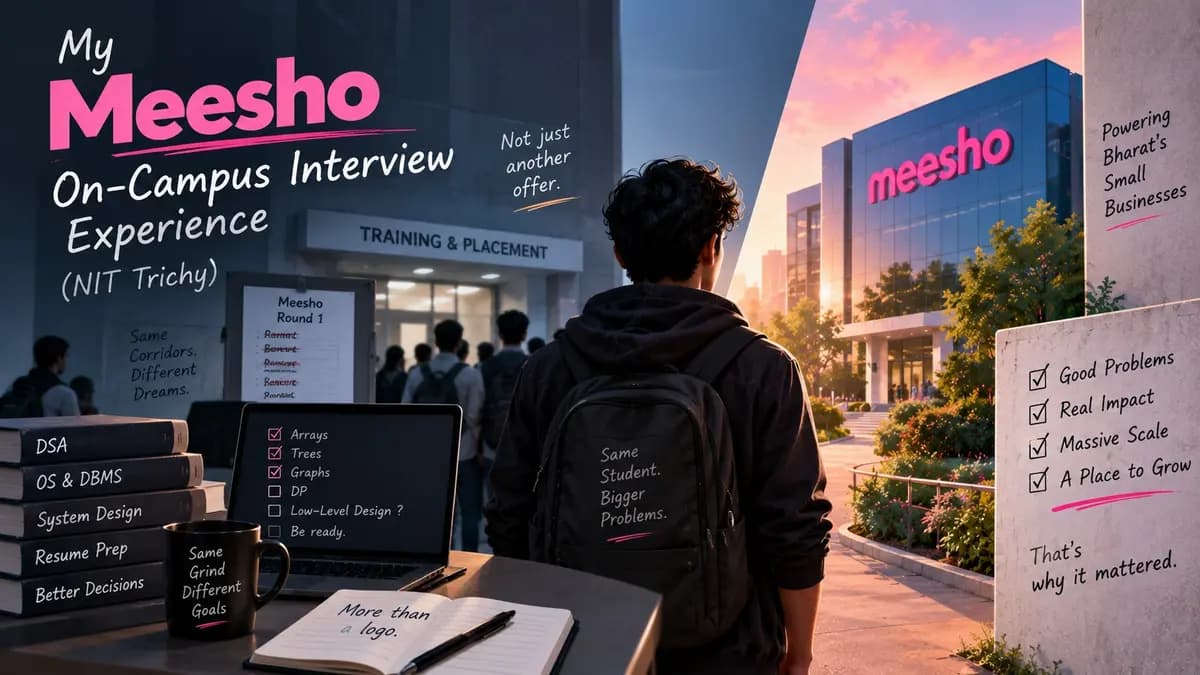
The panel outside T&P had four names scratched off between the OA results and Round 1, updated in something close to real time on a shared spreadsheet that maybe forty of us were secretly refreshing on our phones during a completely unrelated elective lecture that morning. On-campus placements don't give you weeks to sit with dread the way I've read off-campus processes apparently do, they compress the whole thing into one absurdly long day, and somehow that's worse, not better. You don't get to go home and pretend to be normal between rounds. You just sit in a corridor outside the OAT, watching the spreadsheet, watching people walk out of rooms with faces that give away everything before they've said a word.
Why I even bothered with a Day-2 company
Meesho landed a Day-2 slot for our batch, which at NIT Trichy means something specific: it's not the absolute top tier of Day-1 companies, but it's close enough that half the room has already banked a smaller offer from Day 3 or 4 the previous week and is deciding whether to risk it. I was one of those people. I had a decent enough safety net sitting in my inbox already, the kind of offer you're grateful for and also quietly hoping you won't have to accept.
The pre-placement talk happened in the OAT the evening before, and I remember being surprised by how much of it was about scale, not perks. Someone from their engineering team talked about the sheer number of small sellers on the platform and the mess of a problem that is showing the right product to the right person across hundreds of languages and price sensitivities most tech talks don't bother mentioning. It was the first PPT that whole season where I actually wanted to work on the problem, not just wanted the logo on my resume, and I think that mattered more later than I expected it to.
The three weeks before the drive that weren't nearly enough
I had roughly three weeks between the PPT and the actual drive date, and if I'm being honest, "three weeks of focused prep" makes it sound a lot more disciplined than it was. Two of those weeks overlapped with another company's drive and a project submission I'd been putting off since October. Most evenings went to DSA after mess dinner, arrays and trees first since I still second-guessed myself under time pressure on those, then graphs and DP in whatever was left of the final week.
What I actually skipped, and paid for later, was low-level design. I'd read a handful of the standard problems, a parking lot, an elevator system, and told myself I understood the pattern well enough. What I hadn't done was practice designing something where the whole point is that you don't know what gets bolted onto it six months from now, which is a completely different skill from getting a static diagram right on the first attempt. I knew this gap existed in some vague way. I did not do anything about it. That decision came back to visit me almost exactly where I expected, later that same day.
The OA and the MCQ section nobody revises properly
The assessment had two coding problems and an MCQ block on OS and DBMS fundamentals, the kind of section everyone assumes is easy right up until they're staring at a question about page replacement algorithms they last thought about during a random Tuesday lecture in second year. The first coding problem was a sliding window question, maximum sum subarray of a fixed size, and I had it done in about twelve minutes without much drama. The second was a graph problem, counting connected components, which I recognized instantly and then spent an unnecessary two minutes doubting, because Meesho's reputation for a high bar had me half-convinced a plain DFS couldn't possibly be the whole answer. It was. I was overthinking a straightforward question purely because of a reputation I hadn't actually verified for myself.
Results came out nine days later, which for an on-campus process felt like an eternity, mostly because two people in my friend group had already heard back with rejections by day six and every evening after that turned into a slightly grim ritual of checking the portal together in the hostel common room, pretending we weren't checking it, and then all checking it anyway within about ninety seconds of each other.
Round one: DSA that went fine, until the resume questions got specific
The morning of the actual drive, we were herded into a waiting block near the placement office, laptops out, phones half-charged from a night nobody had actually slept properly through. My round one interviewer joined a couple of minutes late, which did absolutely nothing for my nerves, and opened with a coding problem on merging overlapping intervals. I talked through it cleanly, brute force first, then the sorted-and-merge optimization, and he seemed satisfied enough that we moved into my resume fairly quickly.
I'd deliberately picked a personal project involving a small inventory tracker to lead with, mostly because it felt more relevant to an e-commerce company than my other, flashier-sounding project. He asked a specific question I hadn't fully prepared for: how did I handle a product that belonged to more than one category at once. I fumbled the first version of my answer, something vague about "just adding a list field," before he pushed once, gently, "and if a category gets deleted later, what happens to that reference?" I hadn't thought that far ahead when I actually built the thing, and I said so honestly, then reasoned through a fix out loud instead of pretending my original design had already accounted for it. He nodded and moved on. I walked out of that round feeling like Meesho's reputation for difficulty was maybe overstated. That feeling did not survive the next forty minutes.
Round two: the discount-system design I nearly wrecked
The second round opened with a short coding warm-up and then moved into a design question that I can still recite almost word for word: design a simplified product catalog system that supports adding discounts to specific categories, with the explicit note that new discount types would likely need to be added later without touching existing code.
I started reasonably, a Product class, a Category class, a clean enough foundation. Then I got to discounts and did exactly the thing I'd half-known I might do, hardcoded a single calculation method with a growing pile of if-else branches for each discount type. The interviewer let me finish, then asked, not unkindly, "what happens when marketing wants a new discount rule next quarter, does anything here change?" And I just sat there for a few seconds, because the honest answer was yes, a lot would change, and badly.
I said, out loud, "give me a second, this doesn't scale the way I want it to," and started over on that one piece, sketching a common discount interface with separate implementations per type instead of one bloated method. He let me redraw the relevant section of the diagram and we spent the rest of the round tracing how that change would ripple outward. I don't think I fully recovered the confidence I'd walked in with, but I recovered the design, which apparently mattered more.
The HM round, and the question about the hackathon database
By the time I got to the hiring manager round, I'd stopped trying to predict what kind of question was coming and just sat down expecting to be tired, which I was. He asked about a decision I'd made without complete information, and I told him about a hackathon six months earlier where our team had about six hours left and had to pick a database mid-build. I'd pushed hard for the simpler option over the technically better one purely because we didn't have time left to debug anything complicated, and it worked, we shipped.
He asked if I'd make the same call again. I said yes, for that exact situation, but that I'd be a lot more careful applying the same instinct somewhere with real consequences instead of a six-hour deadline with nothing actually at stake. He didn't say much in response, just made a note, and I genuinely couldn't tell in the moment whether that was the right answer or just an honest one. Turned out those were the same thing that day.
The list outside T&P, one last time
The wait after the HM round was maybe ninety minutes, which on any other day would sound trivial and on that specific day felt endless, sitting in the corridor with the same forty people from that morning, all of us pretending to look at our phones for reasons that had nothing to do with the shared spreadsheet. My name showed up on the shortlist a little after 6 p.m., and I found out from a friend shouting it across the corridor before I'd even refreshed the page myself. I called my parents from the hostel stairwell because the network inside my room never worked properly, standing there for a good ten minutes just repeating the word "Meesho" until it stopped feeling unreal and started feeling like something that had actually happened to me. I turned down the offer I'd been sitting on within the hour, which felt anticlimactic in the moment given how much dread had led up to it, mostly because I was still replaying the discount-system stumble on a loop and hadn't fully processed that it hadn't actually cost me anything.
What I'd tell my past self
If I could go back to the version of me three weeks out from that drive, I'd tell him to stop assuming a company's reputation predicts which round will actually be hard. My easiest-feeling round was the plain DSA one, and my hardest was the design round I'd quietly decided I could wing based on a handful of textbook examples. That decision to skip real low-level design practice wasn't laziness exactly, it was more that I convinced myself reading about it counted as preparing for it, which is its own kind of self-deception I only recognized once I was sitting in that room with a discount system falling apart in front of me.
I'd also tell him that the hiring manager round isn't the formality everyone treats it as. I'd rehearsed a version of the hackathon story that made me sound decisive and clean, and the honest, slightly messier answer, the one where I admitted I'd be more cautious next time, landed better than the polished version ever would have. Follow-up questions have a way of finding the gap between a story you've actually thought through and one you've just memorized, and mine barely survived that gap in the design round before it found its footing.
And the waiting, even compressed into one day the way on-campus placements do it, still deserves less of your headspace than it demands. I spent that ninety-minute gap after the HM round doing genuinely nothing productive, just watching a spreadsheet and reading old interview experiences 2026 threads on my phone instead of even attempting to relax, telling myself it was somehow useful research. It wasn't. If you're a few weeks out from your own drive right now, still telling yourself the same thing, the mock interviews and resume feedback on devsunite.com/resources did more for my actual confidence in that design round than any amount of thread-reading ever did.