
 Download App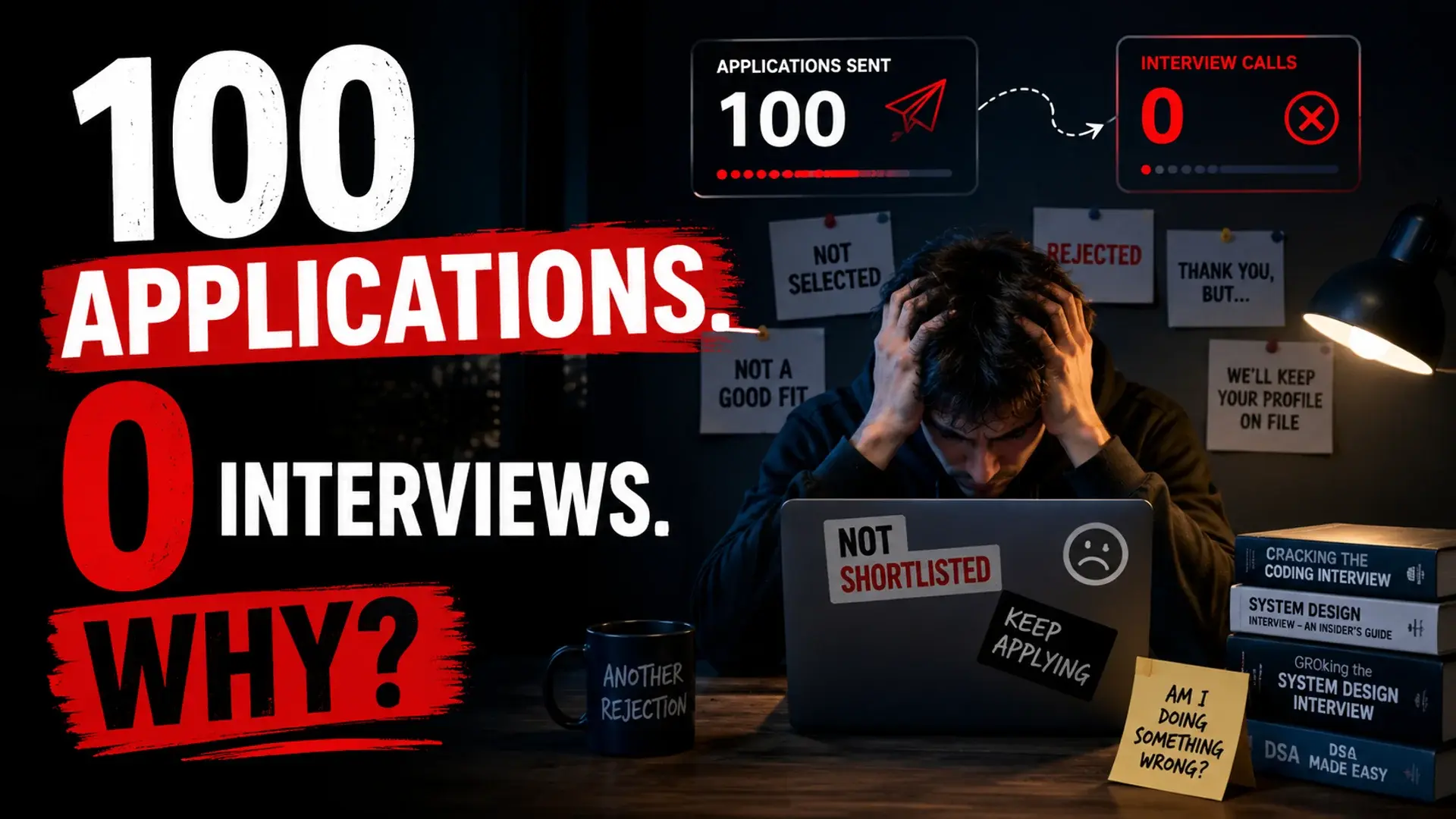
If you have no interviews after applying to 100 tech jobs, pause application 101 and audit the batch. For students, freshers, and early-career developers in India, eight signals separate poor targeting from weak resume evidence, parsing failures, broken portfolio proof, and screening-call problems. The count alone cannot tell you which one failed.
Here, 100 describes the batch you already sent; it is not a recommended quota or a market benchmark. This diagnostic covers entry-level software engineering, QA, DevOps, and data roles in India. It does not estimate a universal interview rate because role, location, eligibility, seniority, and application channel change the denominator.
Why do you get no interviews after applying to tech jobs?
Job-search silence can begin at several different points. You may be applying to roles you cannot take, presenting one resume to unrelated jobs, losing information during resume parsing, or reaching recruiter screens that end before a technical interview is scheduled.
Calling all of those an “ATS rejection” produces random edits. An applicant tracking system (ATS) is employer software for collecting and managing applications. Its configuration varies by employer, so no generic score can reveal exactly what happened inside every company.
The useful question is narrower: which observable signal in your last batch points to the earliest failure?
The eight-signal application audit
Use this table before rewriting anything. Each row connects an observation to a next test; it does not pretend that silence proves the cause.
The framework is intentionally sequential. A perfect project README cannot cure a work-authorization mismatch, and changing fonts will not fix applications aimed at three different careers.
Signal 1: Is 100 your real denominator?
Open the confirmations, not the spreadsheet total. Remove duplicates, abandoned forms, roles that closed before you finished, obvious stretch applications, and jobs whose mandatory location or eligibility conditions you did not meet.
Then label every remaining row with role family, level, location, source, resume version, and outcome. “Applied” should mean the employer or platform confirmed submission. A saved LinkedIn job or an email draft belongs elsewhere.
This clean denominator may be much smaller than 100. That is useful. You now have a batch whose silence can teach you something.
Signal 2: Your applications do not tell one role story
Backend developer, frontend developer, data analyst, data scientist, QA engineer, and DevOps engineer are separate targets. They share technical words, but employers evaluate different evidence for each.
Sort the clean batch by role family and resume version. If one resume went to all six, the document probably makes the reviewer assemble your fit on your behalf. Choose one primary family and one defensible adjacent family, then give each a distinct resume.
For example, a backend resume can lead with API design, database work, tests, and production debugging. A data-analyst version of the same history should surface SQL analysis, metric definitions, dashboards, and decisions supported. The facts remain unchanged; the selection and order change.
Signal 3: Hard filters are failing before your experience is considered
A hard filter has a yes-or-no answer. Common examples include required work authorization, a fixed office location, a graduation window, shift availability, a mandatory degree, minimum experience, and an immediate joining requirement.
Audit the original posting beside the answers you submitted. In India, pay particular attention to city, relocation, graduation year, and notice period. For each application, mark a hard requirement only when the posting presents it as mandatory. Do not turn every preferred skill into a rejection rule.
If this column explains much of the batch, better adjectives on your resume will not help. Narrow the shortlist to roles you can actually accept and answer every screening field consistently with your resume and profile.
Signal 4: The resume text may not survive parsing
Run a crude extraction check locally:
pdftotext resume.pdf -Read the output from top to bottom. Your name, phone, email, headings, employers, dates, skills, and project details should appear once and in a sensible order. This command cannot simulate an employer's ATS, but it catches image-only PDFs, broken character encoding, and obvious column-order failures.
There is a concrete vendor example behind this check. Greenhouse Recruiting's support page, updated March 2, 2026, says its parser cannot process resumes larger than 2.5 MB and lists columns, graphics, tables, headers, footers, and text boxes among potential causes of unsuccessful or partial parsing. When parsing fails, Greenhouse says the resume may be attached while candidate fields require manual entry. Those are Greenhouse-specific limits and failure modes, not universal ATS rules.
Make one plain version: text-based PDF or DOCX, single column, standard headings, ordinary fonts, and contact details in the body. Keep the designed portfolio version for direct sharing if you like it.
Signal 5: The job requirements exist on your resume only as nouns
Keyword presence is a weak check. Evidence coverage asks whether a requirement appears in a sentence that proves you used it.
Build a map for five high-fit postings:
Use the employer's wording where it is accurate, then attach it to a project, internship, freelance task, or contribution. Never add a tool merely because the posting names it. If you need a fast first pass, compare your resume against the exact job description to surface missing terms and get a prioritized edit checklist, then verify every suggested change against work you can defend.
This is also where a human scan matters. Put the strongest relevant evidence in the first half of the page. A recruiter should not need to reach the final project bullet to discover that you have already done the job's central task.
Signal 6: Your proof links create doubt instead of confidence
Open every URL from a logged-out browser on your phone. A private repository, expired deployment, empty portfolio page, or README with no setup instructions weakens the very claim the link was meant to support.
GitHub's own job-search tutorial recommends pinning three to five relevant projects and making each repository easy to understand with features, setup steps, a demo, and test instructions. That guidance describes how GitHub presents work; it does not claim that pinned projects guarantee interviews. Use it as a practical GitHub portfolio cleanup checklist.
Pick one project that matches the target role and repair the trail:
Write a two-sentence problem and outcome at the top of the README.
Add exact local setup commands and a sample environment file with secrets removed.
Include one architecture diagram or short design note if the system has several parts.
Add tests for the behavior you discuss on the resume.
Check that the deployed demo and resume URL both work without your account.
The project can be small. Reviewers need enough context to distinguish a tutorial clone from work where you made and explained technical decisions.
Signal 7: All 100 applications came through one route
A batch dominated by one platform cannot tell you whether the resume fails everywhere or that route is producing weak matches. Split the audit by company career site, LinkedIn Easy Apply, another job board, referral, recruiter outreach, and direct response.
LinkedIn now documents both daily and speed limits for Easy Apply. Its help page says rapid submissions can trigger a temporary pause, which is a platform behavior rather than evidence about your interview odds. LinkedIn's Job Tracker also records saved, in-progress, applied, interview, and archived stages, so use it or a spreadsheet to preserve channel and timing data.
For the next test, source a small batch of high-fit roles from at least two routes. Keep the role family and resume constant. You are testing whether the channel pattern changes, not launching a new job-search strategy in every row.
Signal 8: A recruiter call is a different failure stage
Some candidates say “no interviews” even though they have received recruiter or HR screens. Record those calls. They prove that the application generated human interest, which moves the audit downstream.
After each screen, write down the first point of friction: role description, current skills, location, salary expectations, notice period, shift, communication, or availability. Listen to how you explain your target. “I am open to anything in tech” makes the recruiter place you; a one-sentence role story makes placement easier.
Use this version:
I am targeting entry-level backend roles using Java and Spring Boot. My strongest evidence is an internship API project where I added authentication, PostgreSQL persistence, and integration tests.
If screens happen but technical rounds do not, stop treating the resume as the only suspect. Review the conversation and logistics with the same care you gave the document.
How do you test a fix without wasting another 100 applications?
Run a controlled application batch. Ten applications is a practical working set for this exercise, not a statistically validated threshold.
Choose one role family, level, location boundary, and eligibility profile.
Select current postings where you meet every stated hard requirement and can demonstrate the central work.
Use one clean, parseable resume version with requirement-to-evidence coverage.
Verify every link and application answer before submitting.
Record source, submission date, confirmation, response, screen, and interview.
Keep all other variables steady while changing only the signal you are testing.
Review the batch when outcomes arrive; do not declare a rule from one reply.
If the clean batch remains silent, move to the next earliest signal and run another controlled set. This process is slower per application and faster per diagnosis.
Frequently asked questions
Why am I not getting interviews even though I am qualified?
Qualifications can be present and still remain invisible. A role mismatch, hard eligibility answer, parsing problem, buried evidence, or broken proof link can block the application before a technical reviewer evaluates your ability. Audit a comparable batch before assigning one cause.
Is my resume why I am not getting interviews?
It might be. If the same tailored resume fails across high-fit roles and more than one channel, inspect parsing, requirement coverage, and proof quality. If silence clusters around roles with different levels or mandatory constraints, fix the target first.
How do I know if my CV passed the ATS?
You usually cannot see the employer's parse or screening configuration. You can still reduce obvious risk: extract the document's text, confirm reading order and contact fields, use standard headings, remove layout tricks, and follow the file requirements on the application form.
How many applications should it take to get an interview?
There is no defensible universal number across role families, cities, seniority levels, channels, and market conditions. A clean batch of comparable applications is more useful than a larger mixed total. Track the stages and test one change at a time.
Turn application 101 into a test
Tonight, export the last 100 rows and add the eight signal columns before editing your resume. Tomorrow, choose the earliest failure your own records support and submit one controlled batch. The next reply matters, but the cleaner data trail will keep every later application from becoming another guess.
Sources
Greenhouse Recruiting: Unsuccessful resume parse, updated March 2, 2026. Used only for Greenhouse's documented parser behavior, file-size limit, and listed formatting risks.
LinkedIn Help: Easy Apply limits, accessed September 3, 2026. Used only for LinkedIn's documented daily and speed limits.
LinkedIn Help: Track and organize job opportunities, accessed September 3, 2026. Used only for the Job Tracker stages and tracking features.
GitHub Docs: Using your GitHub profile to enhance your resume, accessed September 3, 2026. Used for GitHub's recommendations on pinned projects and repository documentation.
FAQ
Why am I not getting interviews even though I am qualified?
Your qualifications may be hidden by a role mismatch, hard eligibility filter, parsing problem, weak evidence, or broken application detail. Audit a comparable batch before deciding which explanation fits.
Is my resume why I am not getting interviews?
Possibly, but the pattern matters. If a tailored resume fails across high-fit roles and different channels, inspect its parsing and evidence. If only mismatched roles fail, fix the target first.
How do I know if my CV passed the ATS?
A candidate usually cannot see the employer's ATS result. You can still test whether text extracts in the correct order, contact details appear, headings are clear, and the file stays within stated limits.
How many applications should it take to get an interview?
There is no universal number across roles, locations, seniority levels, and application channels. Track comparable applications and use a small controlled batch to test one change at a time.