
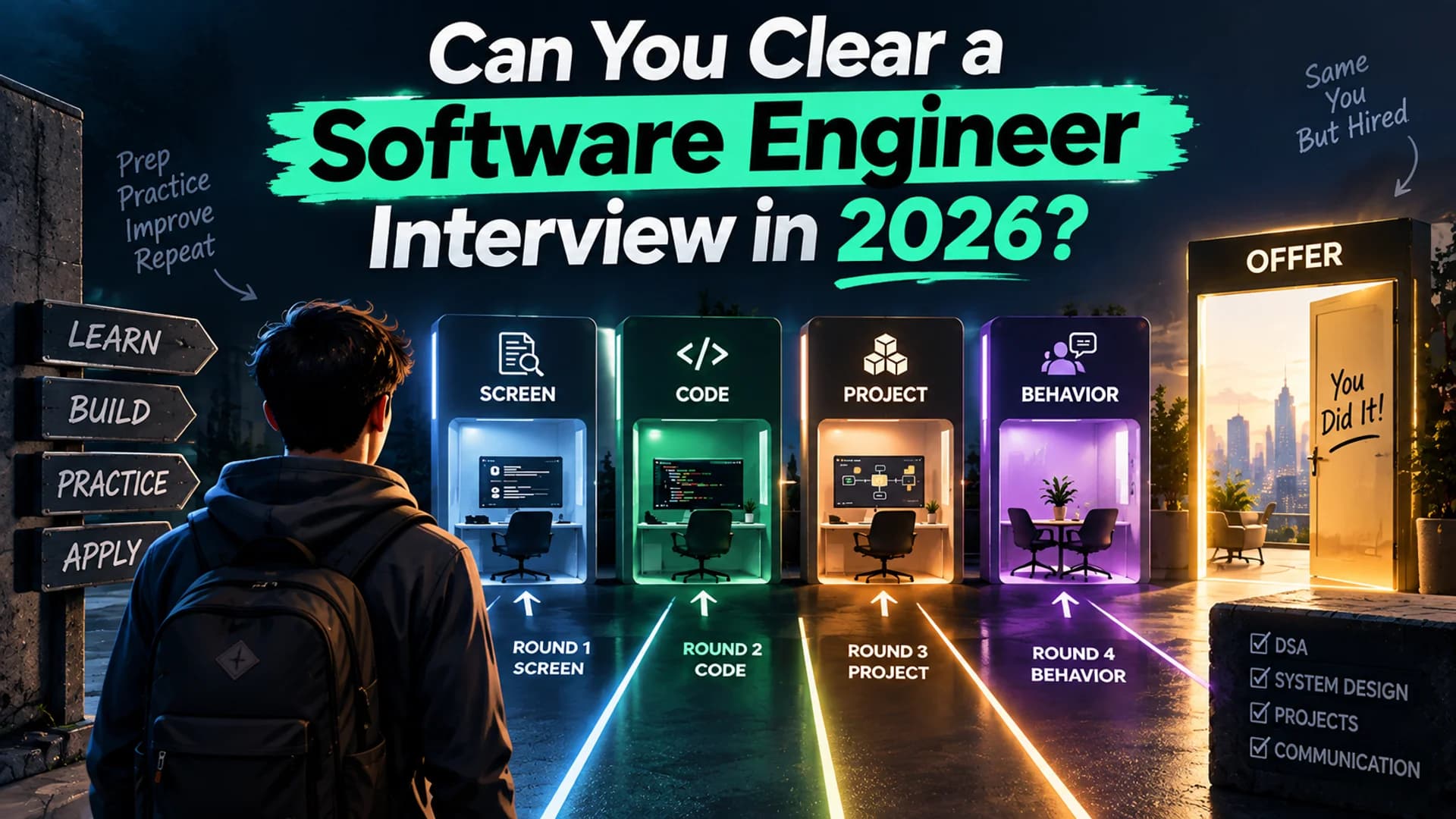
For a fresher, software engineer interview preparation works best as four separate practice tracks: screening, coding, project walkthrough, and behavioral answers. Start from the job description, learn the actual interview format, produce one testable output for each round, and rehearse under the same constraints you expect on interview day. This guide provides the complete plan and a reusable scorecard.
The plan is for final-year students and recent graduates targeting general frontend, backend, full-stack, or software-development roles, especially in India. Company loops vary by role and team, so the invitation and recruiter guidance outrank any generic roadmap. Treat the four-week schedule below as an adjustable template.
Software engineer interview preparation starts with the loop
Do not divide study time equally across every topic you have ever encountered. First write down what this employer may test, what evidence you already have, and what you still cannot demonstrate on demand.
Microsoft's candidate guidance says interview steps vary by role and may include coding, a portfolio review, or another work sample. It also advises candidates to identify relevant skills in the job description. Amazon likewise tells software-development candidates to ask their recruiting contact which subjects and skills they are likely to discuss. Those are company-specific instructions, but they support a useful default: confirm the loop before building the study plan.
Send the recruiter a short, answerable message:
Could you share the interview stages, approximate format of each stage, permitted coding languages or tools, and whether I should expect a project walkthrough or design discussion?
If no answer arrives, plan for the four tracks in this guide. Add aptitude, computer-science fundamentals, take-home work, or basic design only when the posting, invitation, or employer guide gives you a reason.
Use this round-by-round evidence map
This table is the working asset for the whole plan. Copy it into a document, replace the examples with the target role's requirements, and update the final column after every practice session.
Readiness is observable. A resource is useful only when it changes one of these outputs. Another playlist added to a bookmark folder does not.
Round 1: prepare for screening and the online assessment
A screening stage may be a recruiter conversation, an application review, an online assessment (OA), or some combination. Amazon's current university SDE guidance, for example, describes the OA as the first step for its full-time and internship SDE roles. That example does not define every employer's process.
For a recruiter screen, build a requirement-to-evidence map with three columns:
The examples are illustrative. Your version must point to work you actually did. Anything on the resume can become the next question.
For an OA, take one full practice session in the browser and environment you will use. HackerRank's candidate checklist, current when checked in September 2026, tells candidates to verify the interview link, use a supported browser, explore the platform, check language-specific time and memory limits, and run a compatibility check.
The version detail can matter. HackerRank's execution-environment table listed Python 3.14.2 for its Python 3 coding environment and G++ 14.2.0 for C++23 when checked in September 2026. Those versions will change, and another assessment may use something else. Check the platform linked in your invitation before relying on a particular language feature.
Run this preflight before a real assessment:
Confirm the time zone, duration, login method, permitted resources, and submission rules from the invitation.
Choose one language you can write without autocomplete rescuing basic syntax.
Test the browser, camera, microphone, power, network, and platform sample link when provided.
Complete a timed problem set in one sitting. Do not pause the clock to look up a solution.
Record why each lost point occurred: concept gap, implementation error, edge case, time allocation, or environment issue.
That error log determines the next practice session. “Do more DSA” is too broad to be a diagnosis.
Round 2: make coding practice sound like an interview
Silent problem solving builds only part of the skill. During a live coding round, the interviewer can evaluate how you clarify ambiguity, select a data structure, explain complexity, respond to a hint, and test the finished code.
Microsoft's technical-interview page describes a 45-minute round, advises candidates to clarify ambiguities and plan before implementation, and says interviewers may expect candidates to test boundaries and error conditions. Its process uses a third-party coding tool that can compile code. Amazon's software-development guidance, by contrast, recommends practising outside an integrated development environment. Prepare for both cases until your employer confirms the format.
Use the same six-step routine for every live problem:
Restate the input, output, constraints, and one small example.
Ask about ambiguity, including empty input, duplicates, ordering, and invalid values where relevant.
Explain a straightforward approach and its time and space cost.
Improve it only when the constraints require an improvement.
Write syntactically valid code while naming the purpose of each block.
Test a normal case, a boundary case, and a case likely to break your assumptions.
Practise topics in patterns, then mix them. Arrays, strings, hash maps and sets, linked lists, stacks, queues, trees, graphs, sorting, searching, recursion, and Big O analysis form a sensible general base. Microsoft publishes a similar representative list, but explicitly calls its list non-exhaustive. The target employer's guidance remains the narrower source of truth.
Use a simple scoring sheet after each timed solve. Give yourself 0, 1, or 2 points for clarification, approach, correctness, complexity, tests, and explanation. A total score matters less than the repeated weak dimension. Three solutions with zero boundary tests reveal a clearer task than a raw count of completed questions.
Round 3: turn each project into a technical walkthrough
Your strongest project should survive ten minutes of follow-up questions without the README open. Draw its path from user action to response: interface, API or application logic, storage, external services, errors, and tests. Then label what you personally built.
Prepare two projects, not six shallow summaries. For each one, make a one-page project map:
The user problem and the smallest scope you chose
The architecture and data flow
Two technical decisions and the alternatives you rejected
One bug, failed approach, or difficult trade-off
Your exact contribution in a team project
How you tested the important behavior
What you would change next, with a reason
Open with a compact explanation: “This is a campus queue API for students joining service counters. I owned the Spring Boot endpoints and PostgreSQL schema. The decision worth discussing is how I prevented duplicate active tickets.” The interviewer now has several technical routes to explore.
Rehearse the follow-ups that expose borrowed or memorized work. Why this database? What breaks with concurrent requests? Where is validation performed? How would you debug a slow endpoint? Which test protects the riskiest behavior? If a teammate wrote a section, say so and explain the contract between their work and yours.
Core computer-science questions often fit naturally here. A database project gives you a concrete route into indexes, transactions, normalization, or consistency. A web application gives you HTTP, authentication, caching, and failure handling. Explain the concept through a decision you made before reciting a textbook definition.
Round 4: build behavioral answers from fresher experience
Behavioral evidence does not require a previous full-time job. Coursework, a team project, an internship, a hackathon, volunteering, and a failed build can all show how you make decisions. The story needs a real conflict, action, and result.
Microsoft recommends STAR-R: Situation, Task, Action, Result, and Reflection. Build six stories that can flex across common prompts:
A difficult technical problem you debugged
A disagreement about an implementation or deadline
Feedback you initially found hard to use
A mistake or missed commitment
An ambiguous task you clarified
A time you improved a process or helped a teammate
Write bullet points, then speak without reading. Keep the situation short. Spend most of the answer on your action, include the actual result without manufacturing a metric, and finish with what changed in your next attempt.
Replace “we built the backend” with your contribution: “I proposed the endpoint contract, implemented validation, and asked my teammate to review the error schema.” Specific verbs make ownership easier to evaluate and leave room to credit the team.
Run at least one mixed session in which the interviewer can interrupt, challenge an assumption, or switch from a project question to a behavioral follow-up. A friend can do this, or you can practise a role-specific technical and behavioral mock interview using the real job description and review the feedback on each answer.
How should you prepare for a software engineering interview in four weeks?
Four weeks is a planning model, not a promise. If the baseline shows that you cannot yet implement basic data-structure operations or explain your own code, extend the relevant phase. If an interview is sooner, keep the sequence and reduce the volume.
Week 1: map the role and establish a baseline
Annotate one target job description and ask the recruiter about the loop.
Record a recruiter introduction, one project walkthrough, and one behavioral story.
Complete one timed coding set and one live problem while speaking.
Create the round-by-round evidence map and error log.
Choose the two weakest observable skills for Week 2.
Week 2: repair technical gaps
Split sessions between pattern practice and core concepts tied to the role. End each coding problem with complexity analysis and three tests. Review language syntax you repeatedly forget, then reproduce it without autocomplete.
For project preparation, redraw one architecture from memory and inspect the actual code before answering follow-ups. Fix any gap between what the resume claims and what the repository shows.
Week 3: combine execution with explanation
Run two full live-coding sessions and two project-plus-behavioral sessions. Use the 0–2 scorecard for each dimension, and ask the practice interviewer to record the first moment your explanation became hard to follow.
Rework only the weak dimension after a session. If the code is correct but the opening five minutes wander, practise constraint questions and the initial plan. If the walkthrough collapses at testing, inspect and improve the project's tests.
Week 4: simulate, taper, and prepare logistics
Run a mixed mock in the expected order and time constraints.
Review the error log for recurring failures; do not start a new topic unless the role requires it.
Verify the interview link, device, backup connection, identification, time zone, and permitted materials.
Prepare two questions about the team's work, engineering practices, or expectations for the first few months.
On the final day, rehearse short openings and stop heavy practice early enough to arrive rested.
What should you do when the interview format is unclear?
Ask once, then prepare the common core. The invitation may reveal the platform, duration, or interviewer role even when the recruiter cannot provide a topic list. Company career pages can also establish official expectations, but candidate-experience posts should be treated as clues because teams and processes change.
Allocate most time to coding, project depth, and clear communication for a general fresher role. Add a separate system-design track only when the role or recruiter names it. Basic design reasoning still helps in a project walkthrough: identify components, data flow, failure cases, and trade-offs without pretending a college project served production-scale traffic.
If AI assistance is permitted, confirm the exact policy and practise explaining every accepted change. If it is prohibited or unstated, follow the assessment instructions. Tool rules belong to the specific employer and assessment; guesses here can invalidate otherwise good work.
FAQ
How should a fresher start software engineer interview preparation?
Start with one real job description and the interview format. Map each requirement to a coding topic, project example, core concept, or behavioral story, then run a baseline session in every expected round. Spend the next block of study on the weakest observed skill.
How long does technical interview preparation take for a fresher?
There is no universal duration. A candidate who knows the fundamentals but has never spoken through a solution has a different gap from someone still learning arrays and hash maps. Use a timed baseline, choose measurable outputs, and extend the four-week template where the evidence says you need more work.
Which DSA topics should freshers prepare first?
Begin with arrays, strings, hash maps and sets, linked lists, stacks, queues, trees, graphs, sorting, searching, recursion, and Big O analysis. Practise choosing among them and testing the result. Employer guidance may narrow or expand that set for a specific role.
Do freshers need system design for software engineer interviews?
Only some fresher processes include a distinct design discussion. Ask the recruiter and read the role-specific guide. Meanwhile, be ready to explain the components, data flow, failure cases, and trade-offs in your own projects; that preparation remains useful even without a formal design round.
Take one diagnostic before adding another resource
Choose the next role you genuinely plan to interview for and fill in the evidence map today. Within 24 hours, run one timed coding problem, a ten-minute project walkthrough, and one behavioral answer. The lowest score becomes tomorrow's practice task, giving the next week a purpose that a generic question count cannot.