
 Download App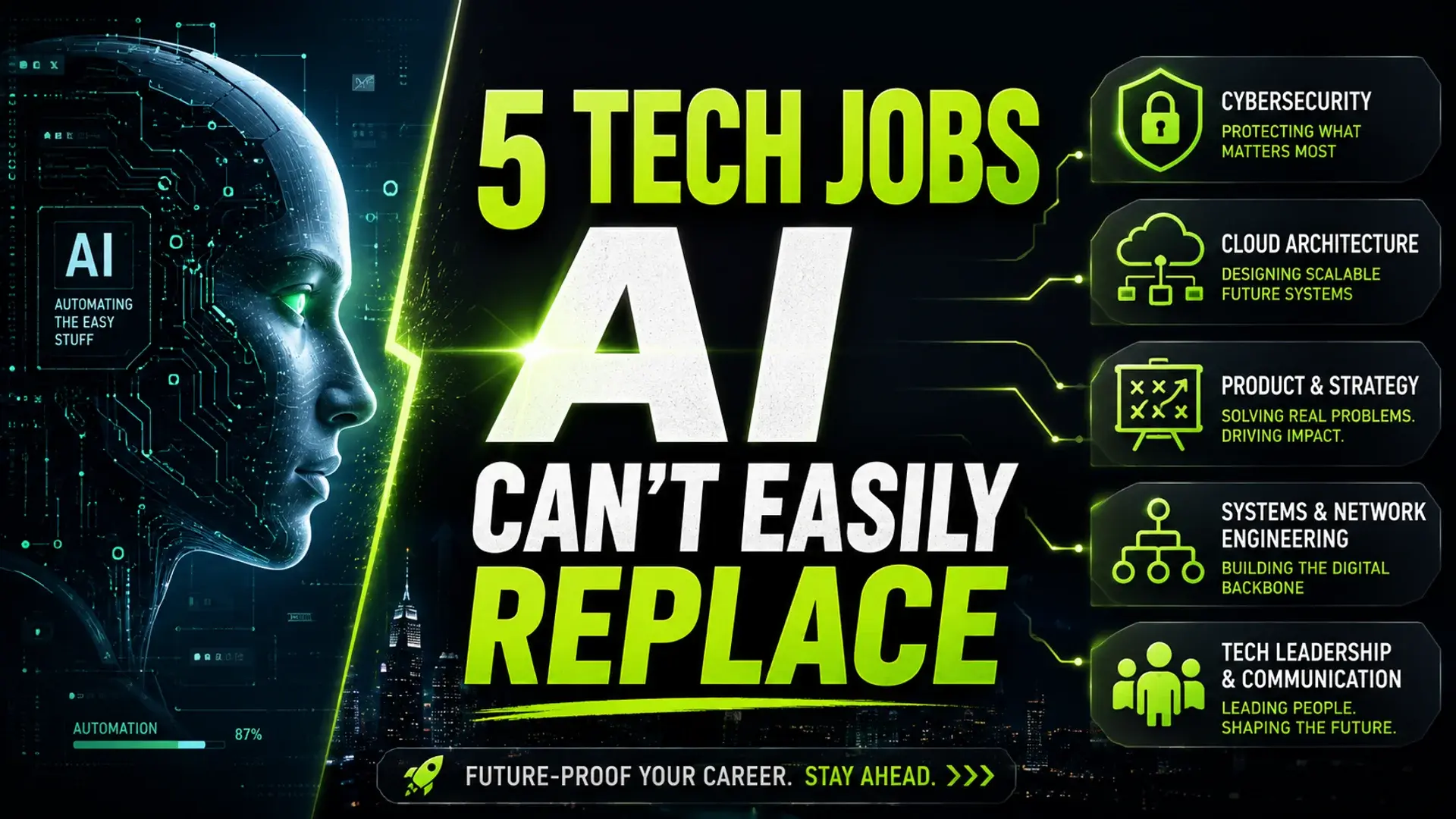
If you are searching for tech jobs safe from AI, reset the criterion. No role has a permanent moat. Infrastructure, cybersecurity, data platforms, AI systems, and complex product engineering have stronger defenses because their work carries live context, adversarial pressure, physical constraints, or accountable decisions that resist packaging into a clean prompt.
This guide is for students, freshers, and early-career developers in India. The evidence mixes global task research with an India-specific technology-services report published in 2025. Its scope is role structure; it makes no vacancy, salary, or guaranteed-outcome claims.
Tech jobs safe from AI: what the evidence can actually say
AI exposure, AI use, productivity, and job loss are four different measurements. A role can use AI every day without losing headcount. A task can be technically automatable yet remain human-owned because of regulation, risk, customer trust, missing data, or the cost of integrating the tool.
The International Labour Organization's May 2025 global index placed one in four workers in an occupation with some generative-AI exposure. Its authors said job transformation was the more likely outcome because most occupations still contain tasks requiring human input. The index measured potential exposure across occupational tasks; it did not count layoffs caused by AI. See the ILO's methodology and findings.
Tech is squarely inside the blast radius. A July 2025 Microsoft Research paper mapped 200,000 anonymized Bing Copilot conversations to occupational activities and found high AI applicability in computer and mathematical work. Microsoft later clarified that its scores described where chatbots could assist with tasks and did not support conclusions about jobs being eliminated. The underlying conversations came from January through September 2024, so they are a usage snapshot, not a forecast.
Recent product data points the same way. In Anthropic's January 2026 Economic Index, computer and mathematical tasks represented 34% of sampled Claude.ai conversations and 46% of first-party API records in November 2025. That dataset describes one vendor's usage, and coding is unusually prominent among its users. It still makes one fact hard to dodge: building AI does not shelter technical work from AI.
A five-part test for stronger defenses
Job titles are too coarse for this decision. A "DevOps engineer" who mostly edits YAML from tickets may be easier to automate than a backend developer who owns incident response for a payments system. Score the work you would actually do against five defenses.
This is an editorial screening framework, not a validated probability model. A role becomes more defensible as several columns appear repeatedly in its daily work. Seniority usually adds defenses because experienced people receive the ambiguous cases and carry more decision authority.
Which tech roles have stronger defenses?
1. Platform, infrastructure, and network engineering
A production outage does not arrive as a neat coding task. The engineer may need to connect a latency spike to a recent deploy, a saturated connection pool, a cloud quota, and a network policy owned by another team. AI can propose commands and summarize telemetry, but the person with access still decides what to change and whether the rollback risk is acceptable.
The India-specific evidence is unusually concrete here. NITI Aayog's October 2025 roadmap, drawing on BCG observations from more than 35 technology-services pilot accounts, estimated 15–25% productivity improvement in code generation, documentation, and testing. It estimated only 0–10% in requirement gathering and deployment, and a sub-10% impact in infrastructure and network operations at that time. Those figures measure productivity in a particular services context. The report presents estimates, not a job-security census. The full comparison is in the NITI Aayog roadmap.
For a fresher, the realistic entry titles may be cloud support engineer, network operations engineer, DevOps intern, or junior platform engineer. Build evidence with Linux troubleshooting, TCP/IP, one cloud platform, infrastructure as code, containers, and an observable service you have deliberately broken and restored. A Kubernetes certificate without a failure story is thin evidence.
2. Cybersecurity engineering and incident response
Security combines live state with an adaptive opponent. A model can draft a detection query, explain an alert, or suggest a patch. It cannot accept business risk, interview a system owner, preserve evidence correctly, and coordinate containment across teams on its own.
The role has an exposed floor. L1 alert triage, policy templates, vulnerability summaries, and repetitive access reviews are attractive automation targets. Stronger paths move toward detection engineering, application security, cloud security, identity architecture, incident response, and AI security.
A good entry portfolio proves investigation. A tool inventory proves very little. Publish a small incident report with a timeline, evidence, competing hypotheses, and containment decision. Build one detection rule, trigger it in a lab, measure false positives, and explain what you would change before deploying it.
3. Data engineering and data-platform work
Generating SQL is cheap. Keeping a data product trustworthy through schema changes, late events, access rules, upstream failures, and unclear business definitions remains expensive. Data engineers earn their stronger defense when they own contracts, quality, lineage, recovery, and stakeholder meaning around the pipeline.
NITI Aayog describes the data-architect role evolving toward AI-assisted architecture, model integration, data governance for AI, and training-data pipelines. That is a policy roadmap's role analysis, not proof that every Indian employer is hiring the profile. It does identify the direction a portfolio should take: beyond a tidy batch ETL demo and into failure handling, data tests, observability, access control, and documented trade-offs.
For an early-career project, ingest a changing public dataset, enforce a schema contract, quarantine bad records, and show how you backfill safely. The README should explain what happens when a source column disappears at 2 a.m. That sentence will do more career work than another screenshot of a dashboard.
4. AI/ML systems, evaluation, and safety engineering
AI adoption creates work around models as well as automating work elsewhere. Production teams need people to evaluate model behavior, control data access, manage latency and cost, monitor failures, defend against prompt injection, and decide when a system should fall back to a simpler path.
The weak version of this career is a thin wrapper around a model API. The stronger version owns an evaluation set, a deployment constraint, or a failure budget. NITI Aayog groups AI engineers, AI architects, AIOps engineers, and ethical-AI specialists among emerging or evolving roles in India's technology-services transition, while warning that the upside depends on training and investment.
Show the difference in a portfolio. Build a retrieval-augmented application with a small gold evaluation set, traceable citations, latency and cost measurements, an injection test suite, and a documented fallback. "Used an LLM" is a feature description. "Caught a regression before switching models" is engineering evidence.
5. Complex product and backend engineering
Software engineering survives best where code is only one part of the outcome. Payments, healthcare workflows, developer infrastructure, identity systems, logistics, and mature enterprise products carry domain rules, migrations, security boundaries, customer commitments, and operational history.
There is a useful warning against treating every coding benchmark as destiny. In a July 2025 randomized trial, METR studied 16 experienced open-source developers completing 246 tasks in mature repositories they knew well. With early-2025 tools, mainly Cursor Pro and Claude 3.5 or 3.7 Sonnet, they took 19% longer when AI was allowed, even though they believed it had sped them up. The result does not generalize to freshers, greenfield apps, newer models, or every codebase. It is a concrete example of context and verification costs overwhelming fast code generation in one demanding setting. Read the METR study and its limitations.
Generic CRUD work has much weaker defenses. Aim for backend or product roles where you clarify requirements, review changes, run migrations, design authorization, instrument releases, and respond when production disagrees with the test suite.
How do the five roles compare for a fresher?
No row wins on every dimension. Platform and security offer strong structural defenses but can be punishing without systems fundamentals. AI systems have obvious relevance and a high rate of tool change. Complex backend work offers the widest entry funnel, yet the safest-looking title can still hide a queue of predictable tickets.
What should you avoid optimizing for?
Prompt fluency by itself is a temporary advantage. Tools change quickly, and employers can give the same interface to every candidate. Pair AI use with a skill that lets you catch a wrong answer: network diagnosis, threat analysis, data semantics, model evaluation, distributed-systems reasoning, or domain knowledge.
Do not chase a senior title as though the title provides protection. AI architect, security architect, and staff platform engineer are usually destinations reached through years of shipped systems and bad incidents. A course can teach the vocabulary; it cannot compress the judgment those roles are hired to exercise.
Routine work exists inside every strong role. If your week can be described as "take a well-specified ticket, transform text or code, and hand off the result," expect the workflow to change quickly. Seek jobs where you also inspect evidence, negotiate constraints, make a reversible decision, and stay for the outcome.
How should you choose a role now?
Use the framework on real openings instead of choosing from career-listicle labels.
Collect 20 job descriptions in one city, remote category, or company type. Keep the experience band consistent so senior jobs do not distort the comparison.
Mark the repeated tasks in each description. Score live state, adversarial pressure, accountability, internal context, and physical or scarce-system coupling as low, medium, or high.
Circle the exposed tasks you still need to perform well: basic coding, test generation, documentation, triage, and configuration. Employers will expect faster execution here, even when these tasks no longer differentiate candidates.
Pick one role family and build one project that proves its strongest defense. Then use a curated list of fresher and early-career software roles in India to compare your evidence with the work employers actually describe.
Re-run the exercise every six months. Model capability changes faster than most degree curricula, while production constraints and organizational incentives move at a slower, messier pace.
FAQ
Will AI replace software engineers?
AI will automate and accelerate many software tasks, especially routine generation and testing. That does not establish that the occupation disappears; demand, accountability, and the remaining task mix also shape employment. Treat forecasts as scenarios unless they measure actual hiring or job loss with a clear denominator.
Is cybersecurity safe from AI?
No. Alert summaries and routine triage are already suitable for automation. Security work has stronger defenses when it involves live investigations, adversarial reasoning, detection engineering, architecture, and accountable risk decisions.
Is AI engineering a future-proof career?
AI engineering benefits from AI adoption, but thin model-wrapper work is easy to copy. Durable AI engineering combines evaluation, data quality, deployment, observability, security, and domain constraints. The tools inside that stack will keep changing.
Which tech role is best for a fresher worried about AI?
Choose the role whose daily work you can learn deeply and prove through projects. Platform, security, data, AI systems, and complex backend work can all be sensible targets, but their entry barriers and local openings differ. Use current job descriptions to test whether a title matches the work you expect.
Make your next project carry the defense
Take the strongest project on your resume and add one responsibility a model cannot quietly own: an incident drill, a threat model, a schema migration, an evaluation gate, or a rollback decision. Document the evidence and trade-off. That gives your next interviewer something better to assess than how quickly you generated the first draft.
Sources
International Labour Organization, Generative AI and Jobs: A Refined Global Index of Occupational Exposure, published May 20, 2025. Global task-exposure model; observed displacement is outside its scope.
Microsoft Research, Working with AI: Measuring the Applicability of Generative AI to Occupations, July 2025, and its scope clarification, August 21, 2025. Based on 200,000 anonymized Bing Copilot conversations from January through September 2024; applicability is not displacement.
Anthropic, Economic Index: Economic Primitives, published January 15, 2026. First-party Claude usage data through November 2025; it does not measure the whole labor market.
NITI Aayog, Roadmap for Job Creation in the AI Economy, October 2025. India technology-services and customer-experience scenarios with BCG and NASSCOM contributors; productivity estimates are not job-loss measurements.
Model Evaluation & Threat Research, Measuring the Impact of Early-2025 AI on Experienced Open-Source Developer Productivity, July 2025. Randomized trial of 16 experienced developers and 246 tasks using early-2025 tools; limited to mature repositories the participants already knew.