
 Download App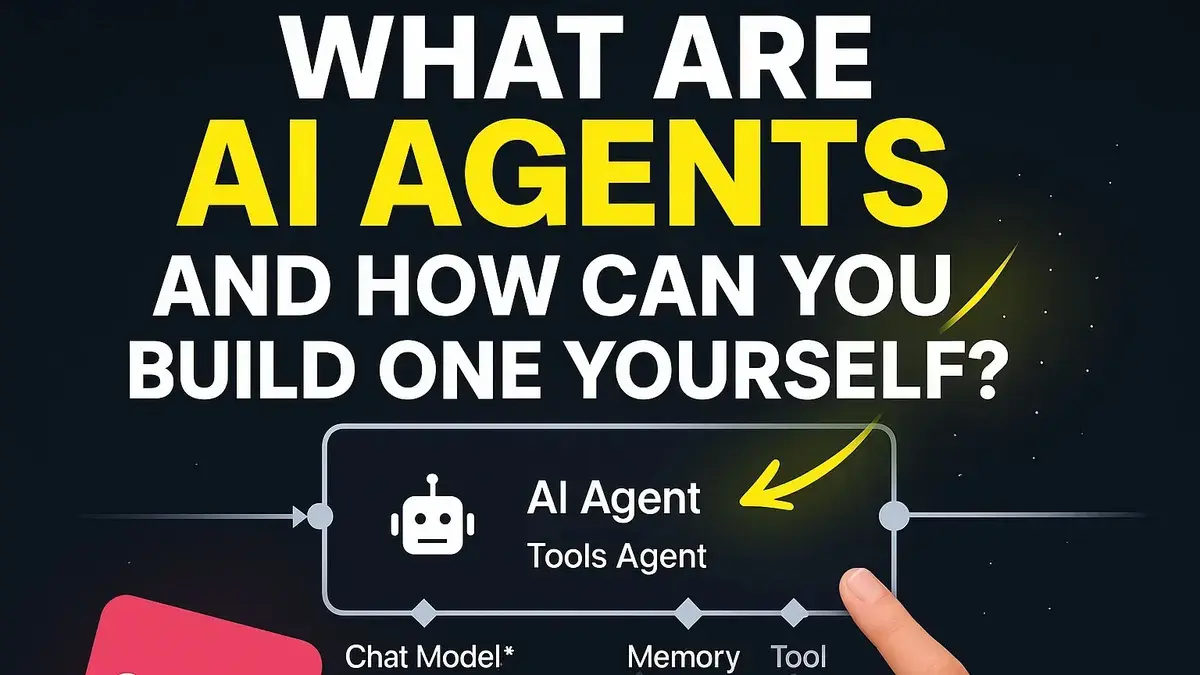
Introduction
You’ve probably heard of chatbots, virtual assistants, or large language models (LLMs) like ChatGPT. But the term AI agent goes a step further. These systems don’t just respond. They act, plan, adapt, and execute tasks on your behalf. In this article, I’ll show you what AI agents are, why they matter, what real-world uses they have now (2025), and how you can build one yourself.What Exactly Is an AI Agent?
Defining the term
An AI agent is a software system that works on goals you give it, uses tools and data, takes decisions, and performs tasks with some level of autonomy. For example:
It can plan the steps needed to achieve the goal.
It can act in its environment (which might be a database, a web interface, an application) and adapt.
It uses memory, reasoning, or tool-calling, not just static responses.
How this differs from chatbots or “just using an LLM”
If you simply ask ChatGPT a question and it gives an answer, that’s reactive. An AI agent is proactive in several ways:
It might break down a goal (e.g., “book a flight + hotel + rental car”) into subtasks and execute them.
It might call external APIs or tools (e.g., calendar, email, database).
It may monitor progress, revise its plan, handle errors or interruptions.
For example, as one article puts it: “An AI agent is a system that uses an LLM to decide the control flow of an application.”
Key characteristics
You’ll commonly see these features when people talk about AI agents:
Goal oriented: It works toward defined objectives, not just free chat.
Autonomous decision making: It chooses actions given its tools and state.
Tool use: It can call other systems, APIs, load information, take actions.
Adaptation / reasoning: It can adjust its plan if something fails, loop back, monitor its state.
Why AI Agents Matter (and Why Now)
Trend data & industry context
Analysts note that the move from conversational AI to agentic systems is already underway.
According to one guide, “AI agent technology has made incredible strides in recent years — and that means today, building your own AI agent is accessible to anyone with a computer.”
The enterprise world is shifting: firms invest in AI agents to automate more complex workflows beyond simple suggestions.
Practical benefits you’ll notice
When you use an AI agent rather than a standard tool, you’ll find:
It saves your time by chaining tasks rather than doing them one-by-one.
It reduces friction: you don’t have to manage every step manually.
It increases scope of automation: you go from “answering questions” to “doing things”.
It also brings risks: since an agent can act autonomously, oversight and governance matter.
Real-world examples
A banking assistant agent that works on behalf of a user to analyse statements, suggest actionable items, and even schedule a meeting. (Example from IBM)
Coding agents: e.g., Jules by Google LLC that can fix bugs and prepare pull requests.
How You Can Build an AI Agent Yourself
Here I’ll walk you through a practical process you can follow. You’ll see steps from idea to prototype. I assume you have some background in development (since you manage a Node/TypeScript stack, this should map nicely).
Step 1: Define the Purpose & Scope
Ask yourself: What do I want the agent to do?
Is it going to assist a user (e.g., personal productivity)?
Or will it be autonomous (e.g., monitors something, acts without my intervention)?
What domain? For example: scraping job-openings (fits your developer interests).
What tasks will it handle end-to-end? e.g., “Detect new job post → parse details → push to database → notify user”
Step 2: Choose Platform / Tools
You’ll pick tools for the agent to run. Some considerations:
Will you build from scratch (Node.js + TypeScript + OpenAI API) or use an agent platform (e.g., LangChain, Botpress)
Tooling for memory, planning, tool‐calls, and orchestration.
Access to external APIs, scheduler, database, etc.Given your stack (Node.js + TS + MongoDB), you might integrate an LLM (e.g., OpenAI API) plus your own orchestration layer.
Step 3: Design the Agent Architecture
You’ll need to define how your agent will work internally. Key components:
Input interface: how does the agent receive requests? (e.g., HTTP, CLI, scheduled job)
Planner / Reasoner: breaks the goal into subtasks and chooses which tools or steps to use.
Tool/Action module: code that executes specific tasks (e.g., scrape site, write to DB, send notification).
Memory / State: store context so agent remembers what it did, what to do next.
Monitoring / Feedback: track if tasks succeed/fail and adjust.
Here’s how one source summarises: “Steps … include defining your scope, picking a platform, creating instructions and variables…”
Step 4: Implement the Agent
Since you like TypeScript + Node.js, you could do:
Set up a project (
npm init, TypeScript config)Install LLM SDK (e.g., OpenAI Node SDK)
Create a planner module that calls the LLM with a prompt like: “You are an agent. Your goal is X. Here are your tools: A, B, C. Decide which tool to call next and with what arguments.”
Create tool modules (scraping, DB write, email send)
Implement state store (e.g., Mongo collection for agent tasks, history)
Orchestrate a loop: agent reads job → plans next action → executes → logs result → loops until goal done
A tutorial at “Medium” walks through a similar build.(Link)Step 5: Test, Monitor, Refine
Run the agent in a safe environment.
Test failure cases: what if a tool fails? Agent should retry, escalate, or ask for human input.
Monitor metrics: task completion rate, time taken, error rate.
Add logging and audit trail (since autonomous agents can act with minimal human input).
If you deploy with elevated permissions or external APIs, include oversight. (Governance matter)
Step 6: Deploy and Maintain
Deploy the agent in your infrastructure (could be serverless, containerized, or a simple VM).
Ensure you secure credentials (API keys, DB access).
Decide on triggers: scheduled job, web-hook, user request.
Maintain: update as tools change, DB schemas evolve, LLM behaviours shift.
Review logs regularly to catch unwanted behaviours (especially since autonomy can cause drift).
Common Use Cases You Can Try
Personal productivity agent: Monitor your email inbox, detect interview request emails, extract key info (company, date, link), push into your MongoDB job-tracking system.
Job-listings agent: Periodically scrape job sites, extract details (company, role, salary, experience) and populate your backend. Your experience with scraping will help here.
Customer-support agent: Use in your freelance business: detect inbound support emails from clients, classify urgency, route to Slack/Teams, reply with canned responses if simple.
Content summarization agent: Watch a feed (e.g., RSS), summarise articles, push into a newsletter draft.
Challenges and Cautions
You’ll succeed if you build carefully; but be aware:
Autonomous actions mean you need oversight. If the agent writes to DB or sends email/spam, you’d face issues. IBM recommends human supervision especially early on.
Tools and data quality matter. If you feed garbage data, your agent will do garbage tasks. Salesforce guide emphasises data preparation.
Governance and risk: By 2025, many articles emphasise that AI agents pose risks of misalignment, data leaks, unwanted actions.
Scope creep: You might build a simple agent but it becomes complex fast. Try to keep the first version lean.
Example: Sketching an Agent for Your Job-Scrape Workflow
Here’s an example aligned with your work (scraping, MongoDB, job postings).
Goal: Monitor a job-listing site, detect new postings, extract companyName, role, location (from title vs city list), salary & experience, push into MongoDB collections (‘jobs’).
Agent design:
Input: scheduled (e.g., every hour) fetch of job cards on site
Planner: For each new card: extract title → parse companyName & role → extract salary & experience fields → extract applyLink domain → call logo API → decide if this is new job or duplicate → insert into DB
Tools: Web-scraper tool, parsing tool, MongoDB write tool, domain extraction tool
Memory/State: Keep list of processed links; store last fetch timestamp
Error handling: If salary field missing, mark salary = null; if link invalid, skip and log.
Monitoring: Log number of jobs found, number inserted, number errors, time taken
You implement this in Node.js + TypeScript; you provide the tooling and scheduling; you call the LLM only for parsing & extraction (if you prefer) or do rule-based extraction if simpler.
Then you can wrap the entire flow into an “agent” that autonomously runs.
FAQ
Q1: Is an AI agent the same as an AI model (LLM)?No. An AI model (like an LLM) is a component that can generate text, classify data or make predictions. An AI agent uses one or more models plus logic, planning, tools, memory, and workflow orchestration to act autonomously.
Q2: Do I need to be a machine-learning expert to build one?No. Many agents are built by using an LLM API, integrating tools and writing orchestration logic. You don’t necessarily train your own models. As one recent guide says: “building your own AI agent is accessible to anyone with a computer.”
Q3: What programming languages or stacks should I use?Pick what you’re comfortable with. Since you already use Node.js and TypeScript, that works fine. Focus on orchestration logic, tool integration and memory/state rather than complex ML code.
Q4: How do I make sure the agent behaves safely?
Define clear goals and scopes (don’t let it “do everything”).
Log its actions and have human-in-the-loop for high-risk tasks.
Monitor errors and drift.
Limit permissions of what the agent can do (principle of least privilege).
Q5: Can I deploy my agent to production?Yes. Once you’ve tested it, you can deploy in your backend or cloud. But treat it like a service: schedule jobs, run in container/VM, monitor, maintain. Like any backend service.
Q6: Where do I start if I have zero experience?Start small: pick a simple task you perform manually often. Build an agent for that. Use existing tutorials (such as the one on Medium) to scaffold your steps. Gradually expand.
Conclusion
You now understand what an AI agent is, why they matter in 2024-25, and have a clear roadmap to build one yourself. You don’t need to invent from scratch. With your Node.js/TypeScript stack, you can tie an LLM, define your workflow, build tool modules and let your agent run tasks autonomously.