
 Download App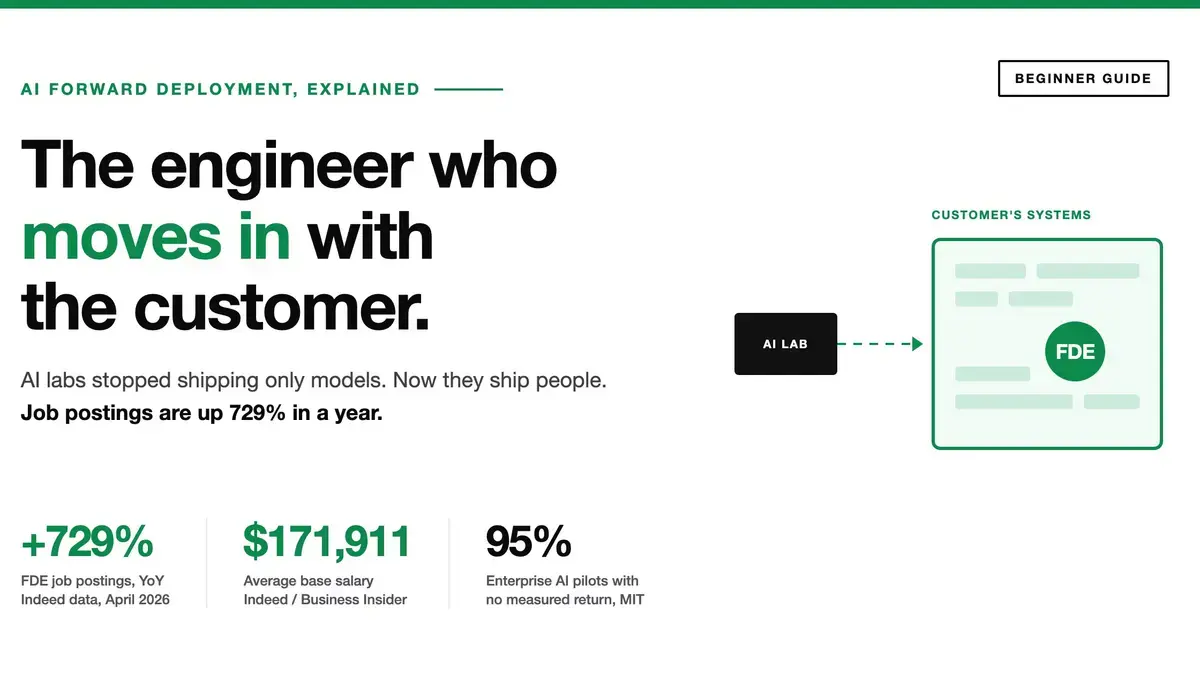
A forward deployed engineer is a software engineer who goes and sits with the customer, builds the thing there, and stays responsible when it breaks.
That's it. That's the whole job.
It sounds almost old-fashioned until you see the numbers. Job postings for the role rose more than 729% in April 2026 compared with a year earlier, with an average base salary of $171,911 (Indeed data reported by Business Insider, 2026). In May 2026, OpenAI and Anthropic each launched a billion-dollar company built entirely around this one job title, four days apart.
If you're early in your career and keep seeing "FDE" in postings without knowing what it means, this guide explains it from zero — what the work is, why it suddenly exists, and whether it's realistic for you.
Key Takeaways
An FDE embeds inside a customer's organization, builds custom software against their real data, and feeds lessons back to the core product team.
Postings grew 729% year over year to April 2026, averaging $171,911 base (Indeed / Business Insider, 2026).
It exists because roughly 95% of enterprise AI pilots showed no measurable profit impact (MIT Project NANDA, 2025).
It is rarely a first job. The reason is judgment, not coding skill.
What Does a Forward Deployed Engineer Actually Do?
They write software for one customer, inside that customer's world. FDEs spend 60–80% of their time with customers and travel between 20% and 50%, according to a detailed breakdown by PostHog's Jina Yoon (PostHog, February 2026). OpenAI's own job specs list travel up to 50%.
The name borrows military language. "Forward deployed" means stationed where the action is, not back at headquarters. Swap the base for an office and that's the idea.
A normal week runs roughly like this:
Sit with the people doing the work. Not the executive who signed the contract — the nurse, the claims processor, the dispatcher. Watch what they actually do.
Find one workflow worth automating. Something specific and painful, not "improve productivity."
Build a rough version fast, against the customer's real, messy data. This is the part that surprises new engineers.
Watch it fail on real inputs, then fix it. Real data has typos, missing fields and edge cases your demo never had.
Report back to the product team so the next release handles this natively.
Step 5 is what separates a real FDE from a consultant. A consultant delivers and leaves. An FDE is a sensor: what you learn at one customer becomes a feature everyone gets.
Why Did This Job Suddenly Appear Everywhere?
Because the models got good and the deployments still failed. MIT's Project NANDA reviewed over 300 disclosed AI initiatives and found roughly 95% of enterprise generative-AI pilots produced no measurable effect on profit and loss, despite $30–40 billion of investment (MIT Project NANDA, 2025). The researchers blamed a "learning gap" — tools that don't retain feedback or adapt to context — rather than the models.
Sit with that for a second. The technology worked. The dropping-it-into-a-real-company part didn't.
Ode's chief technologist Eddie Siegel put it bluntly: "Model selection matters, but it's not where the majority of calories are spent" (TechCrunch, July 2026). The calories go into plumbing, permissions, edge cases, and convincing a skeptical team to change how they work.
Three practical reasons make embedding the answer:
Data can't leave the building. A hospital or bank won't email you their records. Yoon notes enterprises hesitate to share proprietary data without established trust, so the engineer goes to the data.
The contracts are big enough to justify it. AI deals now run six to eight figures, which pays for an engineer's time onsite.
Executives need to see it work on their own data. A polished demo on sample data convinces nobody who's been burned by a failed pilot.
Where Did the Idea Come From?
Palantir. The company pioneered the model and, per Wikipedia's account of the role, the first public reference to the title appeared in a 2010 TechCrunch report (Wikipedia). The origin was mundane: even demoing simple software to intelligence agencies took weeks of NDAs and clearances, so Palantir sent engineers to work inside the customer instead.
Then venture capital noticed. Andreessen Horowitz published an essay in June 2025 titled Trading Margin for Moat: Why the Forward Deployed Engineer Is the Hottest Job in Startups, arguing for "services-led growth" (a16z).
That title contains the honest tradeoff. Software companies love high margins because code costs nothing to copy. Sending humans to customers destroys that margin. The bet is that you buy something better with it — a moat, meaning workflows so deeply embedded in the customer's operations that switching becomes unthinkable.
How Is It Different From Jobs You've Already Heard Of?
The distinction is who owns the outcome and who writes production code. Here's the same territory, four titles:
Role | Primary job | Writes production code? | Owns the result? |
|---|---|---|---|
Software engineer | Build generalizable features for all users | Yes | For the product |
Sales engineer | Prove it technically during the sale | Rarely | No — hands off at signature |
Solutions architect | Design and advise on the integration | Sometimes | Advises, doesn't build |
Forward deployed engineer | Build and run it inside one customer | Yes | Yes, including at 2am six months later |
The measurement differs too. A product engineer is judged on feature adoption across many users. An FDE is judged on whether one customer's problem got solved and whether they renewed.
One warning for job hunters: plenty of companies have relabelled ordinary consulting as "forward deployed engineering." Wikipedia's entry draws the line clearly — a true FDE develops production software, owns the outcome, and feeds requirements back to the core product team. If a posting has none of those three, it's a services role with a fashionable name.
Who's Hiring, and What Does It Pay?
The AI labs stopped treating this as a side function and made it a business. Both moves landed in the same week of May 2026:
Venture | Backers | Scale |
|---|---|---|
OpenAI Deployment Company | TPG, Brookfield, Advent, Bain Capital and others | $4B raised at a $10B valuation |
Ode with Anthropic | Blackstone, Hellman & Friedman, Goldman Sachs; plus Apollo, Sequoia, GIC | $1.5B valuation, ~100 engineers |
Sources: TechCrunch, May 2026; Anthropic, May 2026
Anthropic's own announcement explains the gap it's filling. Large enterprises get help from big systems integrators, but mid-sized organisations — community banks, manufacturers, regional health systems — "lack the in-house resources to build and run frontier deployments." CFO Krishna Rao said demand for Claude "is significantly outpacing any single delivery model."
Ode's CEO Chris Taylor is not modest about the ceiling: "It's pretty easy to imagine this as a trillion-dollar company someday if we execute well."
Beyond the labs, Wikipedia lists OpenAI, Anthropic, Google Cloud and Stripe among employers, and Palantir, Databricks and Ramp appear consistently in practitioner accounts. Pay: $171,911 average base per Indeed's data, with senior roles at frontier labs running considerably higher.
Can You Get This Job as a Beginner?
Usually not as a first job, and the reason isn't your coding ability. The hard part is judgment — walking into an unfamiliar organisation, working out which of fifteen stated problems is the real one, and earning enough trust that a stranger lets you touch production. That's difficult to demonstrate without having done it.
LeadDev's reporting captures the talent squeeze plainly. Piotr Kraus, an FDE advisor and former Palantir engineer, warns the title "might have become a little bit frothy" and adds: "It's definitely not for everybody" (LeadDev, July 2026). Reported entry paths favour people with domain expertise and analytical backgrounds, with data engineers transitioning especially well.
So build toward it deliberately:
Get one real user, not a portfolio project. Ship something a stranger depends on. Handling one person's actual mess teaches more than ten polished side projects.
Learn the boring integration layer. APIs, auth, permissions, CSV imports, data cleaning. This is most of the job.
Learn to evaluate AI output, not just call an API. How do you prove an agent is right often enough to trust? That skill is scarce.
Go deep in one industry. Healthcare billing, logistics, insurance claims. Domain knowledge is the moat you can build before you're senior.
Practise explaining technical work to non-technical people. Do it out loud, to someone who doesn't code, until it's clear.
A realistic on-ramp: join a startup where you're already customer-facing, or start in data or solutions engineering and move across. [INTERNAL-LINK: early-career AI engineering skills → guide to building a portfolio that gets interviews]
The Honest Downsides
Travel is the big one. At 20–50% of your time on the road, burnout is a documented risk in this role, and the work often happens in remote or hard-to-reach locations.
There's a structural critique too. Unframe's field CTO Chris Slovak names the paradox: these solutions promise to automate productivity while adding "expensive, hard-to-find humans" to the delivery model. Yoon's analysis agrees the model only makes sense when implementation is genuinely heavy and margins justify it — if standard product-led growth already works, FDEs are an expensive answer to a question nobody asked.
And Wikipedia's summary notes the tension inside the company: every hour spent solving one customer's specific problem is an hour not spent on the product everyone uses.
Frequently Asked Questions
Is a forward deployed engineer just a consultant?
No, if the role is genuine. A consultant delivers a project and exits. An FDE writes production software, owns it when it breaks, and channels what they learn into the core product. Wikipedia flags that conventional professional-services roles increasingly borrow the title, so check for those three markers.
Do I need a machine learning background?
Rarely. Most of the work is integration, data plumbing, workflow design and evaluation, not model training. Practitioner accounts emphasise domain expertise, customer communication and analytical skill, and note that data engineers transition into the role well.
Is this a real career or just hype?
Both, honestly. The demand is measured — 729% posting growth to April 2026, plus $5.5B of committed capital across two ventures in one week. But a former Palantir engineer calls the title "a little bit frothy," meaning some postings are relabelled consulting.
What's the fastest way in from a junior role?
Move sideways rather than applying cold. Data engineering, solutions engineering and early-startup roles all put you in front of customers with production access. Build depth in one industry while you're there — domain knowledge is what makes a junior credible in a customer's office.
The Skill Worth Taking From This
The interesting thing about forward deployment isn't the job title. It's what its existence proves: the hardest part of AI stopped being the model and became the last hundred metres into a real organisation.
That's genuinely good news if you're starting out. You don't need to beat a frontier lab at training models. You need to be the person who can sit in a room with people who don't code, find the workflow that's quietly costing them, and make software that survives their actual data. That skill isn't being automated any time soon — the labs just raised $5.5 billion betting on how scarce it is.
Sources
Source | Title | URL |
|---|---|---|
Indeed / Business Insider | Job postings for this tech role have grown more than 700% in the last year | |
Wikipedia | Forward Deployed Engineer | |
PostHog (Jina Yoon) | WTF is a forward deployed engineer? | |
LeadDev (Kari McMahon) | The rise of the forward-deployed engineer (FDE) | |
Anthropic | Building a new enterprise AI services company with Blackstone, Hellman & Friedman, and Goldman Sachs | |
TechCrunch (Russell Brandom) | Anthropic and OpenAI are both launching joint ventures for enterprise AI services | |
TechCrunch (Rebecca Bellan) | Anthropic, Blackstone bet the next trillion-dollar AI business is implementation, not models | |
OpenAI | OpenAI launches the Deployment Company | |
Andreessen Horowitz | Trading Margin for Moat: Why the Forward Deployed Engineer Is the Hottest Job in Startups | |
MIT Project NANDA | The GenAI Divide: State of AI in Business 2025 | |
Blackstone | Anthropic Partners with Blackstone, Hellman & Friedman, and Goldman Sachs to Launch Enterprise AI Services Firm |