
 Download App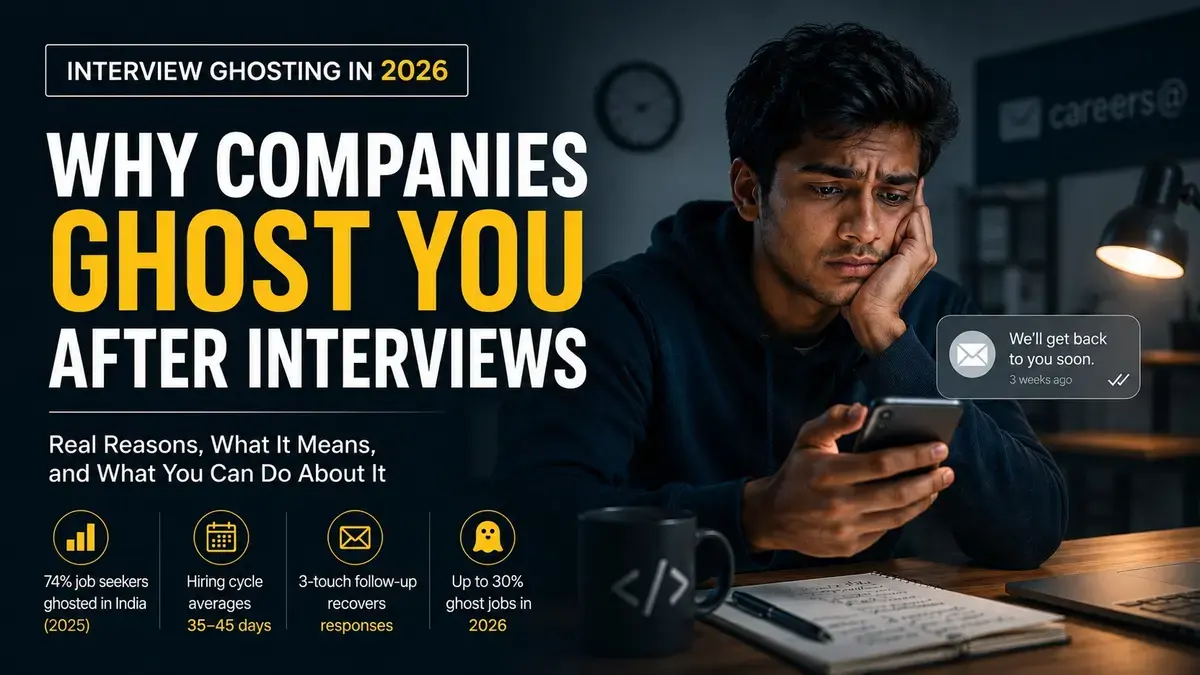
You prepared for two weeks. You cleared the aptitude test. You answered every technical question. The HR person smiled and said, "We'll get back to you soon."
That was three weeks ago.
No email. No call. No rejection. Just silence.
In 2025, 74% of job seekers in India reported being ghosted by a company after an interview (Harper's Bazaar India, 2025). For B.Tech CSE freshers — who often have no other offer on the table and no way to know if they're still in the running — that silence is brutal. Not just frustrating. Genuinely damaging.
This guide explains exactly why it happens, what it usually means, and what you can do about it — including a follow-up protocol that actually gets responses.
Key Takeaways
In 2025, 74% of Indian job seekers were ghosted after interviews — and most of the time, it isn't about you.
India's average hiring cycle runs 35–45 days, longer than most freshers expect (SalaryBox India, 2024).
A structured 3-touch follow-up sent over 14 days recovers responses in a significant portion of ghosted cases.
Up to 30% of active job postings in 2026 are "ghost jobs" — roles that aren't actually being filled (Fonzi.ai, 2026).
Why Has Interview Ghosting Become So Common in India's Tech Sector?
In 2025, 61% of job seekers globally reported being ghosted after a job interview — a nine-percentage-point jump from early 2024 alone (The Interview Guys, 2025 Ghosting Index). In India, the rate climbs higher. The IT sector, which slashed fresher hiring from 600,000 in 2022 to under 150,000 in 2024, created a situation where HR teams are overwhelmed, processes broke down, and no one owns the task of sending rejections.
The blunt truth is this: ghosting is a symptom of broken hiring infrastructure, not a judgement of your ability.
When TCS or a mid-size IT firm receives 200–400 applications for a single fresher role, the people managing those pipelines are stretched thin. Sending personalised rejections to everyone who didn't make it through round three isn't anyone's job. So it doesn't happen.
What's changed since 2022: The sharp decline in IT fresher hiring volume created a paradox — fewer roles but more applicants per role. Recruiters who once managed 20 open positions now manage 5, but each position gets 5× the applications. The result is that post-interview communication, which was already inconsistent, collapsed entirely at many firms.
Top Reasons Indian Companies Ghost After Interviews (2025)
Reason | Share |
|---|---|
Role on hold / budget freeze | 38% |
Better candidate identified | 24% |
Recruiter process failure | 19% |
Role cancelled internally | 12% |
Unstated criteria mismatch | 7% |
Sources: The Interview Guys Ghosting Index 2025; SalaryBox India; composite of HR practitioner surveys
The 5 Real Reasons You Got Ghosted (It's Rarely What You Think)
Most freshers assume ghosting means rejection. Often, it doesn't. Here are the five most common actual reasons:
1. The role was put on hold after your interviewBudget approvals in large IT firms move slowly. A hiring manager may have interviewed you sincerely, then been told two days later that headcount is frozen for the quarter. Nobody calls you because nobody wants to have that conversation. This accounts for nearly 38% of post-interview ghosting in India's tech sector.
2. You're a "backup" candidateCompanies routinely carry 2–3 candidates through to final stages and make an offer to their top choice first. If that person accepts, the others never hear back. If that person negotiates for 3 weeks, you wait 3 weeks with no information.
3. The recruiter who interviewed you left the companyIndia's tech sector has significant recruiter churn. When the person who managed your process exits, your application can genuinely fall through the cracks — not because of anything you did, but because no one inherited the follow-up task.
4. The job posting was never realIn 2026, up to 30% of active job postings are "ghost jobs" — roles that companies post to build talent pipelines, gauge market rates, or meet internal process requirements, with no genuine intent to hire immediately (Fonzi.ai, 2026). You cleared a real interview for a role that was never fully approved.
5. Internal restructuring changed the scopeA role posted for a "junior software developer" may have been quietly repurposed into something requiring two years of experience after a team reorganisation. Rather than call every candidate to explain, the process just... stops.
According to the 2025 SalaryBox India report, India's average hiring cycle runs 35–45 days — longer than most freshers expect. Many candidates interpret normal processing delays as rejection and stop following up, when the role is still very much active and they're still being considered.
How to Tell If You've Been Permanently Ghosted vs Just Delayed
Not all silence is the same. Here's how to read it honestly:
Signs you're probably still in consideration:
It's been fewer than 14 days since your last round
The company's LinkedIn shows recent hiring activity in your domain
You were told the decision timeline was 2–3 weeks
The recruiter responded (even briefly) to a previous follow-up
Signs it's time to move on:
It's been more than 21 days with no response to two follow-ups
The job posting was removed from all platforms
The recruiter's LinkedIn shows they've left the company
You found the same role reposted with a new application date
The 21-day rule: In India's tech hiring, meaningful decisions rarely take more than three weeks once interviews are complete. If 21 days have passed and two follow-ups have been ignored, the statistical probability of receiving an offer from that application is very low. Knowing this isn't giving up — it's allocating your energy correctly.
Your 7-Day Follow-Up Protocol After an Interview
Most freshers either follow up too soon (day 2) or never follow up at all. Both approaches fail. Here's the protocol that works:
Day 1 — Send a thank-you note (within 24 hours of the interview)This isn't a follow-up; it's a courtesy. Keep it under 5 sentences. Reference one specific thing discussed in the interview. End by expressing genuine interest in the role.
Subject: Thank you — [Your Name], [Role] Interview on [Date]Hi [Interviewer Name],
Thank you for your time today. Our discussion about [specific topic] was
genuinely interesting and reinforced my enthusiasm for this role.
I look forward to hearing about next steps.
[Your Name]
Day 7 — First follow-up (if no response)Reference the interview date, restate your interest, and ask directly for a status update. One paragraph. No apologies for "bothering" them — that framing undermines you.
Subject: Following up — [Your Name], [Role] Interview on [Date]Hi [Name],
I wanted to follow up on my interview on [date] for the [role] position.
I remain very interested and would welcome any update on the timeline
or next steps.
[Your Name]
Day 14 — Second and final follow-upSame structure, shorter. Explicitly note this is your final check-in. This often triggers a response because it creates a sense of closure for the recruiter too.
Day 21 — Move on completelyStop waiting. Remove this application from your "active" tracker. The mental bandwidth you're spending on it is better used on the next application.
Post-Interview Follow-Up Timeline
Day | Action |
|---|---|
Day 1 | Thank-you note (within 24 hours) |
Day 7 | First follow-up — ask for status |
Day 14 | Final follow-up — close the loop |
Day 21+ | Move on, reallocate energy |
How to Ghost-Proof Your Next Application
The best response to ghosting is not waiting better — it's applying smarter so you're not dependent on any single company's response.
1. Apply to 20–30 companies simultaneously, not sequentiallyMost freshers apply, wait, get ghosted, then apply to the next company. This stretches a job search from 3 months to 9. Running parallel applications means you always have active pipelines and ghosting by one company doesn't stall your entire search.
2. Fix your resume before you apply againA significant share of post-interview ghosting actually traces back to resume-stage inconsistencies that surface during background checks or HR review — skills listed that the interviewer couldn't verify, formatting that printed oddly, or a LinkedIn profile that contradicts the CV. Before your next application batch, run your resume through DevsUnite's Resume Analyser — it checks ATS compatibility, flags keyword gaps, and scores your CV against actual job descriptions. Two minutes of checking can prevent weeks of unexplained silence.
3. Track every application in a spreadsheetDate applied, company, role, contact name, interview date, follow-up dates, status. When you have 25 active applications, you can't rely on memory. Tracking also shows you patterns — which company types respond fastest, which portals yield the highest callback rates for your profile.
4. Connect where hiring engineers actually talkRecruiters aren't the only path in. Many Indian tech companies — especially startups and GCCs — hire through referrals from their own engineers. Join DevsUnite, a developer community where you can build visibility with practising engineers, share projects, and sometimes learn about openings before they're posted publicly.
A pattern worth noting: Freshers who receive referrals from someone inside the company — even a junior engineer they connected with at a hackathon — report dramatically lower ghosting rates. Internal referrals create a named owner for the candidate's process. Without that, you're a file in a queue.
What to Do Immediately After Being Ghosted
Being ghosted stings. But the 48 hours after you accept you've been ghosted are strategically important. Don't waste them.
Step 1 — Send a final, graceful closeOne last email: "I understand you may have moved in a different direction. I appreciated the opportunity to interview and would welcome consideration for future roles." This takes 3 minutes and occasionally results in a callback months later when a new position opens.
Step 2 — Connect with your interviewer on LinkedInNot to follow up on the role — the role is gone. Connect with a brief, professional note. Many freshers have been contacted by former interviewers for new openings 3–6 months later. The relationship has value beyond the single application.
Step 3 — Document what you learnedWrite down two or three things you'd do differently. Was the technical round harder than expected? Did a question catch you off guard? This debrief — done within 48 hours while it's fresh — compounds across interviews.
Step 4 — Apply to three new companies the same dayThe worst thing you can do is pause. Momentum matters in a job search. Use the energy productively.
Common Mistakes Freshers Make After Being Ghosted
Sending a single follow-up on day 2, then giving up. Day 2 is too soon and one follow-up isn't enough. Three touches over 14 days is what actually gets responses.
Blaming the interview performance when the cause is structural. When 38% of ghosting is caused by budget freezes or role holds, your performance had nothing to do with the outcome. Internalising structural failures as personal failure destroys confidence unnecessarily.
Burning the bridge. Sending a frustrated or passive-aggressive follow-up is tempting. It permanently closes the door on a recruiter who might have been genuinely interested in you for a future role.
Stopping all applications while waiting. India's average hire cycle is 35–45 days. If you stop applying the day of your interview, you could lose an entire month of momentum. Keep applying until you have a written offer in hand.
Frequently Asked Questions
How long should I wait for a response after a tech interview in India?
Wait 5–7 business days before sending your first follow-up. India's average tech hiring cycle is 35–45 days end-to-end, but post-interview decisions typically come within 7–14 days (SalaryBox India, 2024). If you've sent two follow-ups over 14 days with no response, move on and treat the application as closed.
Does being ghosted mean I failed the interview?
Not necessarily. In 2025, 74% of Indian job seekers were ghosted after interviews (Harper's Bazaar India, 2025), and the most common cause is a budget freeze or role hold — not candidate performance. If you passed the technical rounds, assume you cleared the bar and that the delay is structural.
Should I call HR directly if emails are going unanswered?
One call is acceptable — after your second email follow-up on day 14 has gone unanswered. Keep it under 90 seconds: state your name, the role, the interview date, and ask politely for an update. If the call isn't answered or returned within 48 hours, treat the application as closed.
What is a ghost job and how do I avoid applying to one?
A ghost job is a posting that exists on job boards but isn't actively being filled — used for pipeline building or internal benchmarking. In 2026, up to 30% of postings fall into this category (Fonzi.ai, 2026). Avoid them by applying directly through company career pages, checking when the posting was last updated, and using communities like DevsUnite where real opportunities are shared by engineers.
How do I prevent my resume from causing ghosting at the offer stage?
Inconsistencies between your resume, LinkedIn profile, and what you said in the interview are a common silent rejection trigger at the offer stage. Before applying, run your resume through DevsUnite Resume Analyser to catch ATS issues and keyword gaps, and cross-check every claim with your LinkedIn so both say the same thing.
Conclusion
Getting ghosted after clearing an interview is one of the most demoralising experiences in a fresher job search. You did the work. You cleared the rounds. And then — nothing.
But here's what the data actually says: most of the time, it isn't about you. It's about budget cycles, recruiter churn, and broken hiring infrastructure. That doesn't make the silence less painful. It does mean you shouldn't let it shake your confidence or slow your search.
Follow up three times over 14 days. Document what you learned. Fix your resume. Apply to the next batch the same week. The fresher who gets hired isn't always the most technically brilliant — it's the one who keeps going after the applications that never replied.
Sources: Harper's Bazaar India (2025) · The Interview Guys Ghosting Index (2025) · SalaryBox India (2024) · Fonzi.ai Ghost Job Report (2026) · iHire Ghosting Survey (2025) · Atria University Engineering Unemployment Report (2026) · Amazing Workplaces Fresher Hiring Gap Report (2026)