
 Download App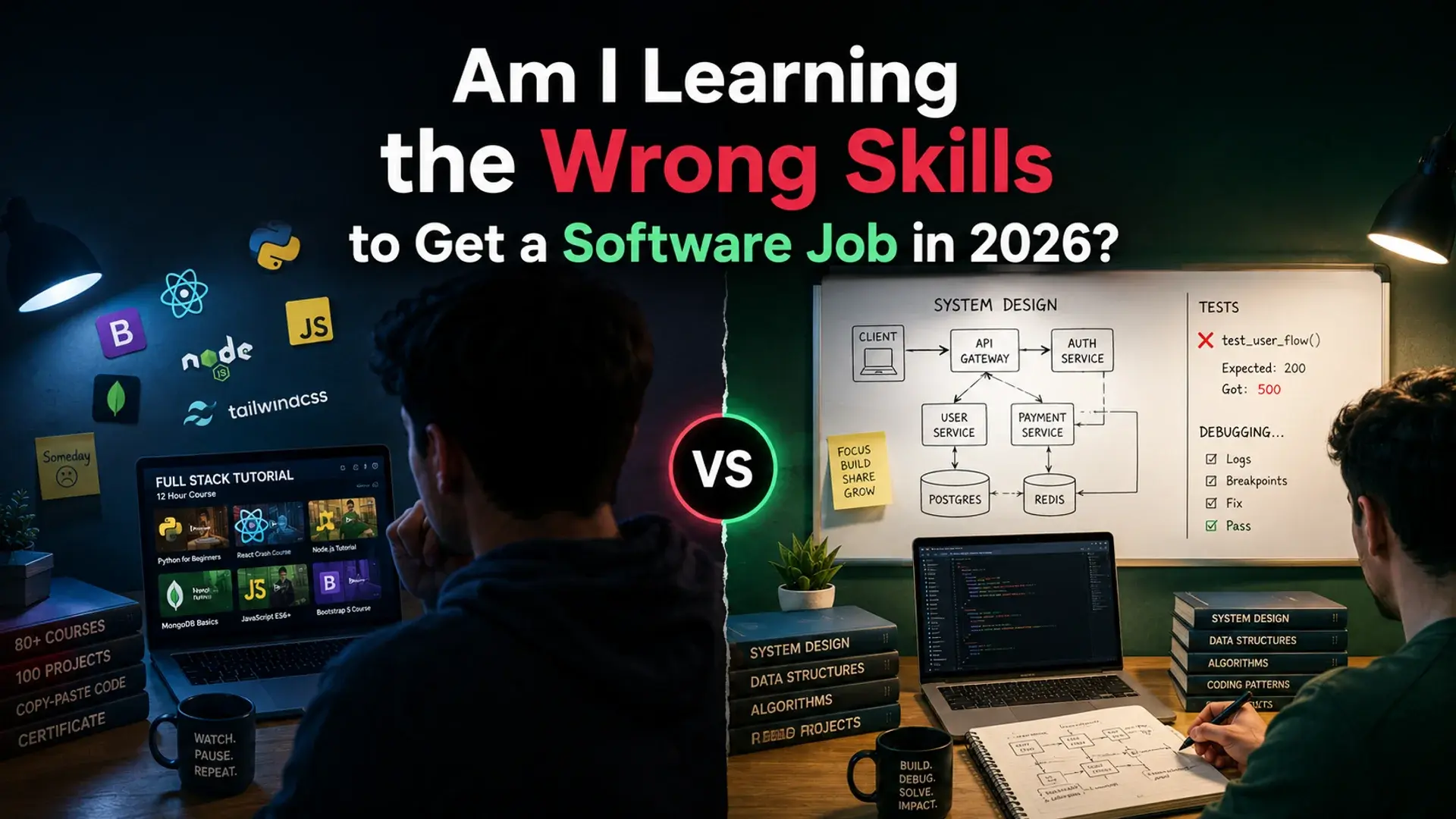
Probably not, but you might be weighting them wrong. Most people worried they're learning the wrong skills to get a software job have the fundamentals that matter: data structures, debugging, reading unfamiliar code, and shipping something end to end. What changed in 2026 is that syntax recall and tutorial-following count for less, and judgment about AI-generated code counts for more.
How do I know if I'm learning the wrong skills to get a software job?
There's a fast test. Ask these five questions about anything you're spending study time on.
Does it survive contact with a real project? If a skill only shows up in tutorials and never in the codebases you clone and read, it's tutorial knowledge, not job knowledge.
Would a hiring manager see evidence of it in 30 seconds? Skills that leave artifacts (a deployed app, a merged pull request, a written design doc) signal more than skills that live only on your resume.
Is it a fundamental or a flavor? Fundamentals like how a hash map works, how an HTTP request flows, or how to bisect a bug transfer across every job. Flavors like one framework's directory conventions expire.
Can a language model already do it better than you, with no checking needed? If yes, that's not where your edge is. Generating boilerplate CRUD (create, read, update, delete) endpoints is now a commodity.
Does it help you catch a confident wrong answer? Knowing when generated code is subtly broken is worth more every month.
If most of your study hours pass questions 1 through 3 and at least one of 4 or 5, you're fine. If you're mostly memorizing syntax and following along with videos, you're building the wrong muscle.
The skills that held their value
The screening process at most companies barely changed, so the skills it rewards didn't either.
Data structures and algorithms still gate the technical phone screen at most mid-size and large companies. You don't need competitive-programming depth, but you need to recognize when a problem wants a set instead of a list and explain the tradeoff out loud. Structured practice against this format still maps directly to how companies screen, and curated DSA practice sheets and system design guides are built around exactly that.
System design fundamentals matter earlier in careers than they used to. Even junior interviews now ask you to sketch how a URL shortener or a rate limiter works. The bar is "can you reason about a system," not "have you run one at scale."
Debugging is the most underrated hireable skill. Being handed a failing test in an unfamiliar codebase and calmly narrowing down the cause is what day-one work actually looks like. Tutorials rarely teach this, because tutorials are written to work.
Reading code you didn't write is core, not optional. Most of the job is understanding an existing system before changing it. This skill got more valuable, not less, because now you also review code a model wrote.
Written communication carries weight. Pull request descriptions, short design proposals, and clear questions in a channel. Remote and hybrid teams run on written clarity, and interviewers notice when you have it.
The skills that quietly lost value
A few things people still grind on stopped paying off around 2024 and haven't recovered.
Memorizing language syntax and standard-library method names. Editors and assistants autocomplete this now. Knowing Array.prototype.reduce by heart saves you seconds. Knowing when a reduce makes the code unreadable saves the review.
Tutorial completion as a progress metric. Finishing a 40-hour course feels like movement and leaves almost no hireable signal. Three small projects you designed and debugged yourself beat ten you followed along with.
Raw speed on greenfield boilerplate. Spinning up a fresh CRUD app quickly was a mild flex in 2021. It's now a single prompt. The value moved to everything that happens after the prototype works.
Framework-idiom depth before fundamentals. Knowing every Next.js caching quirk while being shaky on how a browser makes a request is a common and fragile place to be. The framework will change. The fundamentals won't.
Chasing every new JavaScript framework. The churn is real, but employers hire for the ability to learn a stack, not for having pre-learned this quarter's winner.
The skills that gained value in 2026
Capable coding assistants created new job requirements that barely existed three years ago. Industry surveys such as the annual Stack Overflow Developer Survey have tracked AI coding-tool adoption climbing sharply among professional developers.
Reviewing AI-generated code critically. The work increasingly looks like editing rather than typing from scratch. You need to spot the plausible-looking function that handles the happy path and silently mangles the edge case.
Writing precise specifications. A vague prompt or a vague ticket produces vague output, whether the implementer is a junior developer or a model. People who can state exactly what "done" means are more productive with these tools and more useful without them.
Verification and test design. When code is cheap to generate, confidence becomes the bottleneck. Writing a test that actually pins down behavior is leverage now, not chore work.
System knowledge deep enough to catch confident errors. Language models are fluent and wrong in specific, quiet ways. The developers who gain the most from them are the ones who know a subject well enough to notice when the answer is off.
A quick map of where skills stand in 2026
What should a student or career switcher actually do?
Reallocate, don't restart. A concrete order that still works:
Lock in one language until fluent. Python or JavaScript is fine. Fluent means you stop looking up how to write a loop and start thinking in the language.
Do data structures and algorithms deliberately. Roughly 60 to 100 problems across the common patterns, writing your first solution before looking anything up.
Build three real projects you designed yourself. Not cloned. Each should touch a database, an external API, and a deploy step. Break them on purpose, then fix them.
Learn one framework properly, after the fundamentals are solid. Production work happens in frameworks, so you do need one, just not first.
Practice with AI tools the way the job uses them. Generate a function, then review it line by line and write the tests that would catch it being wrong.
Write about what you built. A short design note per project doubles as interview prep and portfolio signal.
Where the "just learn AI" advice goes wrong
"Learn AI" is close to useless as a directive, and following it literally can burn a year.
For most software jobs, it does not mean training models or studying transformer internals. Those are separate, smaller job markets with their own interview loops. For a typical backend, frontend, or full-stack role, the AI-relevant skill is using coding assistants well and reviewing their output, which you pick up in an afternoon and sharpen on real work.
If you want machine-learning engineering specifically, that path needs linear algebra, probability, and a different set of prerequisites. Decide which job you're aiming at before you spend six months on the wrong ones.
FAQ
Is it too late to learn to code in 2026? No. Entry-level hiring is tighter than it was in 2021, but the U.S. Bureau of Labor Statistics still projects faster-than-average growth for software developer roles this decade. "Too late" usually means the frictionless tutorial-to-job path closed, not that the field did.
Do companies still ask LeetCode-style questions in 2026? Most mid-size and large companies still run an algorithm screen. Some added an AI-use or code-review round on top, but almost none dropped data structures. Practicing the format is still worth the hours.
Should I learn React first or focus on fundamentals? Fundamentals first, then one framework properly. Framework knowledge without understanding how the browser and network actually work is fragile, and it is the most common weak spot in junior candidates.
Will AI replace junior developers? It is changing what junior work looks like more than eliminating it. Boilerplate and first drafts are shifting to AI. Review, debugging, and deciding what to build are staying human.
The takeaway
The safe move in 2026 is not to abandon what you're learning but to audit it. Keep the fundamentals, drop the tutorial grind, and add the one genuinely new skill: treating generated code as a draft you are responsible for. If you can debug something you didn't write and explain why it's wrong, you're learning the right things.
Sources
U.S. Bureau of Labor Statistics, Occupational Outlook Handbook: Software Developers, Quality Assurance Analysts, and Testers — https://www.bls.gov/ooh/computer-and-information-technology/software-developers.htm
Stack Overflow Annual Developer Survey — https://survey.stackoverflow.co/