
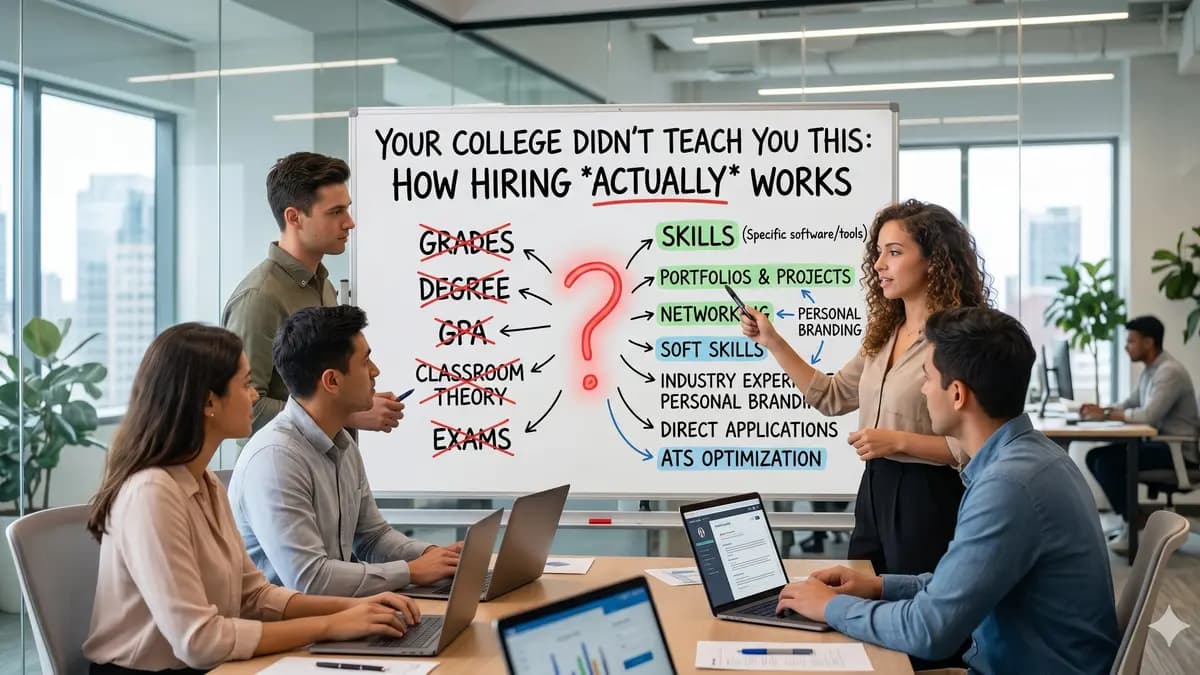
When you applied to that job last week, did you actually know what happened to your resume after you clicked submit or did you just hope for the best and wait?
Most freshers wait. And they wait because nobody ever explained the system they're trying to navigate. Your college prepared you for the technical interview barely but not for the 4 things that happen before you ever get to a technical interview.
Let's fix that. Because understanding how hiring works is the single biggest advantage you can give yourself right now.
The Problem
There is a huge gap between what freshers think hiring looks like and what it actually looks like.
What freshers think happens:
I apply
Someone reads my resume
They call me
What actually happens:
You apply -> ATS scans and scores your resume (keyword match)
If ATS passes it -> a recruiter sees it for 6-7 seconds
If recruiter passes it -> hiring manager reviews it (2-3 minutes)
HR calls for a screening -> Technical round -> Final round
Offer (or silence)
There are 5 stages before an offer. Most freshers only think about stage 3 onwards. You're losing at stage 1 or 2 and never know it.
Practical Tips
1. Understand the ATS: The Invisible Gatekeeper
ATS (Applicant Tracking System) is software that every mid-to-large company uses to manage applications. It reads your resume, scans for keywords from the job description, and gives you a relevance score.
If you score below their threshold, you're filtered out automatically. No human ever sees you.
How to beat it:
Copy exact keywords from the job description into your resume (skills, technologies, role title)
Avoid tables, columns, and images in your resume ATS often can't read them
Use a simple, clean resume format (.pdf is usually safest)
Include a skills section with all relevant technologies listed explicitly
2. The 6-Second Recruiter Test
When a human recruiter does see your resume, they're not reading it they're scanning. In 6-7 seconds they decide: shortlist or skip.
What they look for in those seconds:
Your name and contact details (top, prominent)
Current status "Recent Graduate | Seeking Developer Roles" (tell them immediately)
Top 2-3 skills or technologies
One notable project or achievement
If these aren't scannable in seconds, you're gone. Not because you're bad — because they have 200 more to review.
3. The Hiring Manager Is a Different Person With Different Priorities
If you make it past the recruiter, a hiring manager reviews your resume. They think differently from HR.
HR thinks: Does this person meet the basic requirements?Hiring Manager thinks: Can this person solve my team's problem?
For freshers, this means: your project descriptions shouldn't just list what you built they should hint at why it mattered or what it achieved. Even something like "Built a task manager that reduced my study group's deadline misses by tracking assignments" is more compelling than "Built a task manager using React."
4. Timing Your Application Is a Real Thing
Applications submitted early in a job's lifecycle have a significantly higher shortlist rate. Here's why:
When a job goes live, the recruiter checks applications actively for the first 48-72 hours. After that, they typically have enough candidates in the pipeline and stop reviewing new ones unless there's a specific reason.
Set up job alerts on every platform you use LinkedIn, Indeed, and developer-specific job boards like DevsUnite so you get notified the moment new listings go up. Being application #3 instead of application #287 matters more than people realize.
5. The Follow-Up Nobody Sends
After applying, most freshers do nothing. This is a missed opportunity.
If you applied via email or have the recruiter's email: a short, professional follow-up 7 days later keeps you visible without being annoying. Most hiring managers privately appreciate the initiative. Almost no one does it.
Follow-Up Email Template (if Cold Applying)
Subject: Following up — [Role Name] Application | [Your Name]
Hi [Recruiter Name / Hiring Manager],
I wanted to follow up on my application for the [Role Name] position
I submitted on [date]. I'm still very excited about the opportunity
and believe my experience with [1-2 relevant skills] could be a
strong fit for your team.
Please let me know if you need anything else from my end happy
to share more about my projects or background.
Thank you for your time.
[Your Name]
[LinkedIn Profile URL]
[GitHub URL]
Keep it under 100 words. Be warm, not desperate. Send it once — not twice.
FAQ
Q: If I apply on the company website vs. LinkedIn, does it matter?Often yes. Direct company applications sometimes bypass the ATS or get routed differently. When in doubt, apply both places just make sure your applications are consistent.
Q: Should I mention that I applied in my follow-up email?Yes, always. Reference the exact role and date so the recruiter can find your application easily.
Q: How do I find the recruiter's email to follow up?Check LinkedIn for the company's HR or Talent Acquisition team. Tools like Hunter.io can help find work email formats. For many Indian companies, the format is [email protected] or [email protected].
Q: What if I still don't hear back after the follow-up?Move on. One follow-up is professional. Two is pushy. Don't burn the bridge — they may reach out months later for a different role.
Conclusion
The hiring process is a system with clear stages, real people with limited time, and very specific things they're looking for at each step. Once you understand those stages, you stop feeling like you're shouting into a void because you know exactly where your application stands and what to do at each step.
Nobody taught you this in college. But now you know.
Now that you understand how the system actually works what's the one thing you'd change about how you've been applying?