
 Download App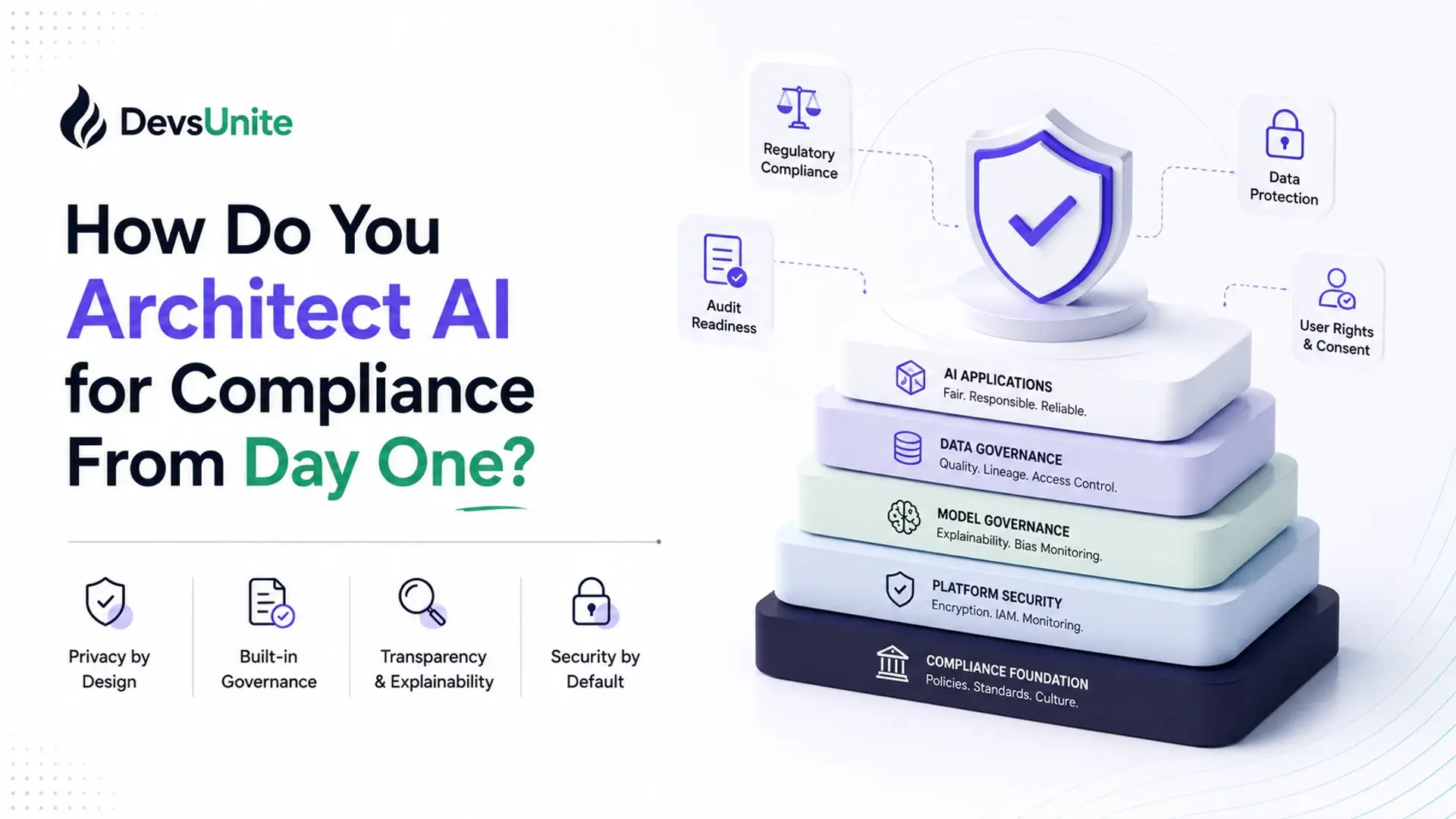
AI compliance architecture means building four things into an AI system before it handles its first regulated decision: a data lineage record, a per-decision audit trail, risk-scaled explainability, and a human override path. An auditor doesn't want a policy document; they want the system to show what data fed a decision, why it produced that output, and who could have stopped it.
What "Compliant" Actually Means for an AI System
There's no single "AI compliance" checklist, because the obligations come from whatever regulates the industry, not from the fact that a model is involved. A healthcare triage model answers to HIPAA (the U.S. Health Insurance Portability and Accountability Act, which governs how patient health information is stored and shared). A lending model answers to fair-lending rules like the Equal Credit Opportunity Act (ECOA) and the data protections layered on top by state law. Anything touching EU users' personal data answers to the GDPR (the EU's General Data Protection Regulation), which gives individuals the right not to be subject to a decision "based solely on automated processing" without meaningful human involvement or a way to contest it.
The EU AI Act, the European Union's AI-specific regulation, adds a layer on top of all of that: a risk-tiered set of obligations (unacceptable, high-risk, limited, minimal) that apply regardless of sector, with the heaviest logging, documentation, and human-oversight requirements landing on high-risk systems. SOC 2 (System and Organization Controls 2, an auditor-issued attestation of an organization's security and operational controls) sits alongside all of this as a vendor-trust signal, not a law, but it's often the bar a B2B customer holds you to contractually before they'll send you their data at all.
The practical implication for an architect: figure out which regime actually applies to a given AI feature before you design its logging and review layer. Building EU-AI-Act-grade audit infrastructure for an internal tool that touches no regulated decision is wasted engineering time; skipping it for a live credit decision is a liability. Regulatory scope also isn't static, so the same architectural patterns that keep a system adaptable as models change make it far cheaper to absorb a new compliance regime than a rewrite would.
What Do Auditors Actually Want to See From an AI System?
Strip away the legal language and most regimes converge on the same five artifacts:
Data lineage: where the training and inference data came from, and under what consent or legal basis.
A per-decision audit trail: an immutable record of the input, the model version, the output, and the confidence for every decision that matters.
Model versioning tied to decisions: the ability to say exactly which model produced a specific past output, because "we've since retrained" isn't an answer to a specific complaint.
Explainability proportional to stakes: a documented reason for the output, not necessarily a full causal explanation, scaled to how much the decision affects someone.
A human override path with its own log: evidence that a person could intervene, and a record of when they did.
None of these are exotic. They're the same primitives you'd want for debugging a production incident. Compliance mostly asks you to make them permanent, attributable to a specific decision, and tamper-evident, instead of ephemeral and best-effort.
The Four Layers of AI Compliance Architecture
Treat these as four separate components with their own storage and access patterns, not one "compliance module" bolted on afterward.
Data lineage and consent tracking. Every training and inference input needs a traceable source and, where personal data is involved, a recorded legal basis. This is the layer most teams skip early and regret later, because you can't backfill provenance for data you didn't tag at ingestion — the same discipline behind governing data quality at petabyte scale applies here, just with a legal basis attached to every record instead of just a quality score.
Decision-level audit trail. One immutable record per decision: input hash, model name and version, output, confidence, timestamp. Append-only storage (object storage with versioning, or a write-once ledger table), not a rotating application log.
Risk-scaled explainability. Don't build feature-attribution explanations for a content-tagging model. Do build them for anything that denies someone credit, a job, or care, and document the method you used, not just the output.
Human-in-the-loop override. A reviewable path that a person can act on, with the override itself logged against the original decision ID, so the audit trail shows both what the model said and what a human did about it.
A Minimal Audit Trail, in Code
The pattern below wraps an inference call and writes an audit record for every decision, without touching the model itself. It hashes the input instead of storing it raw, which keeps PII out of the audit log while still letting you verify later that a specific input produced a specific output.
import hashlib
import json
import time
from dataclasses import dataclass, asdict
from typing import Any, Callable

@dataclass
class AuditRecord:
    decision_id: str
    timestamp: float
    model_name: str
    model_version: str
    input_hash: str          # hash, not raw input — keeps PII out of the log itself
    output: Any
    confidence: float
    human_override: bool = False
    override_reason: str | None = None

def with_audit_trail(model_name: str, model_version: str, sink: Callable[[dict], None]):
    """Wraps an inference call and writes an append-only audit record per decision."""
    def decorator(infer_fn: Callable[[dict], tuple[Any, float]]):
        def wrapped(payload: dict, decision_id: str) -> Any:
            output, confidence = infer_fn(payload)
            input_hash = hashlib.sha256(
                json.dumps(payload, sort_keys=True).encode()
            ).hexdigest()
            record = AuditRecord(
                decision_id=decision_id,
                timestamp=time.time(),
                model_name=model_name,
                model_version=model_version,
                input_hash=input_hash,
                output=output,
                confidence=confidence,
            )
            sink(asdict(record))
            return output
        return wrapped
    return decorator
sink is deliberately abstract here: in production it writes to an append-only store, not a database row you can UPDATE. The decision_id is what lets a later human-override event join back to this exact record, which is the piece most teams forget until an auditor asks for it.
How Much Explainability Do You Actually Need?
Less than most teams assume, and only where it's proportional to the decision. A confidence score is a legitimate explanation for a low-stakes, reversible call. A feature-level explanation (SHAP values, a technique that scores how much each input feature pushed the model's output in a given direction; attention weights; or a documented rule the model effectively learned) is what's expected when the output denies someone something material, because "the model said no" isn't an answer a regulator, or a rejected applicant, will accept.
Building SHAP-level explainability into every model in a system is expensive: it adds compute per inference and engineering time to maintain. The fix isn't to skip it everywhere or build it everywhere, it's to classify decisions by risk before you build, so explainability spend goes to the handful of decision points that actually need it.
Where Compliance Slows Down Shipping, and How to Bound the Cost
Audit logging, explainability, and human review all add latency or engineering surface area, and if you don't bound that cost deliberately, "compliance" becomes the excuse for every missed deadline. A few ways to keep the tax proportional:
Write audit records off the critical path. The decision itself shouldn't block on the audit write. Emit the record asynchronously to a queue, and treat "audit write failed" as its own alert, not a reason to fail the user-facing request.
Cache explanations for repeated feature combinations. Feature-level explanations for near-identical inputs don't need to be recomputed from scratch every time; cache by a hash of the relevant features, not the full payload.
Classify risk before you build, not after. The single biggest velocity killer is discovering mid-build that a feature needs high-risk-tier controls. Run the risk classification as a design step, the same way you'd scope a security review, before writing the model integration.
Keep the override path narrow. Human review should be a fast, well-scoped UI against a specific decision, not a general-purpose admin panel someone has to learn. A slow review path is what actually kills velocity, more than the logging itself.
None of this makes compliance free. It makes the cost predictable and scoped to the decisions that actually carry regulatory weight, instead of a blanket tax on every AI feature you ship.
FAQ
Does every AI feature need this level of auditability? No. Match audit depth and explainability to the decision's risk tier. A recommendation widget needs a request log and a confidence score; a credit or hiring decision needs a full audit record with feature-level explanation and a logged human override path.
What's the difference between application logging and an audit trail? Application logs are operational and mutable by design, meant for debugging. An audit trail is an append-only, decision-scoped record built to answer who, what, why, and when for a single regulated decision, and it has to survive the log rotation and retention policies your ops logs don't.
Do I need a human in the loop for every AI decision in a regulated industry? No. Most frameworks scale the oversight requirement to risk. Low-stakes, reversible decisions can run fully automated with a logged confidence score; high-stakes decisions typically require a reviewable override path, not review of every single case.
How long should AI decision logs be retained? It depends on the regulator, not a universal default. HIPAA-covered entities must retain certain compliance documentation for six years, many financial regulators expect five to seven, and GDPR sets no fixed period but requires you to justify whatever retention window you pick.
Can I retrofit compliance into an existing AI system, or does it require a rewrite? The audit-trail and explainability layers can usually be added via a wrapper around existing inference calls, without a rewrite. Data lineage is the layer that's hard to retrofit, because you can't reconstruct consent and provenance for data you already trained on without records you didn't keep.
The Takeaway
The architecture that survives an audit isn't the one with the most compliance paperwork, it's the one where every decision can be traced back to the data that produced it, the model version that made it, and the person who could have stopped it. Build those four layers in from the start, scaled to actual risk, and the audit becomes a data pull instead of a scramble.
Sources
EU AI Act risk-tier framework and obligations for high-risk systems: European Commission, "AI Act" regulatory framework
GDPR Article 22, right to not be subject to solely automated decision-making: gdpr-info.eu, Art. 22 GDPR
NIST AI Risk Management Framework, governance and documentation guidance: NIST, AI Risk Management Framework
HIPAA's six-year documentation retention requirement for covered entities: U.S. Department of Health & Human Services, HIPAA for Professionals