
 Download App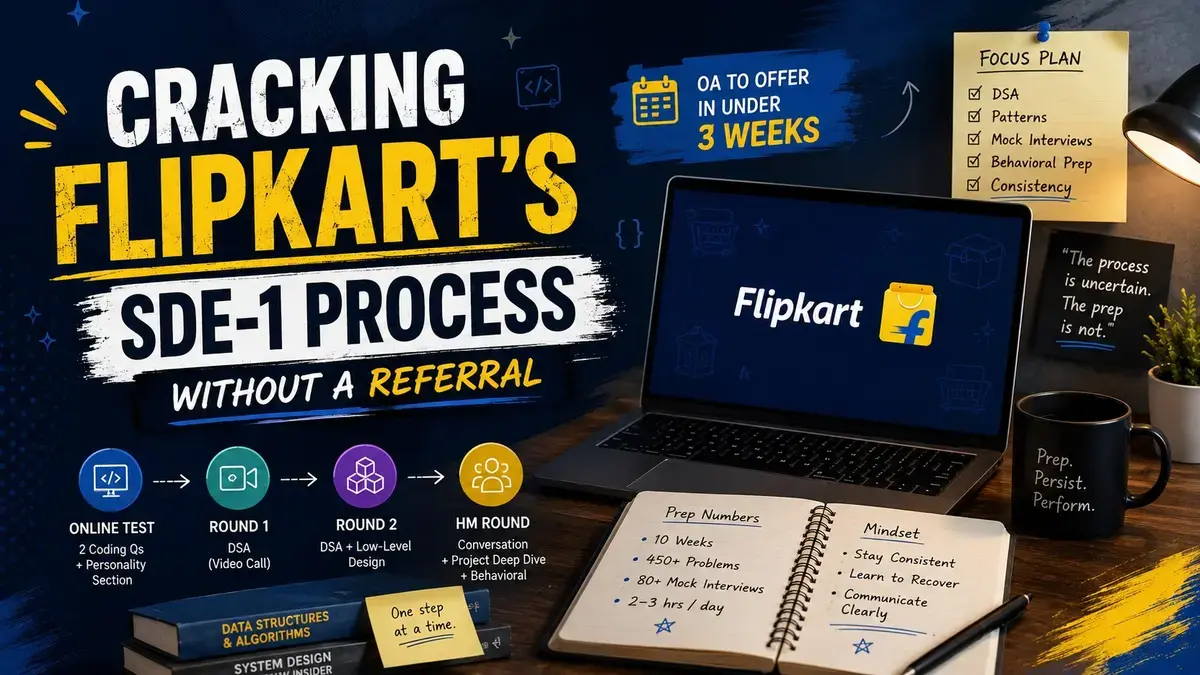
I applied cold, on a Tuesday, between two DBMS assignments. My college doesn't get picked for Flipkart's campus drive, so this was off-campus by default, not by choice. Every senior I knew who'd made it into a product company had gone through a referral, and I didn't have one, so I just filled the form on their careers page at 11pm and forgot about it. The OA link showed up seventeen days later at 2am, and I assumed it was spam before I actually opened it.
The whole thing wrapped in under three weeks, which genuinely surprised me — I'd been reading threads about six-week MAANG timelines and kept bracing for this to drag the same way, and it just never did.
Key takeaways
Applied off-campus with zero referrals, OA to offer in under three weeks
Solved 58 easy, 91 medium, and 12 hard problems over roughly ten weeks of prep
Round one nearly fell apart on a single follow-up question, and I still don't fully know why it didn't
Mock interviews in the last three weeks mattered more than any new LeetCode problem I solved that same month
The round structure
Four stages total, and the pace here is faster than what I'd read about bigger companies.
Online test — two coding questions plus a rate-1-to-5 personality section I answered slightly dishonestly, because who's picking option one for "I enjoy working under pressure."
Round one — DSA over video call, one problem with a follow-up twist that nearly got me.
Round two — DSA again, plus a lightweight low-level design question, closer to "design the classes for X" than a full system design round.
Hiring manager round — mostly conversation, one project deep-dive, one behavioral question about a disagreement with a teammate.
The OA itself was two questions. The first was array pairs summing to a target, done in twelve minutes, no drama. The second was a graph problem I stared at for way too long before remembering BFS is a thing that exists — and the only reason I remembered is my roommate walked in eating Maggi and the smell somehow unstuck my brain, no idea why that works but it does. Submitted with six minutes left on the clock.
Round one was the one that actually got to me. My hostel wifi dropped twice in the first four minutes, which is its own kind of stress test before the actual question even starts. The question was longest substring without repeating characters, which is basically muscle memory at this point — sliding window, done in under ten minutes. The follow-up asked how I'd handle it for a stream of characters instead of a fixed string, and I just went blank. Not nervous-blank, actual blank, like the words left the building. The interviewer said take your time, which somehow made it worse. I got there eventually by writing a tiny example on paper and thinking out loud like an idiot, and I left that call convinced I'd failed it.
If I'm honest, I still think that recovery was luck more than skill — the interviewer just decided ten seconds of silence and a shaky example on paper counted for something. I'll take it, but I wouldn't bank on it happening again.
Round two I honestly don't remember in much detail, which is its own kind of telling. Reverse a linked list in groups of k, and a url-shortener design question that never went past API shape and collision handling. I know it went fine because I got the call for round three, but ask me what I actually said in that room and I couldn't tell you.
How I actually prepped
Roughly ten weeks, evenings and weekends, split across LeetCode and a GfG sheet a senior passed down in the placement WhatsApp group.
Weeks 1–3 — fundamentals: arrays, strings, recursion, just getting fast enough that I wasn't relearning syntax mid-problem.
Weeks 4–7 — the actual grind: trees, graphs, and dynamic programming, which is where most of my medium-difficulty count came from.
Weeks 8–10 — mock interviews and revision instead of new problems, because by then new problems were mostly anxiety management rather than learning.
I stopped grinding hard problems around week six because the return on time wasn't there for an SDE-1 process — every hard problem was maybe two easy-mediums I didn't get to, and Flipkart's rounds never went past medium in my experience. That ratio worked for this company; it might not be the right call for one that leans harder into hard-tier questions.
For round-level pacing, most technical rounds ran about 40 minutes for one problem including the conversation around it. Looking back at how each round actually played out, roughly eight minutes went to clarifying the problem and edge cases, twenty-five to writing the code while thinking out loud, and the remaining seven to testing and debugging. I didn't plan this split going in, and knowing it ahead of time would have stopped me rushing the clarifying part.
The wait, and the call
Nine days between the OA and the round one call, spent checking Gmail on the toilet, before class, during class under the desk with the brightness turned down. My mother asked twice why I looked so tense and I didn't tell her, because if it went nowhere I didn't want to explain that too. The gap between round two and the HM round was shorter, maybe four days, which felt like whiplash after the first nine-day wait.
The offer call came on a Thursday afternoon, middle of a DBMS lab, professor mid-sentence about normalization. I stepped into the corridor to take it, came back in, sat down like nothing happened, and didn't actually process it until that evening.
What I'd do differently
Shift to mocks sooner. The mocks in the last three weeks did more for my actual round performance than another week of grinding did.
Prepare more behavioral stories in real depth. I had five or six half-remembered ones instead of two or three tight ones, and round three went smoother on the story I actually knew cold.
Stop assuming every company's timeline looks like the MAANG posts I'd read. The anxious nine-day wait would've been easier if I'd known upfront that Flipkart typically moves faster than that.
I did the mock interview thing on devsunite.com/resources mostly for the behavioral round practice, and it's the reason the HM round didn't feel like the first time I'd said any of that out loud.
Frequently asked questions
How many rounds does Flipkart's SDE-1 process have?
Four in my case: an online assessment, two technical rounds, and a hiring manager round. No separate system design round at the fresher level — round two's design question stayed at a class-design level, not full-scale architecture.
Is Flipkart's process faster than Amazon's or Google's?
In my experience, yes. OA to offer took under three weeks, compared to the five-to-six week timelines I'd read about for bigger MAANG companies. Fewer rounds also means less scheduling back-and-forth.
How many problems should I solve before an SDE-1 interview like this?
I solved 161 total (58 easy, 91 medium, 12 hard) over ten weeks, and stopped chasing hard problems past week six because Flipkart's actual rounds stayed at medium difficulty. Your number should track the company's real difficulty, not a generic target.